Why employee assessment matters: boost performance, cut turnover

TL;DR:
- Employee turnover costs mid-sized companies 50 to 200 percent of an employee’s salary.
- Effective assessments improve retention, engagement, productivity, and team fit through continuous feedback.
- Implementing balanced, bias-minimized assessment strategies requires clear communication, proper tools, training, pilot testing, and leadership involvement.
Employee turnover is quietly draining your budget, and most mid-sized companies don’t realize how much until it’s too late. Replacing a single employee can cost anywhere from 50% to 200% of their annual salary when you factor in recruiting, onboarding, and lost productivity. Yet many HR leaders still treat assessments as a box-checking exercise rather than a strategic tool. The truth is, structured multi-method assessments paired with continuous feedback can fundamentally change how your team performs and stays together. This guide walks you through the real cost of getting assessments wrong, the benefits of getting them right, and exactly how to build a system that works.
Table of Contents
- The real cost of ignoring employee assessments
- Key benefits of effective employee assessment
- Modern approaches to employee assessment: What works in 2026
- How to implement an effective assessment strategy in your organization
- The uncomfortable truth most HR leaders miss about assessments
- Supercharge your team with advanced assessment solutions
- Frequently asked questions
Key Takeaways
| Point | Details |
|---|---|
| Assessments prevent turnover | Robust, ongoing assessments help reduce costly employee churn in mid-sized firms. |
| Modern tools maximize potential | AI-powered and multi-method assessments give clearer insights into strengths and team fit. |
| Continuous feedback is key | Quarterly or continuous reviews outperform traditional annual reviews for development and engagement. |
| Human oversight still matters | AI aids assessment, but unbiased, contextual judgment by managers is irreplaceable. |
The real cost of ignoring employee assessments
Let’s talk numbers first. When a mid-sized company loses a key team member, the visible costs are just the start. Job postings, recruiter fees, interview time, onboarding, and the months it takes a new hire to reach full productivity all add up fast. But the hidden costs are just as damaging. Team morale drops. Institutional knowledge walks out the door. Remaining employees pick up extra workload, and stress levels climb.
High turnover and mismatched teams increase costs and damage performance in ways that don’t always show up on a spreadsheet. When people are placed in roles that don’t fit their personality or working style, they disengage quietly before they ever resign. That’s the real danger.
Two myths make this worse. First, many leaders believe annual reviews are enough. They aren’t. By the time a yearly review surfaces a problem, the damage is already done. Second, some managers think assessments are only for underperformers. In reality, the link between assessments and retention shows that top performers leave when they feel unseen and underdeveloped.
“Organizations that treat assessment as a continuous conversation rather than a calendar event retain top talent at significantly higher rates and build stronger team cohesion over time.â€
Here’s a quick look at what the data shows when you compare companies with robust versus minimal assessment processes:
| Metric | Robust assessment | Minimal assessment |
|---|---|---|
| Employee engagement rate | 72% | 41% |
| Annual retention rate | 88% | 63% |
| Time-to-productivity (new hires) | 45 days | 90 days |
| Internal promotion rate | 34% | 12% |
The gap is striking. And it’s not just about keeping people longer. It’s about getting more from the people you already have.
Here are the hidden impacts of neglecting assessments that rarely make it into board reports:
- Knowledge loss when experienced employees leave without structured handoffs
- Team stress from uneven workload distribution caused by poor role fit
- Rehiring costs that compound when replacement hires also leave within 12 months
- Missed promotions of internal talent who were never properly evaluated
- Cultural erosion when feedback loops are absent and trust breaks down
Check the employee engagement checklist to see how many of these warning signs are already present in your organization. The earlier you catch them, the less they cost.
Key benefits of effective employee assessment
Once you understand the risks, it’s time to focus on the upside that great assessment practices bring. The return on investment from doing this well is real, measurable, and often faster than HR leaders expect.

Let’s start with a direct comparison:
| Outcome | Structured assessments | No structured assessments |
|---|---|---|
| Turnover reduction | Up to 30% lower | Baseline |
| Employee engagement | Significantly higher | Average or declining |
| Productivity gains | Measurable within 6 months | Slow or stagnant |
| Team fit accuracy | High | Hit or miss |
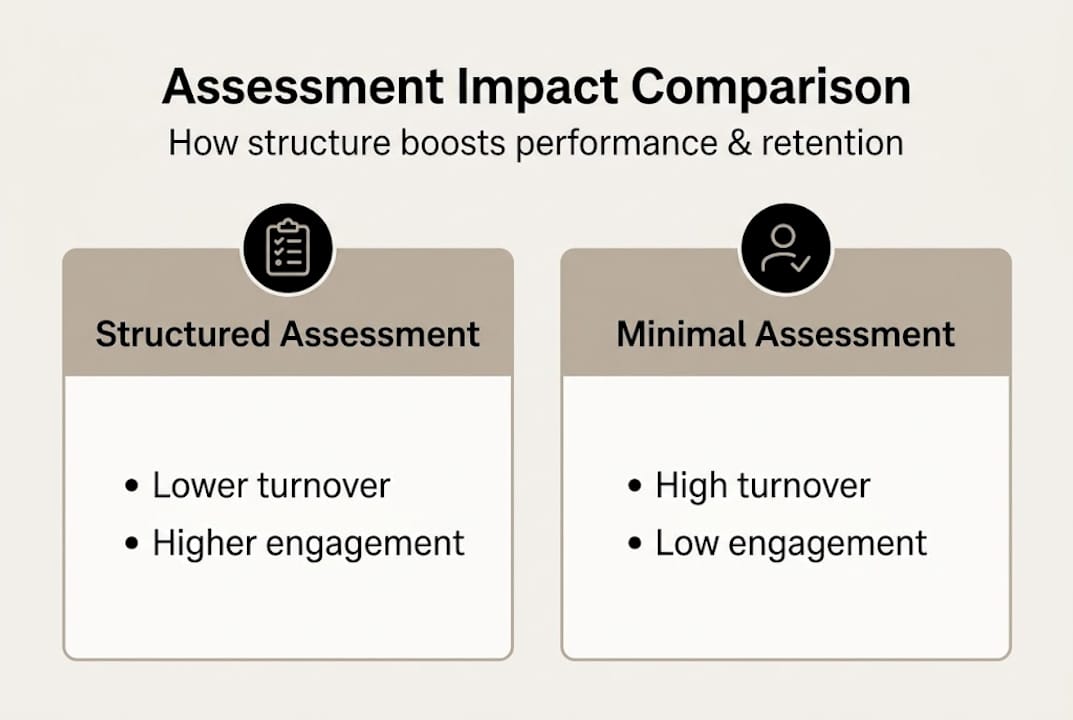
📈 Statistic callout: Companies using structured, multi-method assessments with bias training and calibration report up to 30% reductions in voluntary turnover compared to organizations relying on informal or annual-only reviews.
There are three core benefits that stand out above the rest:
-
Identifying hidden talent. Many of your highest-potential employees are invisible in traditional review systems. Personality-focused tools and multi-method approaches surface strengths that skill-based assessments miss entirely. Explore evaluating employee potential to see how this works in practice.
-
Improving team fit. Placing the right person in the right role based on personality and working style reduces friction, increases collaboration, and cuts the kind of slow-burn disengagement that leads to quiet quitting. Reviewing types of HR assessments can help you choose the right tools for this.
-
Supporting ongoing development. Continuous feedback loops give employees a clear picture of where they stand and where they’re headed. That clarity is one of the strongest predictors of long-term retention.
Bias training and calibration are also non-negotiable here. Without them, even the best assessment tools produce skewed results. Managers rate people they like more favorably, and certain groups get systematically underrated. Regular calibration sessions where managers compare notes and align standards are one of the most effective ways to fix this. It’s not glamorous work, but it makes your data trustworthy.
Multi-method, continuous feedback consistently outperforms annual reviews because it catches problems early, celebrates wins in real time, and builds a culture of honest conversation rather than once-a-year anxiety.
Modern approaches to employee assessment: What works in 2026
To put these benefits into practice, let’s look at the most effective and innovative approaches available today. The landscape has shifted significantly, and what worked five years ago is already falling behind.
Continuous feedback is now the clear winner over annual reviews. Research consistently shows that employees want to know how they’re doing more than once a year. Quarterly check-ins, real-time recognition tools, and ongoing one-on-ones create a feedback rhythm that keeps people engaged and aligned.
AI can help identify patterns in performance data that humans would miss, but human oversight remains essential. AI tools can flag trends, surface anomalies, and reduce the time managers spend on data entry. But they can also reinforce existing biases if not carefully monitored. The best approach pairs AI-powered assessment support with trained human reviewers who bring context and judgment to the table.
Here are the modern assessment methods that are delivering results right now:
- Peer feedback and 360-degree reviews that give employees a fuller picture of their impact
- Personality-analysis SaaS platforms that assess who someone is, not just what they’ve done
- Continuous check-in tools that replace the annual review with regular, structured conversations
- Human Design and psychometric integrations that add depth to personality profiling
- Calibration sessions where managers align on rating standards to reduce individual bias
Exploring personality-focused assessment strategies is a smart next step if you want to move beyond skills-only evaluation. And if you’re curious about the technology side, SaaS in employee assessment has matured significantly and offers real advantages for mid-sized teams.
Pro Tip: Schedule quarterly calibration meetings where your managers review their ratings together before finalizing them. This single practice dramatically reduces bias and increases consistency across your organization. Pair it with HR team management tools to keep the process organized and repeatable.
How to implement an effective assessment strategy in your organization
Modern methods are only as good as their implementation. Here’s how to bring powerful assessment practices into your organization without overwhelming your team or losing momentum.
Following best practices that emphasize structured, bias-minimized assessments and ongoing feedback, here are five steps to get your program off the ground:
-
Communicate the why. Before rolling out any tool, explain to your leadership team and employees why you’re doing this. Frame it as a growth initiative, not a surveillance exercise. People engage with assessment when they believe it benefits them.
-
Choose the right tools. Not all assessment platforms are equal. Look for solutions that combine personality analysis, multi-method inputs, and bias controls. Review the employee potential checklist to identify what your current process is missing.
-
Train your assessors. Managers need to understand how to give feedback that is specific, fair, and actionable. Bias training is not optional. Without it, your data will reflect who managers like, not who is actually performing.
-
Launch a pilot program. Start with one team or department before rolling out company-wide. This lets you identify gaps, gather feedback, and refine your approach with lower risk. Explore talent evaluation SaaS options that support phased rollouts.
-
Review and iterate. Set a 90-day review point to assess what’s working. Collect feedback from both managers and employees. Adjust your tools, cadence, and training based on what you learn.
Pro Tip: Pilot programs are your best friend here. Pick a team that is open to feedback and has a manager who is genuinely bought in. Their experience will become your internal case study and the most persuasive argument for broader adoption.
Getting leadership buy-in early is critical. When senior leaders participate in the same feedback processes they’re asking others to follow, it signals that assessment is a cultural value, not just an HR initiative.
The uncomfortable truth most HR leaders miss about assessments
Here’s what most articles won’t tell you: the biggest barrier to effective assessment isn’t the tool you choose. It’s the mindset you bring to it.
Most HR teams treat assessment as a compliance task. Something to complete, file, and move on from. But high-performing organizations treat it as a core leadership activity. Their managers don’t just conduct reviews. They coach, they listen, and they use assessment data to redesign roles and shift team members toward where they’ll thrive.
“Assessment is not a performance management checkbox. It’s the most direct lever you have for shaping your organization’s culture and long-term talent trajectory.â€
The companies winning at retention right now are the ones where leaders model the feedback behavior they want to see. They share their own development areas openly. They use talent assessment tips not to judge people but to understand them more deeply. That shift, from judge to coach, is what separates a bureaucratic assessment program from one that actually changes how people show up at work.
We challenge you to reframe how you see assessment in your leadership approach. It’s not about catching problems. It’s about finding potential before it walks out the door. âš¡ï¸
Supercharge your team with advanced assessment solutions
If you’re ready to transform your team’s outcomes, Sparkly HR offers practical, expert-driven solutions designed for modern organizations like yours. We specialize in personality-first assessment, combining human insight, AI pattern detection, psychometric tools, and Human Design into one integrated approach that gives you higher-quality data for every hiring and development decision.
Whether you’re just starting to build your assessment strategy or looking to upgrade what you already have, explore SaaS in HR for employee potential to see what’s possible. Our assessment strategies for your team are built specifically for HR managers who want to cut turnover, optimize team fit, and unlock the full potential of every person on their roster. 💡
Frequently asked questions
How often should employee assessments be conducted?
Continuous feedback outperforms annual reviews in both engagement and retention outcomes. Quarterly check-ins are the ideal minimum cadence for most mid-sized organizations.
What tools help reduce bias in employee assessments?
Structured, multi-method assessments combined with regular calibration sessions and bias training are the most effective combination for minimizing rating distortions across teams.
Does AI replace managers in the employee review process?
AI identifies patterns in performance data efficiently, but human oversight is essential to ensure evaluations remain fair, contextual, and grounded in real working relationships.
What’s the first step to implement employee assessments in my company?
Start by communicating the benefits clearly to your team, selecting the right tools for your organization’s size and goals, and launching a pilot program with one team before scaling company-wide.