
Why Assess Potential: A Manager’s Guide for 2026

TL;DR:
- Assessing potential involves evaluating an employee’s capacity for growth and future leadership beyond current performance. Organizations that focus on potential use structured talent reviews and frameworks like the 9-box grid to develop a robust leadership pipeline. Proper governance of assessment tools and calibration across managers are essential to reduce bias and achieve reliable, fair talent decisions.
Assessing potential is defined as the structured process of evaluating an employee’s capacity to grow, take on greater responsibility, and succeed in future roles beyond their current performance. Most organizations still promote based on who delivers results today, not who is built to lead tomorrow. That gap is expensive. The Society for Industrial and Organizational Psychology (SIOP) and Workhuman both identify talent reviews as the cornerstone of future-proofing organizations, and the 9-box grid remains the most widely used framework for mapping performance against potential. Understanding why assess potential matters is the first step toward building a workforce that grows with your strategy, not behind it.
Why assess potential instead of just measuring performance?
Performance tells you what an employee has done. Potential tells you what they are capable of doing next. These are two different questions, and conflating them is one of the most common and costly mistakes in talent management.

A high performer in their current role may lack the adaptability, strategic thinking, or interpersonal range to succeed at the next level. Conversely, a mid-level performer may be constrained by a poorly matched role rather than limited capacity. This is exactly the problem Sparkly was built to address: people are not wrong, they are often placed in the wrong roles.
Talent reviews are structured processes where leaders evaluate both performance and potential using consistent criteria to guide development and succession decisions. The key behavioral indicators of potential include:
- Adaptability: The ability to shift approach when context changes, not just when instructed
- Strategic thinking: Connecting daily decisions to longer-term organizational goals
- Learning agility: Absorbing new information quickly and applying it under pressure
- Influence without authority: Moving teams and stakeholders without relying on positional power
- Emotional range: Regulating personal reactions while reading the room accurately
These indicators are forward-looking by design. They predict future performance in more complex roles, not just current output. Organizations that build talent reviews around these criteria create a pipeline of leaders who are ready before the vacancy appears, not after.
The 9-box grid places employees on a matrix with performance on one axis and potential on the other. This produces nine distinct categories, from “Dilemma†employees (high potential, low performance) to “Stretch†employees (high performance, high potential). Each category calls for a different development response. That specificity is what makes the framework so useful in succession planning conversations.
How to assess employee potential effectively
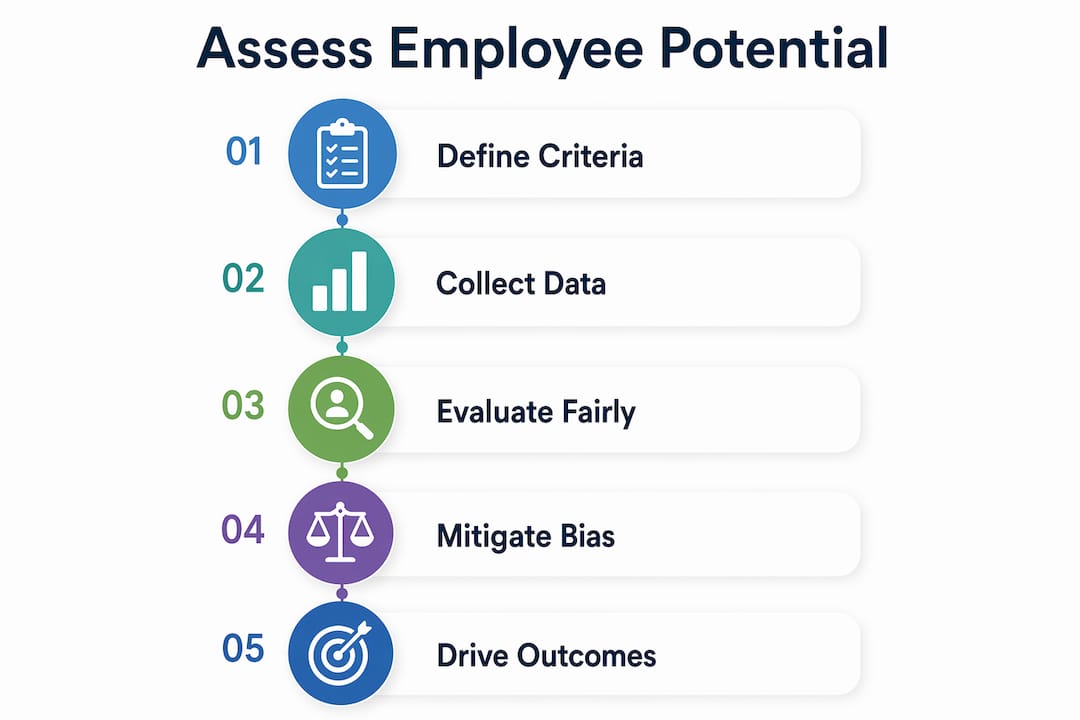
Structured evaluation removes the guesswork. The most reliable approaches combine multiple data sources to build a complete picture of an employee’s capacity. Here is a practical sequence for getting it right:
-
Define what potential means for your organization. Generic definitions produce generic results. Specify the behaviors, cognitive traits, and values that predict success in your leadership pipeline before you assess anyone.
-
Use psychometric tools alongside behavioral data. Psychometric testing, 360-degree feedback, and assessment centers each capture different dimensions of potential. Psychometric and behavioral insights combined with digital platforms produce more accurate evaluations than any single method alone.
-
Run calibration sessions across managers. Individual manager ratings carry unconscious bias. Group calibration discussions, where multiple leaders review ratings together, surface inconsistencies and reduce the impact of personal relationships on scores.
-
Integrate digital HR platforms for continuous data. Episodic assessments conducted once a year miss behavioral patterns that emerge over time. Digital tools that track engagement, task performance, and collaboration signals provide a richer, more current picture.
-
Communicate the process transparently to employees. Employees who understand how potential is assessed are more likely to trust the outcomes and engage with development opportunities. Opacity breeds suspicion and disengagement.
-
Govern your technology choices carefully. SIOP 2026 guidelines emphasize managing measurement concepts such as validity and fairness in technology-enhanced assessments. This means every tool you deploy must be evaluated for bias, not just accuracy.
Pro Tip: Balance assessment depth with organizational capacity. A 500-person company does not need the same infrastructure as a 50,000-person enterprise. Start with calibrated manager reviews and one psychometric instrument, then layer in additional data sources as your process matures.
Sparkly takes this layered approach further by merging four data sources: human judgment, AI analysis, psychometric assessments, and Human Design. The result is higher-probability insights that HR teams can use in interviews and development conversations, not just annual reviews.
What are the biggest risks in potential assessment?
The importance of assessing potential is clear. The risks of doing it poorly are equally clear, and they are worth naming directly.
Unconscious bias distorts ratings. Managers consistently rate employees who look, communicate, or think like them as higher potential. This is not malicious. It is structural. Without calibration and consistent criteria, potential ratings reflect the assessor more than the assessed. Bias and subjective judgment can undermine potential assessment entirely, requiring cross-functional calibration and transparency to ensure fairness.
Low-potential labels become self-fulfilling prophecies. When an employee is quietly categorized as low potential, managers unconsciously invest less in their development, assign fewer stretch opportunities, and provide less feedback. The employee stagnates, which confirms the original rating. The label created the outcome it predicted.
Technology introduces new measurement threats if ungoverned. AI and machine learning tools can process behavioral data at scale, but psychometric principles of fairness and validity must underpin these systems to ensure equitable and reliable talent evaluation. A biased training dataset produces biased outputs, regardless of how sophisticated the algorithm appears.
“Treat measurement validity and fairness as organizational governance priorities, not merely HR operational tasks, especially as AI and machine learning tools become prevalent in assessments.†— Society for Industrial and Organizational Psychology
The mitigation strategies are practical. Use consistent rating rubrics across all managers. Review demographic distributions in your potential ratings quarterly. Require written justification for any employee placed in the lowest potential category. And audit your technology vendors for fairness documentation before deployment. The role of HR technology in fair assessment is growing, and governance must grow with it.
How organizations apply potential assessment to drive real outcomes
The benefits of potential assessment show up most clearly in three areas: succession planning, retention, and workforce strategy. Each one has a direct line to business performance.
Succession planning becomes proactive, not reactive. Organizations that assess potential regularly know who is ready for leadership roles before those roles open. They can assign stretch projects, mentoring relationships, and cross-functional exposure to accelerate readiness. The alternative is scrambling to fill critical roles with whoever is available, which is how organizations end up with the wrong people in the wrong seats.
Retention improves when flight risks are identified early. Regular talent reviews identify flight risks and enable proactive retention strategies through assigning stretch roles and mentoring. Internal promotions decrease exit likelihood significantly. This matters because replacing a mid-level employee typically costs between 50% and 200% of their annual salary, depending on role complexity.
Workforce planning becomes data-driven. When you combine performance data with potential ratings, you can model future capability gaps before they become operational problems. A team with three high-performers and no high-potential employees is a retention risk and a succession gap at the same time. Seeing that clearly changes how you hire, develop, and restructure.
| Application | Strategic outcome |
|---|---|
| 9-box grid mapping | Identifies development priorities and succession candidates in one view |
| Stretch role assignment | Accelerates readiness for high-potential employees while testing assumptions |
| Flight risk identification | Enables targeted retention conversations before resignation letters arrive |
| Workforce gap modeling | Surfaces future capability shortfalls before they affect operations |
Pro Tip: Use your 9-box results to drive specific conversations, not just categorizations. A “Dilemma†employee (high potential, low performance) needs a role redesign conversation, not a performance improvement plan. The distinction changes the outcome entirely.
Digitalization elevates fairness, transparency, and accuracy in potential assessment, making structured evaluation accessible even for smaller HR teams. The tools exist. The question is whether you are using them with enough structure to trust the outputs.
Key takeaways
Assessing employee potential requires structured frameworks, calibrated judgment, and governed technology to produce fair, reliable, and strategically useful talent decisions.
| Point | Details |
|---|---|
| Potential differs from performance | Evaluate future capacity, not just current results, to build a real leadership pipeline. |
| Use multiple data sources | Combine psychometrics, 360 feedback, and digital behavioral data for accurate assessments. |
| Govern your technology | Apply SIOP fairness and validity standards to every AI or digital assessment tool you deploy. |
| Calibrate across managers | Group calibration sessions reduce bias and produce more consistent, defensible ratings. |
| Apply results to real decisions | Use potential data to drive succession planning, retention strategy, and role redesign. |
What I’ve learned about potential assessment after years of watching organizations get it wrong
Most organizations assess potential the same way they assess performance: by looking backward. They promote the person who hit their numbers, not the person who demonstrated the behavioral signals of future leadership. I have seen this pattern repeat across industries, and the cost is always the same. Good people leave because they were never developed. Wrong people get promoted because they were visible.
The shift I advocate for is simple but not easy. Stop asking “Who is performing well right now?†and start asking “Who has the capacity to perform well in a role that does not yet exist?†That requires a different set of tools and a different mindset. Psychometrics, behavioral analytics, and structured calibration are not HR bureaucracy. They are the infrastructure for making better people decisions at scale.
What excites me about where this field is heading is the convergence of data sources. When you merge human judgment, AI pattern recognition, psychometric science, and frameworks like Human Design, you get something more reliable than any single source alone. The goal is not to replace human intuition. It is to give that intuition better inputs. That is exactly what Sparkly is built to do, and it is why personality-focused assessment strategies are outperforming skills-only evaluations in predictive accuracy.
The organizations that will win the talent competition over the next decade are not the ones with the biggest hiring budgets. They are the ones that understand their people deeply enough to place them correctly, develop them intentionally, and retain them before the exit interview.
— Mikk
See how Sparkly turns potential data into people decisions âš¡ï¸
Sparkly is a people-intelligence platform built specifically for managers and HR leaders who want to move beyond gut feeling and CVs. It merges psychometric assessments, AI analysis, human judgment, and Human Design into a single computed view of each employee’s personality, role fit, and growth trajectory.
The result is not just a score. It is a decision-support layer that tells you who to develop, who to reposition, and who is at risk of leaving before they tell you. If you are serious about building a team that performs at its ceiling, explore Sparkly’s employee potential evaluation guide or check the 2026 potential checklist to see where your team stands today.
FAQ
What is potential assessment in HR?
Potential assessment is the structured process of evaluating an employee’s capacity to grow into more complex or senior roles beyond their current performance level. It uses tools like psychometric testing, 360-degree feedback, and behavioral analytics to identify future leadership candidates.
How does potential assessment differ from performance evaluation?
Performance evaluation measures what an employee has achieved in their current role. Potential assessment measures behavioral and cognitive indicators of future success, such as adaptability, learning agility, and strategic thinking, which are not captured by performance metrics alone.
Why is assessing employee potential important for succession planning?
Organizations that assess potential regularly can identify and develop future leaders before vacancies arise. Talent reviews that map both performance and potential using frameworks like the 9-box grid give decision-makers a clear view of succession readiness across the organization.
What are the main risks of potential assessment?
The primary risks are unconscious bias in manager ratings, self-fulfilling prophecies from low-potential labels, and validity threats from ungoverned AI tools. SIOP guidelines recommend treating fairness and measurement validity as governance priorities, not just HR process steps.
How can small HR teams assess employee potential effectively?
Digital HR platforms make structured potential assessment accessible even for lean teams. Starting with calibrated manager reviews and one validated psychometric instrument provides a reliable foundation, with additional data layers added as the process scales.