What Is a Future-Ready Workforce? HR Guide 2026

TL;DR:
- A future-ready workforce combines adaptability, tech-savviness, and proactive learning to stay effective amid rapid change. Currently, only 11% of workers meet this standard, highlighting the urgent need for organizations to develop continuous, personalized development and a supportive culture. Building such a workforce requires ongoing skill tracking, fostering psychological safety, and identifying internal talent based on personality and values.
A future-ready workforce is defined as a group of employees who combine adaptability, tech-savviness, and proactive learning to perform effectively as technology and market conditions shift around them. According to the Adecco Group, only 11% of workers globally meet this standard today. That number should stop every HR leader cold. It means the overwhelming majority of your current team is operating with skills and mindsets calibrated for a world that is already changing beneath them. Understanding what is a future-ready workforce, and what it actually takes to build one, is now the most pressing strategic question in people management. âš¡ï¸
What is a future-ready workforce, and why does it matter now?
A future-ready workforce, sometimes called a workforce with future-readiness capability, is not simply a team with up-to-date technical certifications. It is a group of people who can learn, unlearn, and relearn as conditions change. The Adecco Group defines three core markers: adaptability, tech-savviness, and proactivity. Workers who score high on all three outperform their peers by a wide margin across productivity, engagement, and retention metrics. That gap between the 11% and everyone else is not a skills gap. It is a readiness gap.
The importance of workforce readiness extends beyond individual performance. Organizations that fail to build this capacity face compounding risk: slower product cycles, higher attrition, and reduced ability to absorb disruption. The World Economic Forum projects that by 2030, 29% of workers will need upskilling within their current roles, and 19% will require full reskilling and redeployment. Those numbers represent real budget, real planning cycles, and real decisions that HR leaders need to start making now, not in four years.
The term “workforce readiness†is the recognized industry standard for this concept. You will also encounter “future-proof skills†and “workforce agility†in practitioner literature. All three describe the same underlying goal: building an organization that does not break when conditions change.
What skills and traits define future-ready employees?
Future workforce skills fall into two broad categories, and the balance between them is shifting fast. Technical skills, including data literacy, cloud platform proficiency, and AI tool usage, are table stakes. But they carry a high obsolescence rate. The ILO’s research on lifelong learning and adaptability confirms that technical proficiency alone is insufficient. Socio-emotional traits like curiosity, resilience, and critical thinking are what allow employees to keep acquiring new technical skills as old ones expire.
Here is what the skills profile of a future-ready employee actually looks like:
- Adaptability: Willingness to shift roles, tools, and priorities without losing effectiveness
- AI literacy: Ability to work alongside AI tools, evaluate their outputs, and apply ethical judgment to their use
- Critical thinking: Capacity to assess ambiguous information and make sound decisions without a clear playbook
- Emotional resilience: Staying productive under uncertainty, change, and organizational pressure
- Curiosity: Self-directed drive to learn, experiment, and seek feedback without being told to
The emerging insight from AI researchers at 80,000 Hours is that judgment and taste are becoming the most valuable workforce capabilities in the AI era. As AI handles more repetitive cognitive tasks, the humans who thrive will be those who can decide which outputs are good, which directions are worth pursuing, and which tradeoffs matter. That is a personality and values question as much as a skills question.
Pro Tip: When auditing your team’s future-readiness, assess curiosity and resilience as primary indicators. These traits predict how quickly someone will acquire new technical skills, which makes them more predictive of long-term performance than any current certification.

Understanding the role of soft skills in your team’s development is a practical starting point for identifying who already has the psychological foundation for future readiness.
How can organizations plan for future workforce needs?
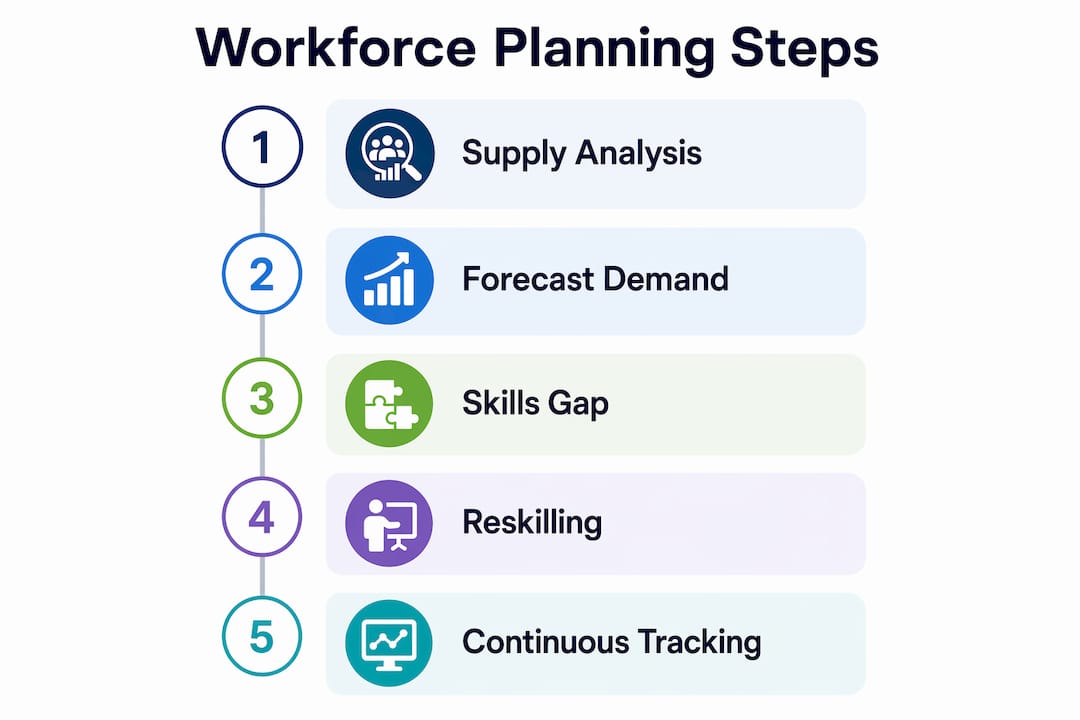
Building a future-ready team starts with a clear-eyed assessment of where you are. SHRM’s 4-step workforce planning framework gives HR leaders a structured way to move from diagnosis to action:
- Supply analysis: Map your current workforce. Who do you have, what can they do, and what are their development trajectories?
- Demand analysis: Forecast what roles, skills, and capabilities the business will need over the next 12 to 36 months based on strategic goals and market signals.
- Gap analysis: Identify the delta between supply and demand. Which critical capabilities are missing or underdeveloped?
- Solution analysis: Decide how to close the gaps. Options include hiring, reskilling, restructuring roles, or building partnerships.
The shift from role-based to skills-based planning is where most organizations get stuck. Traditional workforce planning asks “do we have enough people in each role?†Skills-based planning asks “do we have the capabilities we need, wherever they currently sit?†Deloitte’s research on skills-based workforce planning shows that AI is accelerating required skills changes so rapidly that continuous skills velocity measurement is now necessary. A one-time audit every two years is no longer adequate.
| Planning stage | What HR leaders must do |
|---|---|
| Supply analysis | Audit current capabilities, not just job titles or tenure |
| Demand analysis | Tie skill forecasts to business strategy, not just market trends |
| Gap analysis | Prioritize gaps by business impact, not headcount |
| Solution analysis | Balance build, buy, and borrow decisions with retention risk |
HR leaders who fail to institutionalize continuous skill tracking end up with workforce strategies that lag behind the pace of change. The data exists inside your organization. The discipline to collect and act on it is what separates reactive from proactive HR functions.
What strategies effectively develop future-ready talent?
The most important finding from Adecco’s research is that 93% of future-ready workers have personalized development plans, and 95% participate in leadership training. Future-ready workers are predominantly made through deliberate investment, not discovered through hiring. That reframes the entire talent acquisition versus talent development debate.
Effective strategies for building skills for tomorrow’s workforce include:
- Personalized learning paths: Generic training programs produce generic results. Development plans tied to individual strengths, career goals, and role demands produce measurably better outcomes.
- Digital and AI literacy programs: Every function, not just technology teams, needs baseline fluency in AI tools. This includes understanding what AI can and cannot do, and how to apply human judgment to AI outputs.
- Cross-functional rotations: Temporary assignments in adjacent teams build systemic thinking. Cross-functional roles act as laboratories where employees develop adaptability in real conditions, not simulated training environments.
- Transparent career mobility: Employees who can see a path forward inside your organization are less likely to look for one outside it. Internal mobility programs reduce attrition and surface hidden capability.
- Leadership development at every level: Future readiness is not a senior leadership concern alone. Team leads and individual contributors need the same investment in judgment, communication, and change management skills.
Pro Tip: Pair every reskilling initiative with a career mobility conversation. Employees who understand how new skills connect to their future inside the organization engage with training at significantly higher rates than those who see it as a compliance exercise.
Data-driven talent management approaches that tie development investment to measurable retention outcomes give HR leaders the evidence base to secure budget and executive support for these programs.
How does culture shape workforce future-readiness?
Culture is the biggest barrier to future readiness, and it is harder to change than any skills gap. The Adecco Group’s research is direct on this point: cultural transformation is more challenging than training, because curiosity and emotional resilience cannot be installed through a workshop. They have to be modeled, rewarded, and protected by leadership over time.
The most common failure mode is what practitioners call checkbox reskilling. An organization identifies a skills gap, runs a training program, marks the box complete, and returns to business as usual. The underlying culture, one that punishes failure, discourages experimentation, and rewards tenure over growth, remains intact. The training investment produces no lasting change because the environment does not support the new behaviors.
“The organizations that build genuinely future-ready teams are the ones that dismantle fixed role mindsets. They stop asking ‘what is this person’s job?’ and start asking ‘what can this person do, and where does that capability create the most value?’†This shift requires leaders who model continuous learning themselves, not just advocate for it in all-hands meetings.
Developing workforce agility at the cultural level means creating psychological safety for experimentation, recognizing employees who take on stretch assignments, and building performance frameworks that reward learning velocity alongside output. Personality-based hiring approaches that assess psychological traits rather than credentials alone help organizations identify candidates who will thrive in this kind of culture before they are hired.
Key takeaways
A future-ready workforce requires combining adaptability and socio-emotional traits with continuous, personalized development and a culture that actively rewards learning over tenure.
| Point | Details |
|---|---|
| Readiness is rare | Only 11% of the global workforce is currently future-ready, making this a critical priority. |
| Skills mix matters | Socio-emotional traits like curiosity and resilience outlast technical skills and predict long-term adaptability. |
| Planning must be continuous | Skills-based workforce planning requires ongoing velocity tracking, not annual audits. |
| Development beats hiring | 93% of future-ready workers have personalized development plans, confirming internal investment outperforms external recruitment. |
| Culture is the real constraint | Dismantling fixed role mindsets and building psychological safety determines whether training investments stick. |
My honest take on building a future-ready workforce
I have worked with enough HR teams to know that the gap between workforce strategy and day-to-day culture is where most future-readiness initiatives quietly die. The frameworks are sound. The research is clear. The execution breaks down because organizations keep treating this as a training problem when it is actually a people-intelligence problem.
The teams that get this right share one habit: they invest in understanding their people at the personality and values level before they design development programs. When you know who someone actually is, not just what they have done, you can place them in roles and environments where their natural traits become organizational assets. That is what Sparkly was built to do. It combines psychometric data, Human Design, AI analysis, and human observation to surface the kind of insights that make personalized development plans genuinely personal.
My caution to HR leaders is this: do not over-index on hiring as the solution. The future-ready employee you are looking for is very likely already inside your organization, sitting in the wrong role. Find them before they leave.
The organizations that will win the next decade are not the ones with the best hiring pipelines. They are the ones that know their people well enough to unlock what is already there.
— Mikk
How Sparkly helps you build a future-ready team
Building a future-ready workforce starts with knowing who your people actually are, not just what their resumes say. Sparkly combines psychometric assessments, Human Design data, AI analysis, and structured human observation to give HR leaders a richer, more reliable picture of each employee’s personality, working style, and growth potential.
This means you can design development plans around how people actually think and operate, reduce role mismatch before it becomes attrition, and identify internal candidates for new responsibilities with confidence. Sparkly’s SaaS platform for HR turns four traditionally unreliable data sources into high-probability insights that make every talent decision sharper. If you are serious about workforce future-readiness, start with better people intelligence. Explore how Sparkly helps you cut turnover costs through smarter fit assessment.
FAQ
What is a future-ready workforce?
A future-ready workforce is a group of employees who combine adaptability, tech-savviness, and proactive learning to remain effective as technology and market conditions change. The Adecco Group identifies these three traits as the defining markers of future-ready talent.
What are the most important future workforce skills?
Socio-emotional skills like curiosity, resilience, and critical thinking are the most durable future workforce skills, because they enable employees to keep acquiring new technical capabilities as older ones become obsolete. AI literacy and sound judgment are the fastest-rising technical competencies as of 2026.
How do organizations start preparing for future jobs?
Organizations start by applying a structured workforce planning process: auditing current capabilities, forecasting future skill demands, identifying gaps, and choosing between upskilling, reskilling, or hiring to close them. SHRM’s 4-step framework provides a practical structure for this process.
Why is workforce readiness so low globally?
Only 11% of the global workforce is currently classified as future-ready, largely because most organizations still rely on role-based planning and one-time training programs rather than continuous, personalized development tied to individual personality and capability data.
How does culture affect workforce future-readiness?
Culture is the primary barrier to future readiness. Organizations with fixed role mindsets and low psychological safety see training investments fail because the environment does not reward the adaptive behaviors those programs are designed to build.