Unlock better team dynamics with feedback that works

TL;DR:
- Frequent feedback alone does not improve team outcomes; quality, timing, and system design are crucial. Effective feedback fosters trust, reduces turnover, and enhances performance when delivered thoughtfully and contextually. Over-automated or poorly timed feedback risks increasing stress and undermining psychological safety.
Feedback is one of the most used, and most misunderstood, tools in HR. Many teams pile on more feedback cycles hoping to fix disengagement and stop the revolving door of departures. But feedback frequency alone does not guarantee better outcomes. The real levers are quality, timing, and system design. This guide breaks down what evidence actually says about feedback, and gives you a practical framework to build smarter feedback mechanisms that improve team performance and bring your turnover numbers down for good.
Table of Contents
- Why feedback is critical for team performance and retention
- How feedback frequency shapes team outcomes: Getting the balance right
- Beyond quantity: Why real-time feedback and dashboards don’t always work
- Building a structured feedback system: Practical steps for HR leaders
- The uncomfortable truth: Why most feedback strategies backfire and what actually works
- Drive real change with smarter feedback and assessment tools
- Frequently asked questions
Key Takeaways
| Point | Details |
|---|---|
| Moderate feedback is optimal | Frequent but not excessive feedback leads to the best team performance and engagement. |
| Feedback style matters | How feedback is given impacts retention even more than frequency or technology alone. |
| Structured systems cut turnover | Well-designed feedback frameworks directly reduce employee exits and improve team health. |
| Dashboards aren’t enough | Real-time metrics need reflective analysis and coaching to actually improve outcomes. |
| Tailor to your team | Customizing feedback rhythms and channels to your workplace context yields the greatest gains. |
Why feedback is critical for team performance and retention
Every HR professional knows that feedback matters. But do you know how directly your managers’ feedback habits connect to the departure decisions your employees are making right now? The link is clearer than most organizations want to admit.
“56% of employees who left a job in 2025 cited their manager as the reason they quit.” — Monster’s 2026 Workplace Relationships Report
That number is striking. It tells us that management behavior, which includes the way feedback is delivered, is the single biggest controllable variable in retention. Not salary. Not benefits. Not even career growth opportunities. The day-to-day experience of receiving direction, correction, and recognition from a manager shapes whether an employee stays or starts updating their resume.
Data-driven talent management helps HR teams move beyond gut-feel assessments and pinpoint exactly where feedback quality breaks down. This matters enormously because the breakdown points are not always obvious. Public reprimands, inconsistent review cadences, and vague corrective comments all chip away at trust over time.
Here is what the evidence tells us about how feedback connects to team outcomes:
- Structured, consistent feedback reduces ambiguity and helps employees understand exactly where they stand, which decreases anxiety and increases psychological safety.
- Public criticism or hostile feedback is one of the strongest drivers of voluntary turnover, especially in mid-sized companies where team relationships are highly visible.
- Absence of feedback is equally damaging. Employees who receive no meaningful feedback within 30 days of joining a team are significantly more likely to disengage within six months.
- Positive, specific feedback activates motivation and signals that the organization values the individual’s contribution, which is a key predictor of long-term retention.
Investing in organizational agility in HR means you can respond quickly when feedback patterns in a team start signaling risk. Building that capability before turnover spikes is far more cost-effective than reacting after your best people have already walked out the door.
Exploring proven team building strategies alongside a structured feedback approach creates a reinforcing loop. Teams that trust each other give and receive feedback more honestly, which leads to better performance, which builds more trust. The cycle compounds in your favor when both elements are present.
How feedback frequency shapes team outcomes: Getting the balance right
Here is a counterintuitive insight that surprises most HR professionals when they first encounter it. More feedback is not always better. In fact, excessive feedback increases cognitive load and can actually lower performance by overwhelming employees with competing signals.

Think about the Zeigarnik Effect, the psychological principle that unfinished tasks occupy mental space until resolved. When employees receive a constant stream of feedback without time to process and act on it, they accumulate a growing backlog of unresolved mental loops. The result is distraction, stress, and a drop in the focused work quality you are trying to improve.
| Feedback frequency | Productivity impact | Turnover risk | Stress level |
|---|---|---|---|
| Low (quarterly or less) | Declining over time | High due to ambiguity | Low initially, then rising |
| Moderate (bi-weekly to monthly) | Peaks consistently | Lowest across all categories | Manageable and motivating |
| High (daily or near-constant) | Plateaus then drops | Moderate to high | Elevated and chronic |
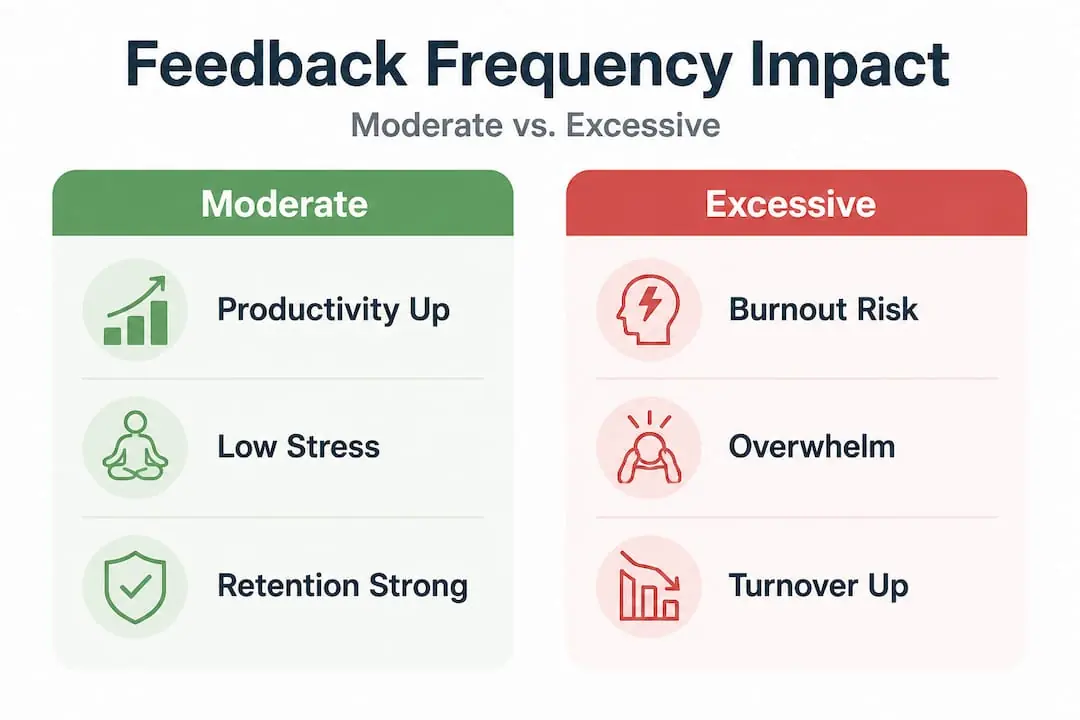
The data pattern here is clear. Moderate frequency wins across every meaningful metric. The sweet spot is consistent enough to maintain clarity and momentum, but spaced enough to allow genuine reflection and behavior change between sessions.
So how do you find the right rhythm for your specific teams? Here is a practical process:
- Audit your current cadence. Map out how often feedback is currently delivered across teams, formats, and managers. You will likely find huge inconsistency within the same organization.
- Segment by team type. Fast-moving project teams may need bi-weekly check-ins, while stable operational teams may thrive on monthly structured reviews.
- Survey your employees directly. Ask them how often they feel they receive useful, actionable feedback. Their perception of frequency often differs sharply from what managers report delivering.
- Run a 90-day pilot. Shift one team to a structured moderate-frequency schedule and measure engagement scores, output quality, and manager satisfaction alongside employee satisfaction.
- Refine based on real data. Use what you learn in the pilot to set a default cadence organization-wide, with flexibility for team leads to adjust within a defined range.
Pro Tip: Use pulse surveys, short 2-3 question weekly or bi-weekly surveys, to fine-tune feedback intervals across different teams. The data you collect will tell you when employees feel over-saturated versus when they are craving more direction. Tools like your employee engagement checklist make this process systematic and trackable.
Beyond quantity: Why real-time feedback and dashboards don’t always work
Real-time feedback dashboards are everywhere right now. The idea sounds great in theory. Give teams live visibility into their collaborative metrics, and they will self-correct and improve continuously. In practice, it rarely works that way.
A major study on collective intelligence found that real-time metric feedback does not reliably improve overall team performance. The research showed that teams given access to live dashboards did not outperform control groups on collaborative tasks, and in some cases performed worse when the data lacked context or coaching.
Why does this happen? A few key reasons:
- Data without interpretation creates noise, not insight. When teams see a metric drop, they often do not know what behavior caused it or what to change. Without coaching, the data generates anxiety rather than action.
- Real-time visibility can trigger defensive behavior. Individuals who see their metrics tracked in real-time sometimes game the metrics rather than improve the underlying work. This is especially common in competitive team environments.
- Collaborative tasks are too complex for simple dashboards. The richness of how a team actually functions, trust, psychological safety, communication patterns, decision-making quality, cannot be captured in quantitative metrics alone.
- Reflective sensemaking outperforms live monitoring. Teams that pause to discuss what is happening, why it is happening, and what they want to do differently consistently outperform teams that simply react to live data.
The practical implication here is important. Investing in machine learning in HR tools makes the most sense when those tools support human reflection and coaching, not when they are expected to replace it. A smart dashboard paired with a skilled HR practitioner or manager who can facilitate meaning-making conversations is far more powerful than a dashboard alone.
Think about your current feedback tech stack. Are your tools giving managers and teams the context they need to act on data thoughtfully? Or are they generating reports that sit unread because no one is sure what to do with them? Reviewing your project management workflow alongside your feedback architecture can reveal exactly where the disconnect between data and action is happening.
Building a structured feedback system: Practical steps for HR leaders
Now that you understand what drives feedback effectiveness and what undermines it, let us put it together into a system you can actually build and sustain. Structured feedback mechanisms designed for the specific context of your teams substantially reduce turnover risk over time. The key word is “designed.” Generic systems fail because they ignore team context, manager capability, and organizational culture.
Here is a framework to build yours from the ground up:
- Start with a feedback audit. Before adding anything new, document what currently exists. What formal review processes do you have? What informal channels? Where are the gaps or inconsistencies across departments?
- Define feedback goals by team. A customer success team and an engineering team have very different feedback needs. Set goals that reflect what good looks like for each team type.
- Establish a structured cadence. Implement a tiered model: weekly informal check-ins (5 minutes, one question), bi-weekly team pulse surveys, monthly one-on-ones with structured templates, and quarterly reviews with goal alignment components.
- Build in qualitative channels. Numbers tell you what is happening. Qualitative input tells you why. Create space for open-ended responses in every feedback touchpoint you build.
- Train your managers. A well-designed feedback system still fails if managers do not know how to deliver feedback with empathy, specificity, and appropriate timing. Invest in this training before rolling out new tools.
- Pilot before scaling. Select one or two teams to test your new system for 60 to 90 days. Gather data, iterate, then roll out organization-wide.
- Review and adapt quarterly. Feedback systems are not set-and-forget. Build a quarterly review into your HR calendar to assess whether the system is achieving its retention and performance goals.
Understanding how to approach shifting team members into roles that better suit their natural strengths becomes much easier when you have structured feedback data to inform those decisions. Similarly, assessing employee fit for specific teams and roles is significantly more accurate when you have a longitudinal picture of how individuals respond to different feedback environments.
Pro Tip: Anonymous feedback channels consistently produce more honest, actionable input than identified channels, especially in teams where there is any power dynamic concern. Build at least one anonymous option into your system. Tools that separate the identity from the response protect psychological safety while still surfacing the information you need to act on.
Strong feedback systems are also built on building team rapport between managers and their direct reports. When trust is present, feedback lands better, gets acted on faster, and generates less defensiveness.
The uncomfortable truth: Why most feedback strategies backfire and what actually works
Here is what we see repeatedly when we work with HR teams who are frustrated that their feedback initiatives are not moving the needle on retention or performance. They have built a “feedback culture.” They have cadences, templates, and tools. But none of it is working.
The uncomfortable truth is that a feedback culture without the right foundation is just noise at scale. If your organization has low psychological safety, high political tension, or managers who use feedback as performance theater rather than genuine development, adding more structure will not fix the problem. It will just make the dysfunction more organized.
Research confirms that moderate feedback frequency peaks performance while excessive or poorly timed feedback actively hinders teams. This means the wise HR professional does not ask “how do we do more feedback?” but rather “how do we make our feedback worth receiving?”
Three things genuinely differentiate high-retention, high-performance teams from everyone else. First, they treat feedback as a conversation, not a delivery. There is always a two-way exchange where the employee’s perspective is actively solicited and genuinely considered. Second, they match feedback timing to the employee’s capacity to absorb it. Giving critical feedback during peak stress periods, like a product launch or a difficult quarter, backfires almost every time. Third, they invest in knowing the individual. This is where talent development for tech teams and personality-based assessment become powerful. When you understand how a person processes information, what motivates them, and where their natural strengths lie, you can calibrate both the content and delivery of feedback to land with impact instead of defensiveness.
Over-automating feedback is one of the most common and costly mistakes we see. When feedback becomes a checkbox that a system generates automatically, employees recognize it immediately. It feels hollow. And hollow feedback is worse than no feedback because it signals that the organization is going through motions rather than investing in real development.
The teams that get this right balance structure with genuine human judgment. They use data to identify patterns and flag risks early. Then they bring skilled humans into the conversation to interpret, coach, and connect. ⚡️
Drive real change with smarter feedback and assessment tools
If this article has helped you see your feedback approach with fresh eyes, you are already ahead of most HR teams still running the same annual review cycle and wondering why people keep leaving. The next step is finding tools and frameworks that operationalize these principles in your specific context.
At Sparkly, we go deeper than most assessment platforms because we focus on personality, not just skills. Skills can be taught. Personality drives how someone gives, receives, and acts on feedback. Our approach merges human judgment, AI analysis, psychometric data, and Human Design to give you higher-probability insights about your people. Explore our SaaS solutions for HR to see how smarter assessment supports better feedback design. Check out the employee fit assessment guide for a practical starting point, and dive into our talent assessment tips to sharpen your team dynamics strategy today. 📈
Frequently asked questions
How often should teams receive feedback for optimal results?
Moderate-frequency feedback consistently produces the best team performance outcomes, while daily or near-constant feedback tends to increase cognitive load and stress without corresponding gains in productivity.
Do real-time feedback dashboards improve team performance?
Real-time dashboards alone do not reliably increase team performance. They work best when paired with reflective coaching conversations that help teams interpret what the data means and decide what to change.
Can better feedback systems help reduce employee turnover?
Yes. Well-designed feedback mechanisms directly address the management behaviors most strongly linked to voluntary turnover, including poor communication, public criticism, and inconsistent expectations.
What are some best practices for building feedback systems?
Set a consistent but not excessive cadence, include both quantitative and qualitative input, train managers in empathetic delivery, and offer at least one anonymous feedback channel to protect psychological safety across the team.
Is negative feedback always harmful to team morale?
No, but public reprimands and hostile delivery significantly drive up turnover and stress. Constructive corrective feedback delivered privately, with specificity and care, can actually strengthen trust and performance when done well. 💡