
The Future of Job Design 2026: Your Strategic HR Guide

TL;DR:
- By 2026, job design will center on deliberate orchestration that divides tasks between humans and AI, transforming roles beyond automation. Organizations must intentionally map tasks, assign decision rights, and embed feedback loops to optimize human-AI collaboration effectively. Failure to do so risks maintaining outdated workflows, losing talent, and limiting productivity gains.
The future of job design 2026 looks nothing like what most organizations are preparing for. Over half of U.S. jobs will be fundamentally reshaped by AI within the next two to three years, according to BCG. Yet most leadership teams are still treating this as an automation project rather than a people strategy. The real opportunity isn’t replacing tasks. It’s redesigning how work gets done around the strengths of both humans and AI, creating roles that people actually want to fill, and building the kind of organization that attracts top talent in a fast-shifting market.
Table of Contents
- Key Takeaways
- The macro trends reshaping job design in 2026
- Why human-AI collaboration must be designed, not assumed
- What employees actually need from their work environments
- Practical frameworks for HR leaders to redesign jobs now
- Ethics, accountability, and culture in AI-integrated work
- My take on what most leaders are getting wrong
- How Sparkly helps you redesign jobs with confidence
- FAQ
Key Takeaways
| Point | Details |
|---|---|
| AI reshapes, not just replaces | More than half of jobs will change structurally, requiring deliberate redesign rather than passive automation. |
| Orchestration is the new job model | Designing who hands off what between humans and AI is now a core leadership and HR responsibility. |
| Employees want creativity and autonomy | 70% of workers want more creative work, making human-centric role design a retention strategy, not a perk. |
| Personality drives role fit | Mapping tasks to personality and working style produces better outcomes than skills-only job matching. |
| Culture must evolve with the work | Continuous learning and shared accountability between humans and AI systems must be built into the culture, not added later. |
The macro trends reshaping job design in 2026
⚡️ The context you’re working in right now has shifted faster than most job descriptions have caught up to. Three forces are converging to make job design a board-level conversation.
First, AI is not simply automating tasks. It is changing the nature of entire job functions. Corporate functions are becoming leaner, AI-driven, and restructured around judgment and oversight rather than execution. A finance analyst’s job in 2026 looks less like data processing and more like decision validation, pattern interpretation, and stakeholder communication. That requires a completely different job architecture.
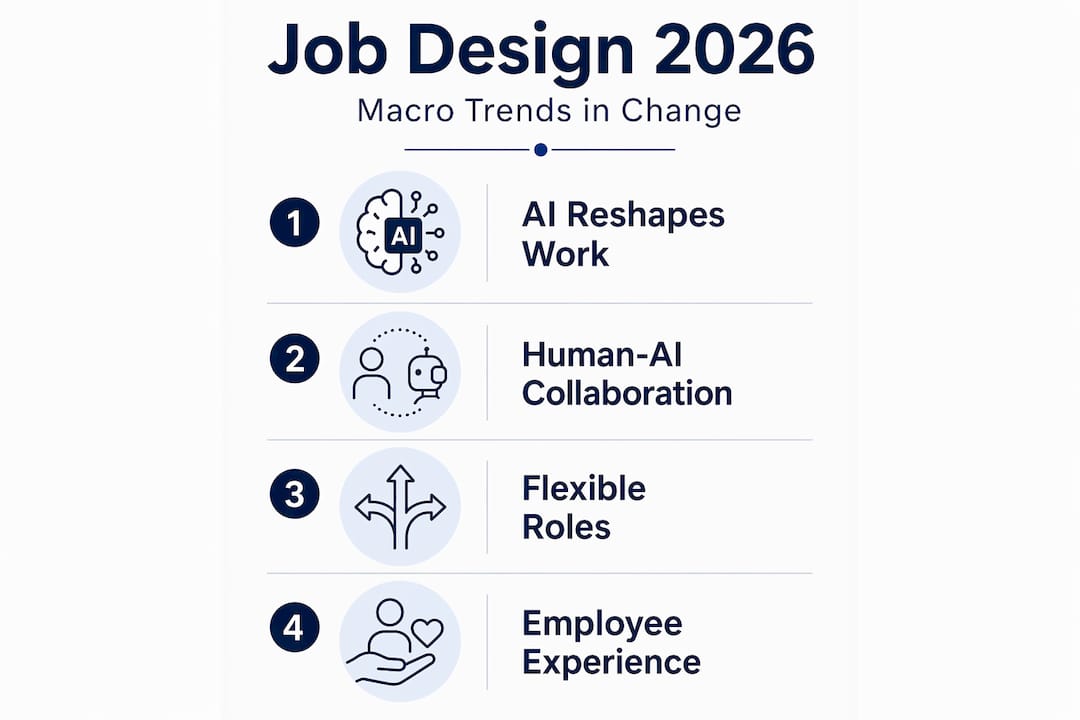
Second, employees know what they want and they’re voting with their feet. 70% of employees want more creative work, 65% want more collaboration, and 62% want self-directed roles, according to Gensler’s Global Workplace Survey. These aren’t soft preferences. They are signals about which organizations will retain their best people and which ones won’t.
Third, the market is already pricing in AI capability. Workers with AI skills now command an average wage premium of 56%, which tells you something important: the gap between organizations that redesign jobs intentionally and those that don’t will widen quickly.
“Productivity gains from AI already outpace organizational redesign. The risk isn’t that AI fails. It’s that organizations optimize old workflows instead of transforming how work actually gets done.” — Deloitte, 2026 Human Capital Trends
The organizations treating job design as secondary to AI deployment are going to find themselves with expensive tools running on outdated role structures. That combination produces frustration, not performance.
Why human-AI collaboration must be designed, not assumed
Most organizations install AI tools and assume workers will figure out how to integrate them. That assumption is costly. Most organizations see only marginal AI gains without intentional redesign of roles and decision rights. The technology works. The job design around it doesn’t.
What’s emerging as the solution is a concept called orchestration. Orchestration roles manage workflow handoffs between humans and AI agents, requiring systems thinking and redefined leadership. Think of it as air traffic control for your workflows. Somebody has to decide what the AI handles, what the human reviews, and where the judgment calls live. Right now, in most organizations, nobody owns that clearly.
Here’s what intentional human-AI job design looks like in practice:
- Map every major task in a role against two questions: Does this require human judgment, emotional intelligence, or relationship trust? And can AI execute this with adequate accuracy and speed?
- Assign decision rights explicitly. Define which decisions are AI-led, which are human-led, and which require human review of an AI recommendation. This isn’t just a workflow exercise. It’s a trust and accountability exercise.
- Redesign performance expectations. When AI handles execution, human performance metrics shift toward quality of oversight, quality of judgment, and quality of collaboration with both AI systems and other people.
- Build feedback loops. Workers need mechanisms to flag when AI outputs are wrong, misleading, or missing context. Without this, you get what Brookings has called the “enshittification” of work, where AI degrades job quality silently because nobody built in the correction process.
Pro Tip: Before deploying any new AI tool into a team’s workflow, run a 30-minute session where that team maps which tasks they want to keep and why. The answers reveal where human judgment is most concentrated, and that’s exactly where you should design in more human ownership, not less.
What employees actually need from their work environments
Understanding what your workforce wants in 2026 goes beyond surveys. It connects directly to how you structure roles, physical environments, and team models.
The data from Gensler is worth sitting with. When 70% of employees want more creative work, that’s a direct indictment of job designs that have reduced human work to approval queues and status updates. It means workers feel underused. That’s a redesign problem, not a motivation problem.
Here’s what employees are asking for in their work environments right now:
- Creative challenge. Roles that include open-ended problem solving, not just process execution.
- Collaboration structures. Scheduled, purposeful collaboration time rather than reactive meeting culture.
- Autonomy over method. Flexibility in how work gets done, even when the outcome is fixed.
- Wellness and focus support. Physical environments that include quiet zones for deep work and social spaces for real connection.
- Growth without a vertical ladder. Career development that moves sideways into new skill areas, not just upward into management.
The recruitment technology trends shaping 2026 show that candidates are now evaluating job architecture during interviews, not just compensation. They want to know what the role actually involves day to day, how much autonomy it carries, and whether the organization is set up for them to grow.
| Employee priority | What it looks like in job design |
|---|---|
| Creative work | Roles include unstructured problem-solving time |
| Collaboration | Team workflows built around shared deliverables |
| Autonomy | Flexible methods with clear outcome ownership |
| Wellness | Workloads designed to prevent sustained cognitive overload |
| Lateral growth | Skill expansion built into role progression |
The organizations getting this right aren’t just building better places to work. They’re building workforces that are faster to adapt, less likely to burn out, and more likely to stay.
Practical frameworks for HR leaders to redesign jobs now
Here’s where strategy meets execution. Redesigning jobs for 2026 doesn’t require rebuilding your entire org chart. It requires shifting how you think about the building blocks of a role.
Start with task-level analysis
Break each role into its constituent tasks. For each task, ask three questions. Is this better done by a human, by AI, or by a human reviewing AI output? How much of this task matches the person’s natural working style and cognitive strengths? And does this task energize or drain the person in this role?
That last question sounds soft. It isn’t. Energy alignment is one of the strongest predictors of sustained high performance. People who spend most of their time on tasks that match their natural patterns don’t just perform better. They stay longer and handle stress more effectively.
Redesign career ladders beyond the vertical
Traditional career ladders assume that growth means managing more people. That model is being restructured as organizations flatten and AI handles more coordination work. In its place, leading organizations are building career lattices: structured paths that allow employees to expand into adjacent skill domains, take on cross-functional project ownership, and build expertise without needing a management title to do it.

Use personality data, not just skills data
Skills tell you what someone can do today. Personality tells you how they work, where they thrive, and which environments will cause them to disengage or burn out. The most effective emerging job design strategies use personality and cognitive profile data to match people to tasks before putting them in roles, not after.
| Job design approach | What it captures | What it misses |
|---|---|---|
| Skills-based matching | Current capability | Working style, energy fit, growth direction |
| Personality-based matching | Natural strengths, collaboration style | Specific technical knowledge |
| Combined profile matching | Full picture of fit and potential | Nothing significant |
Pro Tip: When evaluating someone for a redesigned role, compare their personality profile to the actual task distribution in that role, not just the job title. Titles describe hierarchy. Tasks describe the real work. Fit lives at the task level.
Ethics, accountability, and culture in AI-integrated work
The enthusiasm around AI in job design needs to be matched with equal seriousness about what can go wrong.
- Accountability gaps are real. When a hiring recommendation, a performance score, or a resource allocation decision comes from an AI system, someone still needs to own it. Designing jobs without clarifying that ownership creates legal exposure and cultural confusion.
- Younger workers face disproportionate risk. Young workers lead innovation but face the highest AI displacement risk. If entry-level roles are automated before these workers can build experience, organizations lose the pipeline for future creative leadership. Job design must include deliberate onramps for early-career people.
- Co-design with workers is not optional. People-first AI integration requires workers to be involved in how AI tools are introduced into their roles. Organizations that skip this step see lower adoption, lower trust, and worse outcomes.
- Cultural debt compounds fast. If your culture doesn’t reward learning, adaptation, and honest feedback about AI failures, your job redesign efforts will stall at the structural level and never reach behavioral change.
“A people-first approach to AI means co-designing the work with the workers who do it, not just communicating change to them after the fact.” — Brookings Institution, 2026
Leadership accountability has to be explicit here. The role of AI in recruitment and workforce decisions needs human oversight built in structurally, not added as an afterthought when something goes wrong.
My take on what most leaders are getting wrong
I’ve watched organizations invest heavily in AI tools while treating job design as a downstream HR task, something to handle after the technology is deployed. That sequence is backwards. And it’s expensive.
What I’ve learned from working with organizations going through these transitions is that the biggest missed opportunity isn’t picking the wrong AI tool. It’s failing to ask the most important question before any deployment: what do we want humans to be doing more of after this change, not less of?
The organizations that get this right are thinking about orchestration from day one. They’re designing roles where human judgment sits at the most consequential decision points, where AI handles the volume, and where the handoff between the two is explicit and reviewed regularly. That’s not a technology strategy. That’s a people strategy that happens to use technology well.
I also believe the HR function has an enormous opportunity here that it keeps underselling. HR leaders who can map personality and working style data to redesigned task distributions aren’t just filling roles. They’re building the organizational capacity to adapt faster than competitors. That’s a genuine strategic advantage.
The leaders I admire most in this space aren’t asking “how do we automate this job?” They’re asking “what does this person do best, and how do we build a role that gets the most of that?” That question sounds simple. Answering it rigorously, at scale, is where the real work lives.
— Mikk
How Sparkly helps you redesign jobs with confidence
The insights in this article point toward one consistent need: better data about people, not just about processes. That’s exactly where Sparkly operates.
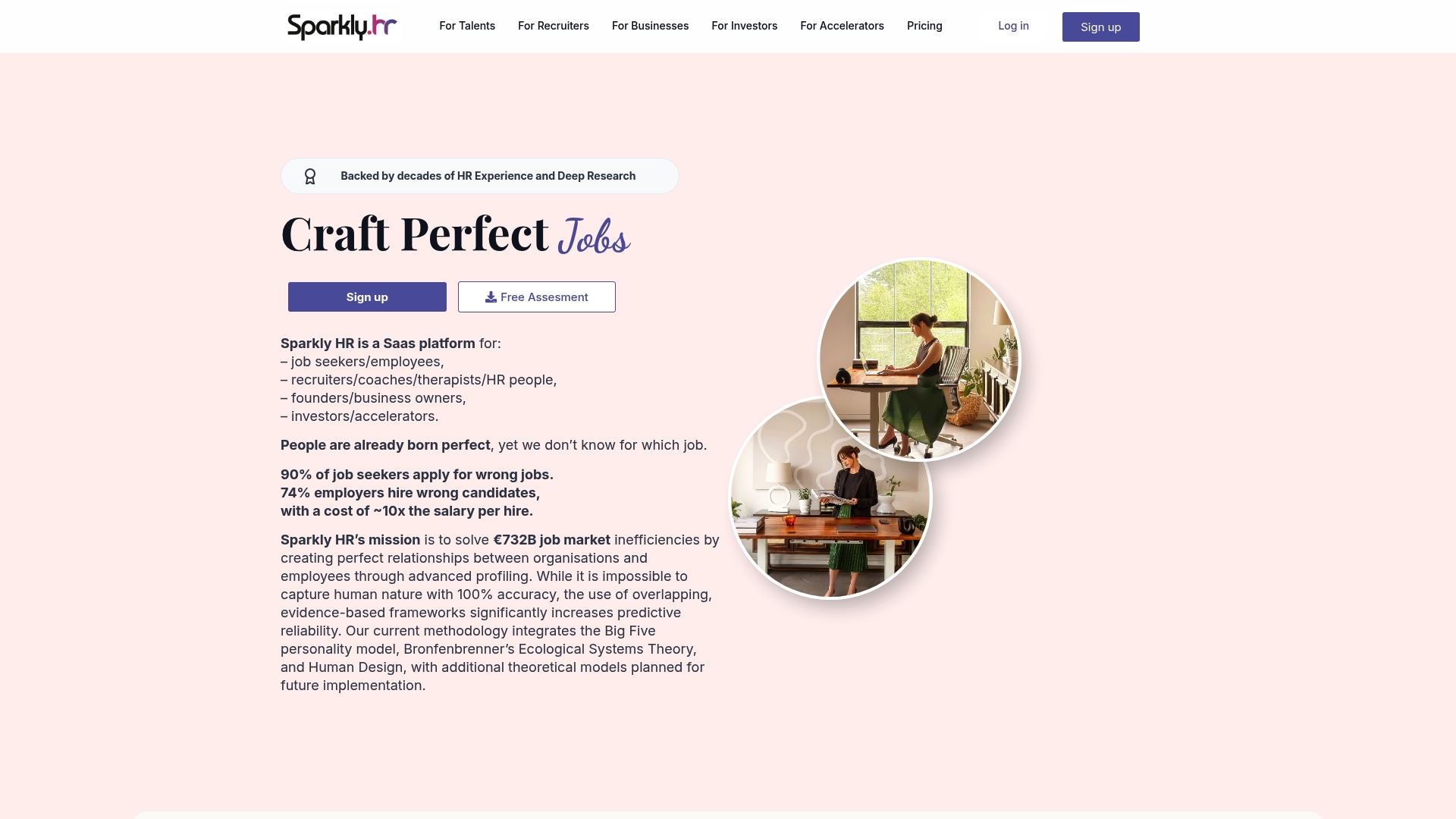
Sparkly is built for HR leaders and business managers who want to move beyond gut feeling and generic job titles. By merging psychometric assessments, Human Design profiles, AI analysis, and structured human evaluation, Sparkly produces high-probability insights about how each person works, where they thrive, and which roles and tasks genuinely fit them. Skills can be learned. Personality shapes everything else.
Whether you’re transforming employee potential through SaaS, evaluating which team members are ready for redesigned roles, or building a hiring process that catches personality fit before day one, Sparkly gives you the data layer your job design strategy needs. You can also explore top talent evaluation tools for 2026 to see how Sparkly compares. The future of work rewards organizations that know their people deeply. Sparkly makes that possible.
FAQ
What is the future of job design in 2026?
Job design in 2026 is shifting from task-based role definitions toward orchestration models that deliberately divide work between human judgment and AI execution. BCG research projects that over 50% of U.S. jobs will be fundamentally restructured within the next few years.
How will AI change job roles in 2026?
AI is moving most execution-heavy tasks out of human job descriptions and replacing them with oversight, judgment, and coordination responsibilities. Organizations that redesign roles around this shift see real productivity gains. Those that don’t risk optimizing outdated workflows with expensive tools.
What do employees want from job design in 2026?
According to Gensler’s 2026 workplace survey, 70% of employees want more creative work, 65% want more collaboration, and 62% want more self-direction. Effective job design builds these elements into role structure, not just company culture statements.
Why does personality matter more than skills in job design?
Skills describe what someone can do today. Personality determines how they work, what environments they thrive in, and which tasks will sustain their energy over time. Role fit built on personality data reduces burnout, mismatch, and turnover more effectively than skills matching alone.
What is orchestration in the context of job design?
Orchestration refers to explicitly designing the handoff points between human workers and AI agents within a workflow. It assigns clear decision rights, defines where human judgment is required, and builds feedback mechanisms so AI outputs are continuously checked and corrected.