
Team restructuring strategies for stronger, agile teams

TL;DR:
- Effective restructuring improves retention when paired with clear roles and onboarding.
- Poorly executed restructuring can significantly increase turnover and organizational costs.
- Transparent communication and personality fit are crucial for successful team transitions.
Team restructuring sounds straightforward on paper, but it carries a genuine risk that many HR leaders overlook: done poorly, it can actually increase turnover rather than fix it. 82% higher 1-year retention is achievable when restructuring is paired with clear roles and structured onboarding, yet that same process without proper planning sends talented people straight to competitors. If your organization is navigating rapid growth, a merger, or persistent performance gaps, this guide will walk you through what effective team restructuring looks like, which methods work, which pitfalls derail even well-intentioned efforts, and how to measure success with real benchmarks.
Table of Contents
- What is team restructuring?
- How team restructuring impacts retention and team dynamics
- Methods and models for successful team restructuring
- Common pitfalls and how to avoid them
- Our perspective: What most leaders miss when restructuring teams
- How Sparkly HR can help you restructure for long-term success
- Frequently asked questions
Key Takeaways
| Point | Details |
|---|---|
| Effective restructuring boosts retention | Clear roles and onboarding lead to higher employee retention and team stability. |
| Proactive changes beat reactive | Planning ahead reduces disruption, cost, and team demotivation. |
| Communication and compliance are critical | Frequent missteps involve unclear communication or skipping legal steps—avoid both. |
| Benchmark against top performers | Aim for voluntary turnover rates of 6-10% for strong, agile teams. |
What is team restructuring?
After outlining the stakes of team restructuring, let’s define exactly what it means and why organizations pursue it.
Team restructuring is the deliberate process of changing team composition, roles, reporting lines, or working relationships to improve organizational performance. It is not a layoff announcement dressed up in nicer language. It is a strategic move to align your people with evolving business goals, whether those goals involve scaling fast, integrating a new acquisition, or closing a skills and collaboration gap that has been quietly draining productivity.
Most restructuring initiatives are triggered by a handful of recognizable events. Here are the most common:
- Mergers and acquisitions, where two teams need to operate as one without duplication or confusion
- Rapid growth, where a startup structure no longer supports a 100-person organization
- Digital transformation, where new technology demands different roles and cross-functional thinking
- Performance gaps, where output falls short because the team design itself is the problem
- Leadership changes, where a new executive brings a different vision for how work should flow
- Market shifts, where customer needs evolve faster than the current team setup can respond
The goals behind restructuring are usually role clarity, better collaboration, and greater organizational agility. Role clarity alone is underrated. When people genuinely understand what they own, decision-making speeds up and accountability improves. Better collaboration follows naturally when reporting structures actually reflect how work gets done rather than how it was done three years ago.
Pursuing internal talent shifts as part of restructuring is often more effective than hiring externally, because the institutional knowledge stays in the building. Pairing that with the right team collaboration tools helps newly restructured teams find their rhythm faster.
Pro Tip: Before you move a single box on the org chart, ask whether the problem you are solving is structural or cultural. Restructuring fixes structural problems. If the real issue is trust, communication norms, or management behavior, reorganizing roles will not help and may create new friction.
Be aware that poor execution in restructuring can increase turnover significantly. Ambiguity about new roles, silence from leadership, and rushed timelines are the three fastest ways to watch your best people start updating their resumes. Structuring the process thoughtfully from the start prevents this entirely preventable outcome.
How team restructuring impacts retention and team dynamics
With the concept clarified, let’s dig into the measurable ways restructuring affects turnover rates and team cohesion.
The evidence is clear: when restructuring is planned and executed well, it measurably improves retention. When it is not, the consequences are costly and often irreversible. Understanding this spectrum helps you calibrate your approach before you begin.
Here is how structured versus unstructured restructuring outcomes typically compare:
| Scenario | Voluntary turnover rate | 1-year retention |
|---|---|---|
| Top-quartile companies post-restructure | 6 to 10% | 85 to 90%+ |
| Industry average post-restructure | 12 to 18% | 70 to 78% |
| Poor execution post-restructure | 20 to 30%+ | Below 65% |
| Pre-restructure baseline (struggling teams) | 22 to 35% | Below 60% |
These numbers tell a story. 82% higher 1-year retention is not accidental. It is the direct result of giving people clear roles, structured onboarding into their new responsibilities, and transparent communication throughout the transition.
“The cost of replacing a single employee ranges from 50% to 200% of their annual salary, depending on seniority. A poorly executed restructure that drives out five senior contributors can cost a mid-sized company hundreds of thousands of dollars within a single quarter.â€
Poor restructuring typically fails in predictable ways. When leadership announces changes without explaining the reasoning, employees fill the information vacuum with worst-case assumptions. When timelines are compressed, people do not have time to process the change before the next one arrives. When the new structure creates reporting ambiguity, political friction replaces productive work.
The turnover impact on business goes beyond replacement costs. You lose institutional knowledge that cannot be documented. You lose client relationships that live in individual people. You lose team culture that took years to build. These are real organizational costs that do not show up cleanly in a budget spreadsheet but absolutely show up in quarterly results.

One often-missed dynamic is the effect on the employees who stay. When colleagues leave after a restructure, survivors frequently experience heightened anxiety, increased workloads, and reduced psychological safety. If you are focused exclusively on the people exiting, you may be missing the erosion happening among the people you most want to keep.
Strategies focused on reducing turnover fast recognize this and build retention actions for both groups into the restructuring plan. The goal is not just to survive the change, but to emerge from it with a team that is more cohesive and energized than before. That outcome is achievable, but it requires intention.
Methods and models for successful team restructuring
Knowing the stakes, let’s explore the leading frameworks and tactical steps that make restructuring succeed.
The single most important distinction in restructuring methodology is proactive versus reactive. Proactive restructuring is cheaper and less disruptive than reactive restructuring in almost every scenario. Proactive restructuring happens when leaders anticipate where the organization needs to go and adjust structure before performance suffers. Reactive restructuring happens after the problem has already become a crisis.
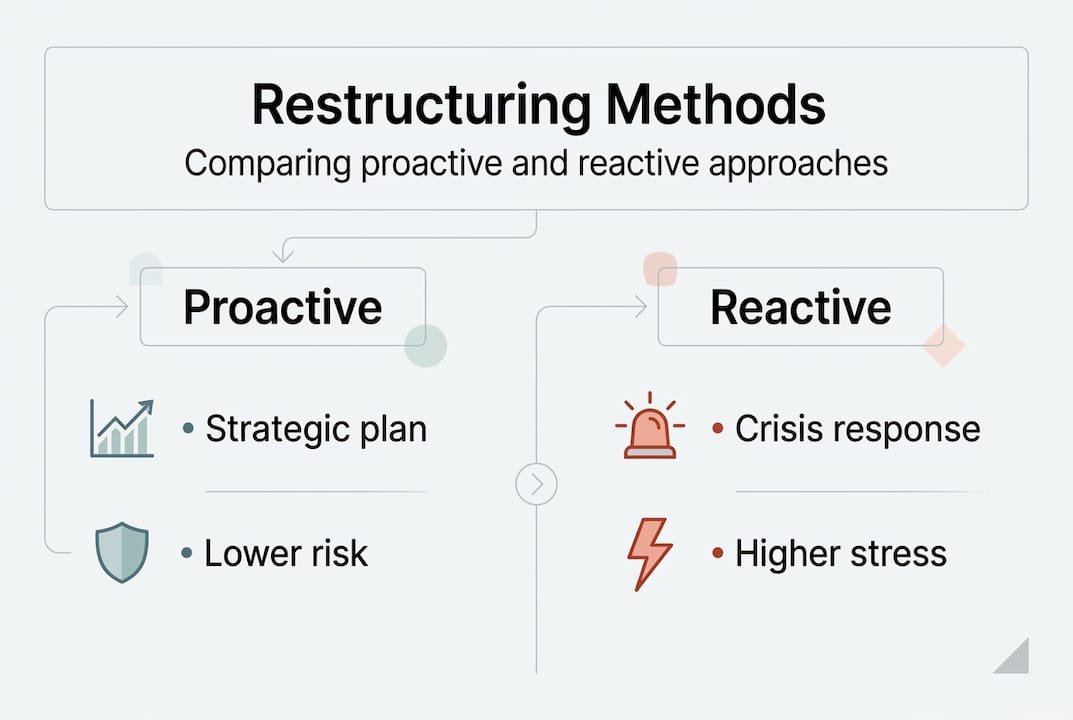
| Approach | Trigger | Cost | Disruption level | Retention risk |
|---|---|---|---|---|
| Proactive | Strategic planning | Lower | Moderate | Low to medium |
| Reactive | Performance crisis | Higher | High | High |
The models that consistently produce better outcomes include cross-functional teams, role assessment-led redesign, and dynamic pod structures. Cross-functional teams pull together people from different disciplines around a shared goal, eliminating the handoff delays that slow traditional siloed structures. Role assessment-led redesign starts with mapping what work actually needs to be done, then designing roles around that work rather than around existing headcount. Dynamic pods create smaller, agile units within larger organizations that can form, adapt, and dissolve as business needs change.
Here is a practical sequence for planning a successful restructure:
- Define the strategic goal clearly. What specific business outcome is this restructuring designed to achieve? Write it down in one sentence.
- Audit current roles and workflows. Understand what work is actually happening, not just what job descriptions say.
- Identify gaps and redundancies. Where is critical work unowned? Where is the same work happening in multiple places?
- Design the future structure. Map new roles, responsibilities, and reporting lines against the strategic goal.
- Assess personality and cultural fit, not just skills. Skills can be learned; personality alignment drives long-term team health.
- Build a communication plan. Decide who hears what, in what order, and through which channels before you begin.
- Phase the implementation. Avoid changing everything at once. Sequence changes to give teams time to stabilize.
- Create structured onboarding for employees moving into new roles, even if they have been at the company for years.
- Establish feedback loops. Build in regular check-ins to catch problems early.
Understanding how to shift team members effectively is a core skill for HR leaders navigating any of these steps. Pair that with proven team optimization strategies and the process becomes far more manageable.
Pro Tip: Consult your legal team before you finalize any restructuring plan, not just when redundancies appear likely. Even restructures with no layoffs can carry legal exposure around changed terms of employment, discrimination claims, or consultation requirements depending on your jurisdiction.
The traits of high-performing teams do not emerge by accident. They are designed into the structure from the beginning, reinforced by the right roles, and sustained by leaders who treat the restructure as a beginning rather than a resolution.
Common pitfalls and how to avoid them
With a plan in place, it is essential to understand the real-world obstacles and avoidance strategies that determine whether restructuring succeeds or stalls.
Even well-resourced restructures derail when leaders fall into common traps. Here are the mistakes that appear most frequently and most expensively:
- Unclear communication: Announcing the what without explaining the why destroys trust faster than any structural change
- Rushed timelines: Compressing a six-month change into six weeks guarantees poor execution and high anxiety
- Skipping legal review: Changing roles, responsibilities, or reporting lines without legal guidance creates exposure even when no redundancies are involved
- Ignoring informal leaders: The people employees actually look to for signals are rarely the ones with the biggest titles
- Restructuring too frequently: Each successive reorg reduces employee trust and increases what HR professionals call “org tax,†the accumulated cost of constant organizational change that erodes productivity and morale
- Treating structure as the only lever: Culture, communication norms, and management quality all shape team performance and cannot be reorganized away
- Forgetting the effective onboarding checklist for employees moving into new roles, leaving them unsupported in unfamiliar territory
The question of whether to require employees to reapply for their jobs during restructuring deserves specific attention. Some organizations use this as a mechanism to objectively evaluate fit for new roles. In practice, it frequently backfires. Experienced, high-performing employees read a reapplication requirement as a signal that their contributions are not valued. Many will not wait to find out the outcome; they will simply leave. The risk of losing your strongest people through this mechanism is often far greater than the benefit of the selection process it provides.
“Frequent reorganizations create an invisible ‘org tax’ that accumulates across every team in the business. People spend energy managing uncertainty rather than doing their best work, and the cumulative cost to productivity, engagement, and retention can be severe even when individual restructures seem minor.†— HR leadership insight
Legal consultation is non-negotiable, and this bears repeating because so many organizations skip it when no layoffs are involved. Legal consultation is mandatory even without redundancies because changes to role scope, compensation relationships, or reporting structures can trigger legal obligations depending on where your employees work.
The practical solution to most of these pitfalls is the same: slow down the announcement phase, invest in two-way communication, phase the implementation thoughtfully, and treat the period immediately following the restructure as the most critical stage, not the finish line.
Our perspective: What most leaders miss when restructuring teams
Here is what our experience reveals that the data alone cannot show.
Most leaders approach restructuring as an exercise in org chart design. They spend hours debating reporting lines and role titles while barely touching the question that actually determines whether the restructure succeeds: will these people trust the organization enough to commit to what comes next?
Restructuring is not about moving boxes on a chart. It is about aligning personality fit, working styles, and culture in ways that let people bring their best to new configurations. Skills can be learned. Personality drives how someone responds to ambiguity, how they build relationships under pressure, and whether they will stay when the path forward feels uncertain. That is why boosting retention with personality fit is one of the highest-leverage moves available during any restructure. 💡
Transparent, two-way communication matters far more than getting titles or reporting lines exactly right. If your people feel heard and informed, they will adapt to imperfect structures. If they feel dismissed or blindsided, even a technically excellent redesign will underperform.
Pro Tip: Identify your informal leaders before the restructure and activate them as change champions. These are the people others turn to when they are worried. Their genuine confidence in the process is worth more than any all-hands announcement.
Lasting change takes months, not weeks. Stability post-restructuring is ongoing maintenance work. Organizations that celebrate the restructure launch and then disappear from the communication and support process consistently see the gains erode within a year.
How Sparkly HR can help you restructure for long-term success
To put these ideas into action, here is how Sparkly HR can support your restructuring journey.
Restructuring decisions are only as good as the data behind them. Sparkly HR’s employee assessment platform helps you move beyond guesswork by combining human input, AI, psychometric assessments, and Human Design into a single, higher-probability picture of each team member. This means you can make role and team composition decisions based on who people actually are, not just what their resume says. Understanding how SaaS supports HR gives your restructuring process a measurable edge. âš¡ï¸

If you are ready to build teams that hold together through change rather than fracturing under it, explore Sparkly’s talent assessment SaaS solutions designed specifically for HR leaders who want restructuring to create lasting improvement, not just temporary reorganization. Your team’s next configuration deserves to be its best one.
Frequently asked questions
What are the biggest risks of team restructuring?
The main risks are higher turnover if poorly executed, loss of morale, and unintended skill gaps; poor execution in restructuring can increase voluntary exits significantly within the first year.
How often should a company restructure its teams?
Restructuring should be done proactively and infrequently; frequent reorgs create org tax that erodes engagement and productivity across the entire organization over time.
Should employees have to reapply for their jobs in a restructure?
Requiring reapplication is risky and often hurts morale because reapplication for jobs risks demotivation, and your strongest performers are often the first to walk away rather than wait for the outcome.
What’s the benchmark for good team turnover after restructuring?
Top-performing companies achieve voluntary turnover rates between 6 and 10% after effective restructuring, compared to the industry average of 12 to 18% and poorly executed restructures that can exceed 25%.
Is legal consultation necessary even without layoffs?
Yes, legal consultation is essential for any restructuring because legal consultation is mandatory even without redundancies; changes to roles or reporting lines can carry legal obligations that vary significantly by jurisdiction.