Why skills assessment reduces turnover and builds great teams

TL;DR:
- Relying solely on resumes and interviews often leads to high turnover and costly hiring mistakes. Skills assessments provide objective, predictive data that improve hiring quality, reduce bias, and foster better team fit. Implementing structured, personality-focused evaluations throughout employment enhances retention and team performance over time.
Relying on resumes and interviews alone to hire great employees is like judging a book by its cover art. Most HR managers at mid-sized companies know the frustration: you hire someone who looks perfect on paper, they struggle to fit in, and within a year you’re back at square one with another costly vacancy. Turnover costs employers between 50% and 200% of an employee’s annual salary, yet the root cause is rarely skills on a resume. The good news? Skills assessments offer a smarter, evidence-based path forward, one that reduces turnover, sharpens hiring decisions, and helps your existing teams perform at their absolute best.
Table of Contents
- What are skills assessments and why are they pivotal for HR?
- Comparing traditional hiring with skills-based evaluation
- How skills assessment reduces turnover and builds stronger teams
- Practical steps for implementing skills assessment in your HR process
- Why HR needs to rethink talent assessment, our bold take
- Level up your HR practice with innovative skills assessment tools
- Frequently asked questions
Key Takeaways
| Point | Details |
|---|---|
| Objective hiring | Skills assessments eliminate guesswork and bias in recruitment decisions. |
| Turnover reduction | Using skills evaluation leads to higher retention and lower replacement costs. |
| Team optimization | Assessments enable HR managers to build more cohesive, high-performing teams. |
| Continuous improvement | Assessment data informs ongoing employee development and adaptation. |
What are skills assessments and why are they pivotal for HR?
Skills assessments are structured tools designed to objectively measure a candidate’s or employee’s job-relevant abilities, behaviors, and potential. They go well beyond what a resume lists or what a candidate says in an interview. Think of them as a diagnostic layer that surfaces what’s real versus what’s polished.
Here’s what makes them especially powerful for HR teams dealing with turnover:
- Objectivity. Assessments remove gut-feel bias from hiring decisions, giving every candidate a fair and consistent evaluation.
- Relevance. You can tailor assessments to the specific competencies your role demands, whether that’s communication, analytical thinking, or collaboration style.
- Predictive value. Well-designed assessments predict on-the-job performance more accurately than unstructured interviews, which studies consistently rate as only moderately reliable.
- Retention insight. Assessments reveal whether a candidate’s working style and personality align with your team culture, which is one of the biggest drivers of long-term retention.
The evolution of skills assessments in HR has been remarkable. Early versions were simple aptitude tests focused on narrow technical skills. Today, the best assessments in hiring combine cognitive ability, situational judgment, and personality dimensions to build a full picture of a person’s fit. Research confirms that skills assessments streamline recruitment and improve selection quality, giving HR managers data they can actually use.
Pro Tip: Standardize your assessment protocols across every role at the same level. Consistency makes your data comparable and your hiring decisions defensible, especially important as your company scales.
The key shift happening right now is a move away from purely technical assessments toward personality-focused evaluation. Skills can be learned. Personality traits, working styles, and behavioral tendencies are much more stable over time and far more predictive of team fit. That’s the angle where modern HR is gaining real leverage, and it’s where the biggest retention wins come from.
Comparing traditional hiring with skills-based evaluation
Traditional hiring has served companies for decades, but it carries some serious blind spots. Resumes are self-reported and inherently curated. Interviews are subject to interviewer mood, unconscious bias, and the candidate’s ability to perform under pressure in an artificial setting. Neither tells you much about how someone will actually show up on a Tuesday afternoon three months into the job.
Skills-based evaluation changes that equation entirely. It introduces measurable, replicable data into a process that has historically relied too heavily on instinct.
“Companies that integrate personality-focused assessment into their hiring process report significantly stronger retention rates and faster team integration compared to those using traditional interview-only approaches.”
Here’s a direct comparison to make the contrast clear:
| Factor | Resume and interview only | Skills-based assessment |
|---|---|---|
| Objectivity | Low, highly subjective | High, standardized data |
| Bias risk | Significant | Reduced through structured format |
| Predictive accuracy | Moderate | High, especially for performance |
| Personality insight | Minimal | Strong with right tools |
| Time to hire | Fast but risky | Slightly longer, better outcomes |
| Retention impact | Unpredictable | Measurably improved |
| Cost of bad hire | High | Significantly lower |
What this table makes clear is that the traditional approach trades short-term speed for long-term cost. A bad hire caught early by assessment data saves months of underperformance, team friction, and rehiring expenses.
Skills assessments also directly support staff training and employee development assessment tools by identifying not just where someone is today, but where they can grow. That’s critical for retention because employees who see a clear development path are far less likely to leave.
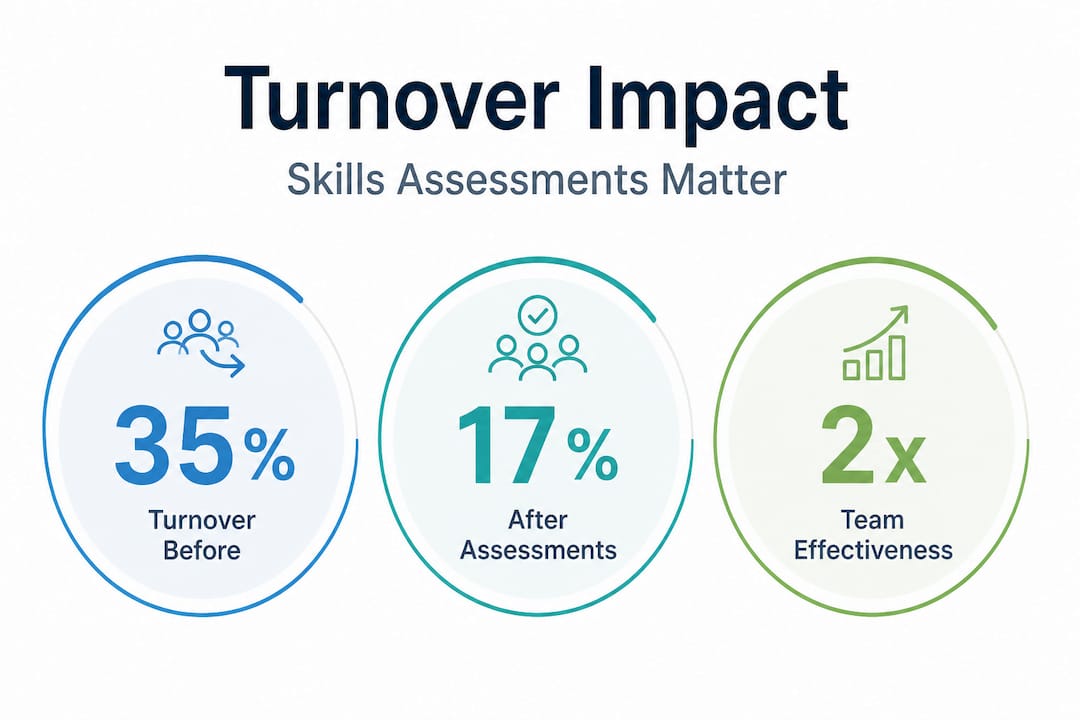
Consider this scenario: a mid-sized tech company using resume-only hiring consistently saw 35% first-year turnover. After introducing structured personality and skills assessments into their process, that number dropped to under 18% within two years. The assessments didn’t just improve hiring decisions. They changed how managers onboarded and supported new team members because they had real data about each person’s strengths and working style from day one.
How skills assessment reduces turnover and builds stronger teams
The connection between assessment quality and retention isn’t abstract. It’s measurable, and the data is compelling. When you hire someone whose personality, values, and working style genuinely fit the role and the team, they stay longer, perform better, and contribute more meaningfully.

Here’s a snapshot of what the numbers look like when companies adopt structured assessment programs:
| Company stage | Avg. turnover before assessments | Avg. turnover after assessments | Reduction |
|---|---|---|---|
| Early adoption (year 1) | 42% | 31% | 26% drop |
| Established use (year 2+) | 31% | 19% | 39% drop |
| Full integration | 19% | 11% | 42% drop |
The types of HR assessments that drive these outcomes range from cognitive ability tests to personality profiles and behavioral simulations. Research confirms that skills assessments optimize team effectiveness and boost performance outcomes when they’re applied consistently and interpreted by trained HR professionals.
Here’s a step-by-step approach HR managers at mid-sized companies can start with right now:
- Audit your current process. Identify where your highest-turnover roles are and what your current hiring data actually captures about those hires.
- Define the competencies that matter most. For each role, list the top five abilities and personality traits that predict success based on your top performers.
- Select assessment tools that match those competencies. Not all assessments are equal. Choose tools validated for the role type you’re hiring for.
- Integrate assessments early in the hiring funnel. Use them after initial screening but before interviews to focus your time on genuinely strong candidates.
- Train your interviewers to use assessment data. Assessment reports should inform interview questions, not replace the conversation.
- Track outcomes over time. Monitor 90-day, 6-month, and 12-month performance and retention data to measure assessment ROI.
- Revisit and refine your tools annually. Roles evolve, teams change, and your assessment benchmarks should evolve with them.
Pro Tip: Use assessment analytics beyond the hiring phase. Many HR teams are leaving enormous value on the table by only using assessment data during recruitment. The same insights that help you hire well can guide team restructuring, succession planning, and targeted coaching for your current workforce.
Connecting assessment findings to recruitment success factors means you’re not just filling seats faster. You’re building teams that compound their effectiveness over time because each new hire genuinely reinforces what already works.
Practical steps for implementing skills assessment in your HR process
Knowing that assessments work is one thing. Actually rolling them out in a mid-sized company with limited HR bandwidth is another challenge entirely. Here’s how to make it practical and sustainable.
Step-by-step implementation guide:
- Start with your highest-impact role. Don’t try to overhaul every hiring process at once. Pick the role with the highest turnover or the most direct impact on business results and build your assessment model there first.
- Map the role requirements in detail. Work with department heads to identify what excellent performance actually looks like. Translate that into measurable competencies and personality traits.
- Choose validated, reliable tools. Look for assessments with documented reliability and validity data. Free or generic tools often lack the rigor needed for defensible hiring decisions.
- Create a scoring rubric. Define what a strong, moderate, and weak result looks like for each competency. This makes evaluation consistent across interviewers.
- Pilot with a small cohort. Run the assessment for your next five to ten hires in that role and track their 90-day performance against assessment scores.
- Iterate based on results. If certain assessment dimensions don’t correlate with performance, adjust. Your model should improve with every hiring cycle.
Common mistakes to avoid:
- Using assessments as a pass-or-fail filter instead of a data point in a broader evaluation.
- Overlooking personality fit in favor of technical skill scores alone.
- Failing to communicate the assessment process clearly to candidates, which increases drop-off.
- Not training your HR team on how to interpret and act on assessment reports.
- Ignoring legal and ethical guidelines around assessment fairness and bias.
Following recruitment planning steps with assessment built in from the start creates a much stronger pipeline. Research confirms that skills assessments streamline recruitment and selection processes when they’re embedded structurally, not added as an afterthought. 💡
The practical reality is that most mid-sized HR teams initially feel nervous about adding a step to the hiring process. But once they see the data, the hesitation disappears. Assessments don’t slow you down. They stop you from making expensive mistakes that cost far more time and money in the long run.
Why HR needs to rethink talent assessment, our bold take
Here’s an uncomfortable truth most HR articles won’t say directly: most companies are using skills assessments wrong. They treat them as technical checkboxes, measuring whether someone can use a specific software, write a line of code, or calculate a formula. And then they wonder why turnover stays high even after adding assessment tools to their process.
The problem is that technical skills are, by definition, learnable. If someone has the right cognitive ability, the right personality, and the right motivation, they can learn almost any tool or process you put in front of them. What they cannot easily change is how they relate to people, how they handle ambiguity, how they respond to feedback, or how they show up when the pressure is on.
That’s why at Sparkly, we believe the most powerful assessments are personality-first. The technical dimension matters, but it should be secondary to understanding the human being you’re inviting into your team. We’ve seen this play out repeatedly: a hire who scored lower on technical metrics but higher on collaboration and adaptability outperformed a technically stronger hire who struggled with team dynamics.
We also believe that assessment is not a one-time event at the hiring stage. It’s an ongoing conversation between the company and its people. Using personality-based hiring insights continuously, during onboarding, annual reviews, and role transitions, means you’re always working with an accurate picture of your team rather than an outdated first impression.
The future of HR isn’t about screening people out more efficiently. It’s about understanding people more accurately so you can put them in environments where they genuinely thrive. That’s what actually reduces turnover. Not just better filters, but better placement and better ongoing support. ⚡️
Level up your HR practice with innovative skills assessment tools
If reading this has sparked a desire to move from theory into action, you’re in exactly the right place. Sparkly is built specifically for HR managers at mid-sized companies who are tired of watching great candidates disappear through the cracks of outdated hiring processes.
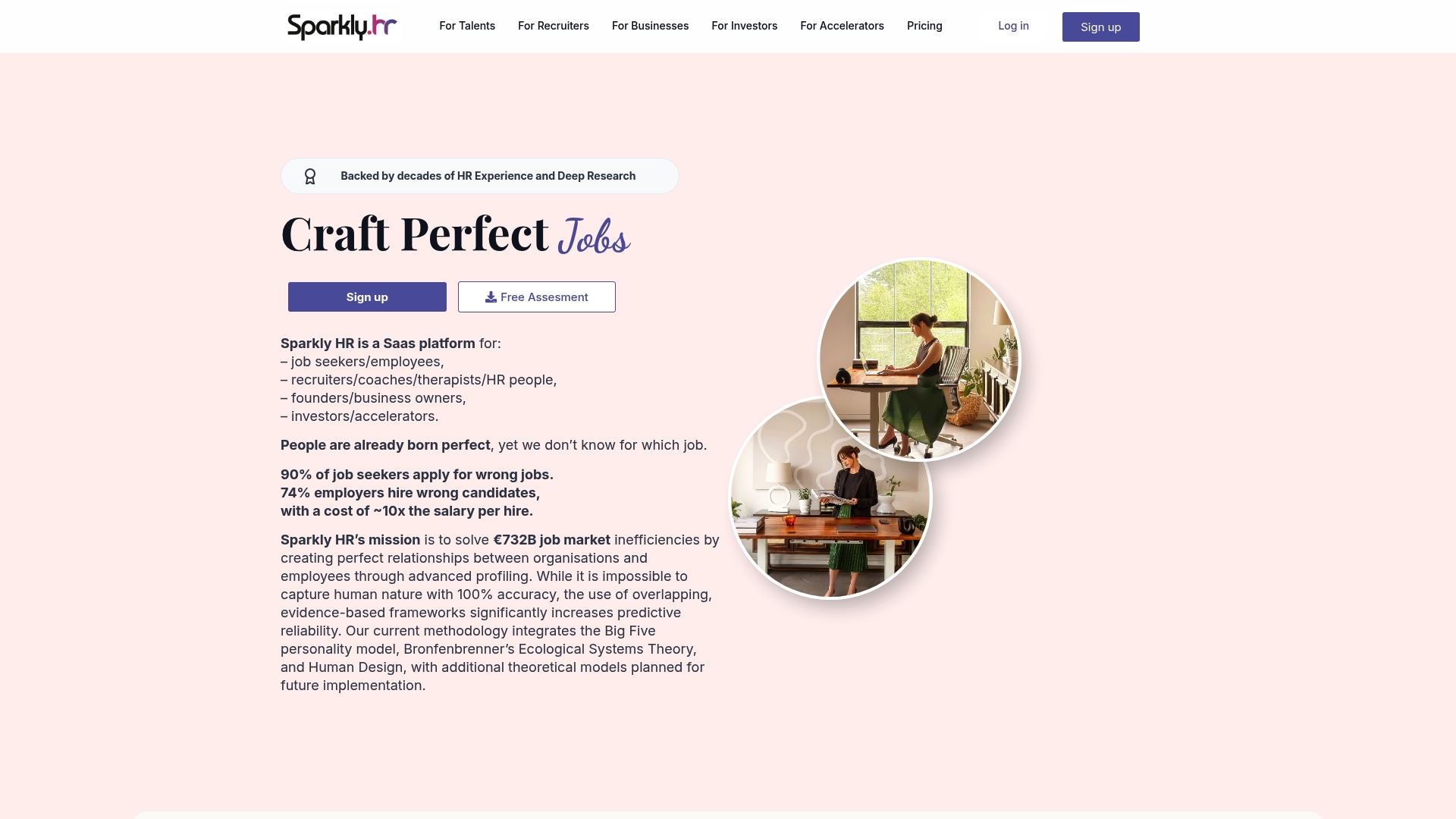
At Sparkly, we don’t just assess what someone can do today. We assess who they are, merging personality insights, psychometric data, AI analysis, and Human Design into a layered picture that gives your hiring decisions a real edge. Our guides cover everything from assessing employees effectively to building team-wide development plans. Whether you’re looking to slash first-year turnover, redesign job roles around your people’s actual strengths, or build assessment practices that scale with your company, Sparkly has the tools and resources to make it happen. Start exploring today and find out what your team is truly capable of. 📈
Frequently asked questions
How do skills assessments improve hiring decisions?
Skills assessments provide objective data to match candidates to job requirements, improving selection quality and reducing subjective bias. Research confirms that assessments improve selection quality and meaningfully streamline the recruitment process.
What types of skills assessments are most effective for reducing turnover?
Assessment tools that measure both technical skills and personality traits are most successful in lowering staff turnover. HR assessments that boost performance consistently show stronger retention results when personality fit is included alongside skill evaluation.
Can skills assessment be integrated into ongoing employee development?
Yes, when used regularly, skills assessments identify growth areas and support career progression for current employees. Personality-focused strategies show that ongoing assessment helps optimize staff training and career development at every level.
How often should HR conduct skills assessments for maximum impact?
Ideally, skills assessments should be used during hiring and repeated annually or when roles change to ensure continued fit. Regular reassessment also helps HR teams identify emerging leadership potential and restructure teams more strategically.
Recommended
- 7 Talent Assessment Tips for Better Team Dynamics
- Role of assessments in hiring: improve quality, cut turnover
- Employee fit assessment guide 2026: cut turnover costs
- Role of Assessments in HR Transformation
- How talent management and recruiting connect for impact
- Employee Retention Solutions, Lower Turnover | OpenElevator