
Job Enrichment Definition: A 2026 Guide for HR Leaders

TL;DR:
- Job enrichment is a strategy that increases employee motivation by adding autonomy, responsibility, and growth opportunities to roles. It focuses on developing intrinsic motivators rather than simply increasing task quantity, leading to higher engagement and lower turnover. Success depends on ongoing management support, personalized role fit, and continuous feedback.
Job enrichment is defined as a vertical job design strategy that increases employee motivation and productivity by adding autonomy, decision-making authority, and accountability to a role rather than simply increasing task quantity. The term was formalized by psychologist Frederick Herzberg in the 1960s, and it remains one of the most practical frameworks HR leaders have for improving engagement without changing headcount. Where most retention tactics focus on perks or pay, job enrichment targets the work itself. This guide covers the full meaning of job enrichment, how it differs from related strategies, which techniques actually work, and how to implement it in a way that sticks. ⚡️
What is the job enrichment definition in HR practice?
Job enrichment is a vertical job design strategy that improves motivation and productivity by increasing autonomy, decision-making authority, and accountability rather than adding task quantity. That distinction matters enormously. Adding more tasks to a role is job enlargement. Adding more depth to a role is job enrichment. The two are frequently confused, and that confusion leads to programs that exhaust employees rather than engage them.

Herzberg’s original framework identified two categories of workplace factors. Hygiene factors, such as salary and working conditions, prevent dissatisfaction but do not create motivation. Intrinsic motivators, such as responsibility, growth, and recognition, are what drive long-term engagement. Job enrichment targets the second category directly. That is why it produces more durable results than compensation adjustments alone.
In practical terms, a customer service representative whose role is enriched might gain the authority to resolve refund disputes independently, own a client relationship from start to finish, and receive direct feedback on their outcomes. None of those changes add more calls to their queue. They add meaning, ownership, and growth to the work already there.
Job enrichment vs job enlargement: what is the real difference?
The distinction between job enrichment and job enlargement is one of the most important in job design, and one of the most misapplied. Job enrichment vertically expands a role by adding decision-making power, while job enlargement horizontally expands it by adding more tasks of the same type. Enlargement without training and support is a direct path to burnout.
Job crafting is a third, related concept. Where enrichment is employer-driven and enlargement is structural, job crafting is employee-driven. Workers proactively reshape their tasks, relationships, and the meaning they assign to their work. Job crafting complements enrichment well because it gives employees agency within the structure their employer has already improved. You can explore job crafting’s impact on turnover and satisfaction in more depth.
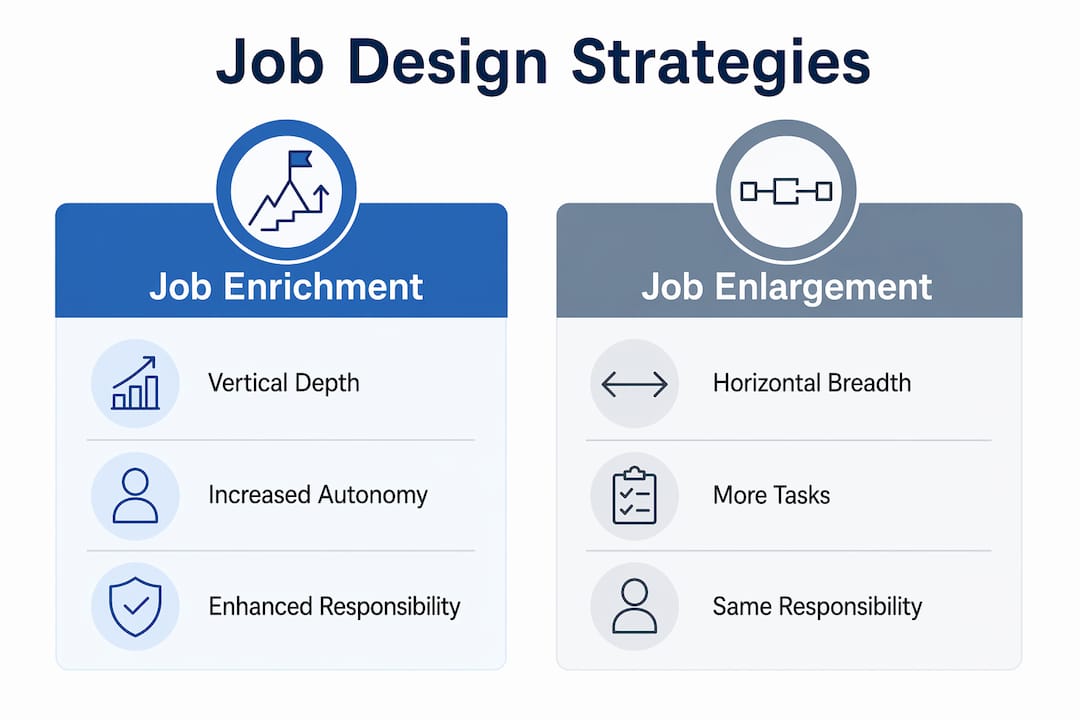
The table below shows how these three strategies compare across key dimensions:
| Feature | Job enrichment | Job enlargement | Job crafting |
|---|---|---|---|
| Direction | Vertical (depth) | Horizontal (breadth) | Employee-driven |
| Primary goal | Motivation and autonomy | Variety and workload | Meaning and fit |
| Risk if misapplied | Overwhelm without support | Burnout from overload | Misalignment with org goals |
| Initiated by | Employer or HR | Employer or HR | Employee |
| Example | Manager authority to approve budgets | Adding three new reporting tasks | Reframing admin work as client care |
Understanding where each strategy fits prevents HR leaders from prescribing the wrong solution. A disengaged employee who lacks challenge needs enrichment. An employee who is bored but already autonomous may benefit from crafting. An understaffed team may need enlargement, but only with clear training and boundaries.
What are the core techniques of effective job enrichment?
Effective job enrichment rests on five core elements identified in job design research: autonomy, skill variety, task identity, task significance, and feedback. Each element adds a different dimension of meaning to a role. Together, they create work that employees find genuinely motivating rather than just tolerable.
Here are the five most practical job enrichment techniques HR leaders can apply:
- Increase autonomy. Give employees control over how they complete their work, not just what they complete. A marketing analyst who chooses their own research methods feels more ownership than one who follows a rigid template.
- Add accountability. Assign employees ownership of outcomes, not just tasks. When a project succeeds or fails, the enriched employee knows why and has the authority to respond.
- Build in skill variety. Rotate employees through different functions within their domain. A finance associate who also presents quarterly results to leadership develops faster and stays more engaged.
- Create task identity. Let employees see a piece of work through from start to finish. Fragmented tasks reduce meaning. Complete tasks build pride.
- Establish direct feedback loops. Connect employees to the results of their work. Customer feedback, performance data, and peer reviews all reinforce the link between effort and impact.
Removing drudge work through automation is equally important. When repetitive, low-value tasks are automated, employees can focus on complex, meaningful work aligned with their strengths. This is not about reducing workload. It is about redirecting energy toward work that actually builds engagement.
Pro Tip: Apply the Goldilocks principle when assigning new responsibilities. New challenges should stretch employees without overwhelming them. Pair every new accountability with a feedback mechanism and a development resource, and you significantly reduce the risk of anxiety or performance failure.
What are the benefits of job enrichment for organizations?
Organizations that use job enrichment report higher employee engagement, lower turnover, and increased innovation. Those three outcomes are not coincidental. They follow directly from what enrichment does to the psychological experience of work.
Herzberg’s two-factor theory explains the mechanism. Intrinsic motivators like responsibility and growth produce sustained engagement in a way that pay raises and office perks simply cannot. When employees feel their work matters and that they have real authority over it, discretionary effort increases. They solve problems without being asked. They stay longer because the work itself is rewarding.
“Job enrichment addresses intrinsic motivational factors such as responsibility and growth, beyond extrinsic hygiene factors like pay, fostering long-term engagement.” — MindTools
The cultural benefits are equally significant. Enriched roles signal organizational trust. When a company gives an employee real decision-making power, it communicates that the person is capable and valued. That signal spreads. Teams with enriched roles tend to have lower stress, stronger collaboration, and a higher tolerance for change. You can see how these dynamics connect to broader organizational agility and turnover reduction.
For business leaders, the return on investment is clear. Replacing an employee costs between 50% and 200% of their annual salary, depending on the role. Enrichment is one of the most cost-effective retention tools available because it improves the daily experience of work rather than patching over dissatisfaction with short-term incentives.
How to implement job enrichment without common pitfalls
Job enrichment efforts often fail when treated as a one-time event. The most common mistake is redesigning a role in a workshop, announcing the changes, and then returning to business as usual. Without ongoing coaching, mentoring, and feedback, the new responsibilities feel like extra burden rather than growth.
The following best practices give enrichment programs the staying power they need:
- Involve employees from the start. Forming cross-functional task forces that include employees leads to better identification of roles suitable for enrichment. Employees know where the drudge work is. They know which responsibilities would genuinely motivate them.
- Secure leadership buy-in before launch. Managers who do not believe in the program will undermine it passively. Train managers to coach rather than control, and make enrichment part of their own performance expectations.
- Build continuous feedback loops. Schedule regular check-ins to assess how new responsibilities are landing. Use those conversations to adjust challenge levels and provide development resources.
- Pair enrichment with role-fit assessment. Not every employee is ready for every type of enrichment. Personality, working style, and energy patterns all affect how a person responds to increased autonomy or accountability.
- Treat it as a culture shift, not a program. Successful enrichment requires a culture of continuous learning with coaching and managerial support. That culture does not emerge from a single initiative.
Pro Tip: Form a cross-functional enrichment task force that includes frontline employees, their managers, and an HR lead. Meet quarterly to review which roles have been enriched, what is working, and where additional support is needed. This keeps enrichment alive as a practice rather than a project.
Workload balance deserves special attention. HR experts emphasize that enrichment should not increase workload by adding tasks. It should remove monotony and empower employees. If your enrichment program is making people busier without making their work more meaningful, you have drifted into enlargement territory. Recalibrate. You can also use an employee engagement checklist to track whether enrichment efforts are translating into measurable engagement gains.
Key Takeaways
Job enrichment works because it targets the intrinsic motivators that drive sustained engagement, and those gains compound when enrichment is embedded in daily management rather than treated as a one-time redesign.
| Point | Details |
|---|---|
| Vertical, not horizontal | Enrichment adds depth and authority to roles, not more tasks of the same type. |
| Herzberg’s framework applies | Target intrinsic motivators like responsibility and growth, not just hygiene factors like pay. |
| Automation enables enrichment | Remove repetitive tasks first so employees can focus on meaningful, complex work. |
| Ongoing culture beats one-time programs | Embed enrichment in daily coaching and feedback loops or it will not last. |
| Role fit determines readiness | Assess personality and working style before assigning new responsibilities to avoid anxiety or failure. |
Why most enrichment programs miss the most important variable
I have seen a lot of job enrichment initiatives launched with genuine enthusiasm and solid design, only to quietly fade within six months. The pattern is almost always the same. The role gets redesigned. The employee gets the new responsibilities. The manager gets a memo. And then nothing changes in how the work is actually managed day to day.
The variable that gets missed most often is fit. Not skill fit. Personality fit. Some people are energized by autonomy and thrive when given open-ended authority. Others find ambiguity draining and perform best with clear structure and defined outcomes. Giving the wrong type of enrichment to the wrong person does not just fail to motivate. It actively creates stress.
This is where I think the field needs to move. Enrichment should not be a blanket policy applied to job categories. It should be calibrated to the individual. That means understanding how a person processes challenge, what kind of feedback they need, and where their natural strengths align with the responsibilities you want to add. The employee potential evaluation process is where this calibration actually happens.
The other thing I would push back on is the assumption that enrichment is always the right lever. Sometimes a disengaged employee is in the wrong role entirely. Adding depth to a mismatched role does not fix the mismatch. It accelerates the exit. The honest conversation HR leaders need to have is whether enrichment is the answer or whether a role redesign, a team shift, or a completely different assignment is what the person actually needs.
— Mikk
How Sparkly helps you enrich the right roles for the right people
Job enrichment works best when you know who you are enriching and why. That is exactly where Sparkly comes in.

Sparkly is a people-intelligence platform that goes beyond skills and CVs to assess personality, working style, and role fit using a combination of psychometric data, Human Design, AI, and human insight. Instead of guessing which employees are ready for greater autonomy or accountability, you get computed insights that show you where enrichment will land well and where it will create friction. Sparkly’s work and role fit analysis helps HR leaders redesign jobs around the people already in them, reducing mismatch and burnout risk before they become costly exits. If you are serious about making enrichment a strategic advantage rather than a well-intentioned experiment, SaaS-powered HR transformation is the practical next step.
FAQ
What is the simple definition of job enrichment?
Job enrichment is a vertical job design strategy that increases motivation by adding autonomy, responsibility, and growth opportunities to a role rather than adding more tasks. It targets intrinsic motivators, not workload.
How does job enrichment differ from job enlargement?
Job enrichment adds depth and decision-making authority to a role. Job enlargement adds more tasks of the same type horizontally. Enlargement without support often causes burnout, while enrichment builds engagement.
What are the main benefits of job enrichment?
Organizations using job enrichment report higher employee engagement, lower turnover, and increased innovation. These outcomes follow from improved intrinsic motivation, stronger ownership, and greater trust between employees and their organization.
What causes job enrichment programs to fail?
Programs fail most often when treated as a one-time redesign rather than an ongoing management practice. Without continuous coaching, feedback loops, and leadership support, new responsibilities feel like extra burden rather than growth.
How do you know which employees are ready for job enrichment?
Readiness depends on personality, working style, and current role fit, not just skills. Assessing how an employee processes challenge, responds to autonomy, and aligns with the responsibilities being added gives HR leaders a far more reliable signal than performance reviews alone.