
How to Improve Workforce Agility With Personality Assessment

TL;DR:
- Workforce agility includes task, time, and resilience, essential for adapting under pressure.
- Personality-based assessments improve long-term team fit and predict performance better than skills alone.
- Continuous, layered evaluation and small adjustments sustain organizational agility and employee retention.
Rapid market shifts no longer give HR teams months to regroup. They give you weeks, sometimes days. Yet most businesses with 20 or more employees are still relying on skills-based hiring to build adaptable teams, and it keeps backfiring. Skills can be taught. Personality cannot be retrofitted. When someone’s core traits clash with a role’s demands, no amount of training fully bridges that gap. Workforce agility directly improves performance in agile environments across three key dimensions: task, time, and resilience. This guide walks you through exactly how to build that agility into your workforce using personality-focused assessments.
Table of Contents
- Understanding workforce agility: Why and what to measure
- Preparing for agility: Mapping roles to adaptable personalities
- Assessing for agility: Tools, tests, and best practices
- Verifying and sustaining workforce agility gains
- Why agility improvements stall: What most HR teams miss
- Leverage the best tools for long-term agility and retention
- Frequently asked questions
Key Takeaways
| Point | Details |
|---|---|
| Agility drives performance | Higher workforce agility leads to better adaptability and business results. |
| Personality-job fit matters | Employees who fit their roles stay longer and respond better to change. |
| Assessment is key | Use validated tools and regular evaluation to build a resilient, agile team. |
| Sustain with feedback | Ongoing feedback and review cycles help maintain and improve agility. |
Understanding workforce agility: Why and what to measure
Let’s break down what workforce agility actually means and why focusing on the right metrics is your foundation. Workforce agility is your organization’s collective ability to shift, respond, and perform under pressure without losing momentum. It is not a vague buzzword. It has three measurable dimensions that HR can act on directly.
Task agility is how well employees adapt their working methods to shifting goals. Time agility is how effectively people manage priorities when timelines compress or expand. Resilience is the capacity to recover quickly from setbacks and keep performance stable. Task, time, and resilience agility each show a positive impact on team performance, making all three worth assessing.
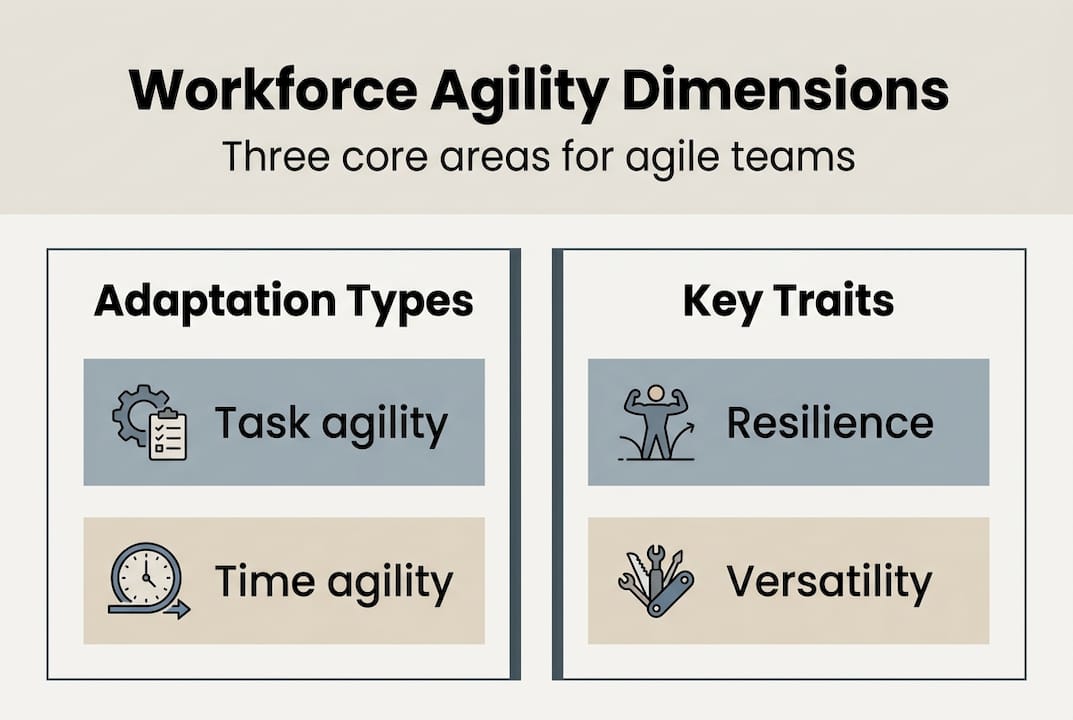
Understanding these dimensions changes how you hire and develop. When you measure only technical skills, you miss the behavioral patterns that predict whether someone will thrive when conditions change. That is why exploring organizational agility in HR matters so much, and it is where personality fit enters the picture.
| Factor | Traditional skills assessment | Personality-focused agility assessment |
|---|---|---|
| What it measures | Technical ability, past performance | Behavioral traits, adaptability, fit |
| Predicts turnover | Weakly | More reliably |
| Identifies culture fit | Rarely | Consistently |
| Supports team shifts | Limited | Strong |
| Long-term value | Decreases as skills evolve | Remains stable over time |
⚡️ Signs your agility strategy is underperforming:
- Turnover spikes after major org changes
- High performers in stable roles struggle when responsibilities shift
- Team culture fragments during growth phases
- New hires meet skill requirements but clash with team dynamics
- Managers report poor collaboration despite strong individual output
“Workforce agility drivers show a partial mediation effect (VAF between 35% and 60%) on team performance, meaning agility is a real, measurable contributor, not just a soft concept.”
Building strong agility-building strategies requires that you measure personality alongside skill, not instead of it. The combination gives you data that actually predicts how someone performs when things get hard.
Preparing for agility: Mapping roles to adaptable personalities
Understanding workforce agility is only valuable if you know how to align roles with the right personalities. Personality traits are not just interesting data points. They are behavioral blueprints. Certain traits consistently predict how someone will perform in dynamic, high-pressure, or collaborative environments.
Research confirms that personality-job fit is crucial, with high neuroticism and low agreeableness specifically linked to higher turnover. This is exactly why a one-size-fits-all job description does not hold up. A project manager who scores low on conscientiousness will struggle to keep shifting timelines under control. A sales rep high in introversion may close deals in one-on-one settings but falter in fast-moving team environments.

| Role | Key personality traits for agility |
|---|---|
| Project manager | High conscientiousness, moderate openness |
| Sales representative | High extraversion, high resilience |
| HR business partner | High agreeableness, high adaptability |
| Product developer | High openness, moderate neuroticism |
| Operations lead | High conscientiousness, low neuroticism |
Learning how to do a solid job fit analysis gives your team a real edge when making placement and promotion decisions. Here is a practical way to create a personality-agility map for your organization:
- Audit your current roles. List every position and identify the three to five behaviors most critical to success under pressure.
- Define the ideal personality range. Use Big Five traits or a validated psychometric model to describe the personality profile that matches those behaviors.
- Assess your current team. Run personality assessments for employees in those roles and compare results to the profile.
- Identify gaps. Flag mismatches between current personality profiles and role demands.
- Prioritize placements. Shift or support team members based on where their personalities align best.
Making sure you understand job fit at a personality level is what separates reactive HR from strategic workforce planning.
Pro Tip: Use anonymized personality profiles when comparing candidates or internal employees. This reduces unconscious bias and keeps decisions grounded in behavioral data rather than personal impressions.
Assessing for agility: Tools, tests, and best practices
Now you are ready to assess for agility. Let’s focus on tools and smart practices HR teams should use. Assessment is where the strategy becomes real, and it is also where most HR teams make avoidable mistakes.
📈 Leading assessment tools and methods for workforce agility:
- Big Five personality inventories (NEO-PI-R, BFI)
- Situational judgment tests that simulate high-pressure decisions
- Behavioral event interviews structured around agility scenarios
- 360-degree feedback combined with self-reports
- Integrated platforms that merge psychometric data with AI analysis
Selecting the right tool depends on your team size, role diversity, and budget. A single psychometric test rarely gives the full picture. What works best is a layered approach, where you combine self-reports with structured manager input to build a rounded view of each employee.
Research highlights that power skills like adaptability and resilience are the core of building real agility, and these traits show up most reliably in behavioral assessments, not resume reviews.
Here is a streamlined workflow for running an agility assessment:
- Define the assessment goal. Are you hiring for a specific role, planning a team restructure, or running a retention audit?
- Select your tool stack. Match tools to goal: use personality assessments for hiring and 360 feedback for development.
- Communicate clearly with participants. People perform more honestly when they understand the purpose and feel psychologically safe.
- Run the assessment. Collect data across personality, behavioral scenarios, and peer input.
- Analyze for agility markers. Look specifically at resilience, adaptability, and collaboration scores.
- Take action. Use results to guide placement decisions, coaching plans, or team design changes.
For teams in fast-moving sectors, job fit analysis for tech shows how this workflow plays out in practice. You can also review agility dimensions research for a deeper look at the science behind the framework.
Pro Tip: Combine self-reports with peer and manager input for a rounded view. Self-assessments reveal how people see themselves. Manager input reveals how they actually show up under pressure. Together, they produce far more reliable insights.
Verifying and sustaining workforce agility gains
Assessment is not a one-and-done process. Agility thrives on ongoing adjustment. Once you have your initial data, the next step is building a system that keeps improving over time.
💡 Metrics to track for sustained agility:
- Employee retention rates by department and role
- Speed-to-role transition when team members shift positions
- Manager-reported adaptability scores during review cycles
- Team performance data before and after org changes
- Engagement survey results tied to role fit satisfaction
Each of these tells you something different. Retention shows you whether people are staying. Speed-to-transition tells you how fast they adapt when conditions change. Adaptability scores reveal how employees are showing up emotionally and behaviorally. Tracking all of them together gives you a real view of agility health.
Research confirms that self-correcting feedback and stable teams are vital for maintaining agility over time. This means your measurement system must loop back into action. Data without response is just noise.
“Agility is not achieved in one assessment cycle. It is built through consistent feedback loops, small team adjustments, and a willingness to act on what the data reveals.”
One of the most underused tools in HR is personality-based engagement tracking. When you know a team member’s personality profile, you can predict engagement dips before they become resignation letters.
Pro Tip: Set a quarterly agility review cadence. At each review, compare current metrics against your baseline, identify any new mismatches, and make small shifts before problems compound. Iteration beats reinvention every time.
Why agility improvements stall: What most HR teams miss
Stepping back, most guides miss some critical truths, and here is what experience shows. Most HR teams that invest in agility initiatives see early wins, then plateau. They upgrade their hiring process, run a round of assessments, and wait for transformation. It rarely comes on its own.
The core issue is that HR keeps treating agility as a hiring problem. In reality, it is a continuous team design problem. You cannot hire your way to an agile workforce if the team structure itself resists change.
Real agility gains come from micro-shifts. Moving one person to a better-fit role. Restructuring a small team around complementary personalities. Running a pilot with a single department before scaling. These small moves, done consistently, build the muscle that large rollouts never do.
“Lasting agility is a product of culture, not just assessment results.”
We also see teams skip the most powerful lever: shifting team members for retention. Internal mobility based on personality fit outperforms external hiring in both cost and speed. Yet most organizations do not build a structured path for it. Start small, iterate fast, and measure what changes. That is where the real gains are.
Leverage the best tools for long-term agility and retention
Ready to put these insights to work for your team? Here is how you get started.
Sparkly HR is built for exactly this challenge. We merge psychometric assessments, AI analysis, human judgment, and Human Design to produce the kind of personality insights that predict real-world performance, not just test scores. Our platform helps you assess, map, and shift your team members based on personality fit, so agility becomes a system, not a one-time event.
Explore our personality-focused strategies to see how HR teams are using personality data to reduce turnover and move faster. Check out our team optimization strategies for practical playbooks your team can implement right now. And discover how SaaS in HR solutions is changing the way organizations think about workforce potential.
Frequently asked questions
What are the three main dimensions of workforce agility?
Task, time, and resilience are the three core dimensions, with each one contributing positively to overall team performance and adaptability.
How does personality-job fit impact turnover?
Poor personality-job fit raises turnover risk significantly, especially when employees score high in neuroticism or low in agreeableness relative to their role’s demands.
Which power skills are most important for workforce agility?
Adaptability, resilience, and cultural versatility are the top power skills for building and sustaining agility across teams and functions.
How often should HR assess workforce agility for best results?
HR should reassess agility at least quarterly, giving teams enough time to show behavioral change while catching mismatches before they become turnover events.