How to improve team performance with personality strategies

TL;DR:
- Conscientiousness and agreeableness are key predictors of high team performance.
- Valid Big Five assessments offer more reliable insights than MBTI or DISC.
- Ongoing personality evaluation and team adjustments optimize long-term team effectiveness.
Most HR managers know their teams are capable of more. The frustrating part is not knowing exactly what is holding them back. Guessing at team fit, relying on gut instinct, or using outdated tools can quietly cost organizations thousands in lost productivity and turnover. Conscientiousness and agreeableness are proven predictors of higher team performance, yet most companies still skip personality science entirely. This article walks you through the frameworks, tools, and real-world steps to close that gap, from choosing the right assessments to embedding personality data into your daily workflows and measuring what actually changes.
Table of Contents
- Understand the science behind personality and team performance
- Choose the right tools: selecting and interpreting personality assessments
- Integrate personality data into team structures and workflows
- Monitor progress and troubleshoot common pitfalls
- Why conventional team-building misses the mark—and what actually works
- Elevate your team performance with smarter HR solutions
- Frequently asked questions
Key Takeaways
| Point | Details |
|---|---|
| Evidence-based approach | Choose scientifically validated tools like the Big Five for reliable team assessment results. |
| Prioritize core traits | Focus on conscientiousness and agreeableness for maximal team performance impacts. |
| Integrate, don’t isolate | Blend assessment insights with continuous team process improvements for lasting gains. |
| Minimize trait variability | Build teams with consistent personality profiles to reduce friction and improve output. |
Understand the science behind personality and team performance
To build an effective improvement plan, you need to understand what drives team results at the psychological level. Not all personality traits are created equal when it comes to performance, and the research is surprisingly clear on which ones matter most.
Conscientiousness and agreeableness are the strongest predictors of higher team performance, while neuroticism consistently harms outcomes. Conscientious team members follow through, stay organized, and hold themselves accountable. Agreeable members collaborate well and reduce friction. Neurotic individuals, on the other hand, tend to create instability under pressure.
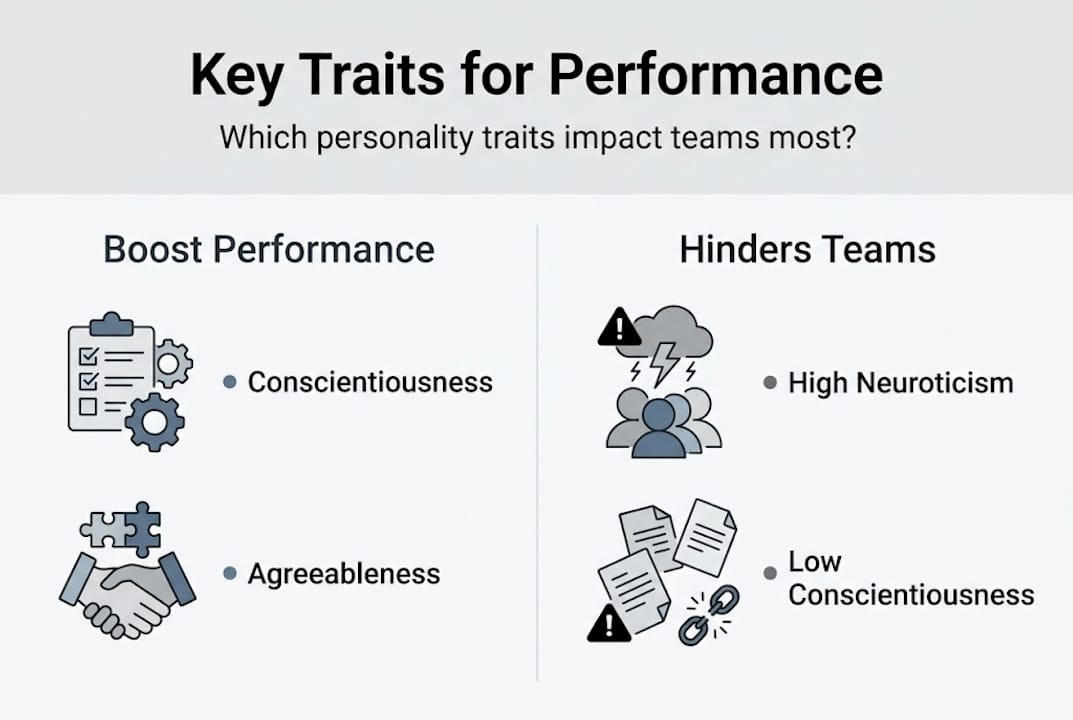
Here is a quick summary of how the Big Five traits connect to team outcomes:
| Trait | Effect on team performance |
|---|---|
| Conscientiousness | Strong positive impact |
| Agreeableness | Moderate positive impact |
| Openness | Situational, positive in creative roles |
| Extraversion | Mixed, depends on team structure |
| Neuroticism | Consistent negative impact |
One critical but often overlooked factor is trait variability. When team members have wildly different conscientiousness scores, for example, high performers often compensate for low performers. This creates resentment and inconsistency. Teams with more uniform trait profiles tend to outperform those with high variability, even if the average score looks similar.
So which assessment tools actually capture these traits reliably? Big Five tests are more scientifically valid and predictive than MBTI or DISC. MBTI, in particular, struggles with test-retest reliability, meaning people often get different results when retested weeks later. That is a serious problem if you are making team decisions based on those results.
For a broader view of your options, explore the HR assessment types that HR teams use today. You can also use a personality management checklist to make sure you are covering all the right bases before rolling out any new tool.
Pro Tip: Do not just assess individuals in isolation. Pull together a group personality profile for your whole team and look for patterns. Where are the gaps? Where is the variability highest? That is where your performance risk lives.
Processes like Six Sigma and Lean approaches work well alongside personality data because they give you a structured way to identify and eliminate the root causes of underperformance, not just the symptoms. Pair personality insights with process discipline and you get a much more complete picture. For more on this, check out these talent assessment tips that connect assessment data to team dynamics.
Choose the right tools: selecting and interpreting personality assessments
Once you are clear on which traits to prioritize, it is time to map out your assessment toolkit. The market is full of options, and not all of them deserve equal trust.
Here is a comparison of the most widely used tools:
| Assessment | Scientific validity | Best use case | Key limitation |
|---|---|---|---|
| Big Five (NEO-PI) | High | Predicting job performance | Can feel clinical or long |
| CliftonStrengths | Moderate | Strengths-based coaching | Does not measure risk traits |
| MBTI | Low to moderate | Team communication styles | Poor test-retest reliability |
| DISC | Low to moderate | Sales and communication | Limited predictive power |
Big Five tools are empirically stronger than MBTI or DISC for predicting actual job outcomes. That does not mean MBTI or DISC are useless. They can still spark useful conversations about communication preferences. But you should not use them as the foundation for hiring or team restructuring decisions.
This brings us to what we call the “broken ruler†mindset. Every self-report assessment has built-in bias. People answer based on how they see themselves, not always how they actually behave. That means you should treat test results as relative signals, not absolute truths. A high conscientiousness score is meaningful. But it is more meaningful when compared to the rest of the team and triangulated with other data points like manager observations or work output patterns.
Here is a step-by-step approach to vetting any new assessment tool before you roll it out:
- Check for published validity studies. Does the tool predict performance in peer-reviewed research?
- Test for reliability. Do scores stay consistent when people retake the assessment?
- Evaluate bias risk. Has the tool been tested across different demographic groups?
- Consider the user experience. Will your team actually complete it honestly, or will they rush through it?
- Plan for interpretation. Who will explain the results, and how will you prevent misuse?
“The goal is not to label people. It is to understand tendencies so you can design better teams and conversations around them.â€
For guidance on matching assessment choices to your hiring goals, see these hiring best practices for alignment. And if you want to go deeper on evaluating individual potential alongside personality, this potential evaluation guide is worth your time. 📈
Integrate personality data into team structures and workflows
Equipped with valid assessments, the next move is embedding these insights into your actual processes. Data sitting in a spreadsheet does not improve anything.
Here is a practical workflow for turning personality data into team action:
- Map your current team profile. Aggregate individual scores into a team-level view. Identify which traits are overrepresented and which are missing.
- Identify performance risk zones. Look for high variability in conscientiousness or agreeableness. These are your most likely sources of friction and inconsistency.
- Redesign roles around strengths. If someone scores low on conscientiousness but high on openness, they may thrive in an exploratory or creative role rather than a process-heavy one.
- Adjust team composition deliberately. Use member shifting for better dynamics to move people into roles where their natural tendencies are an asset, not a liability.
- Onboard new hires with team fit in mind. Share relevant team profile data with new members so they understand the group’s working style from day one.
- Review and recalibrate regularly. Personality data should feed into quarterly or biannual team reviews, not just a one-time hiring decision.
Trait variability within teams can harm performance, and high-consistency teams consistently outperform high-variability ones. This is why team composition is not a set-it-and-forget-it task. People grow, roles evolve, and team needs shift. For a structured approach to this, explore these team optimization strategies and the detailed shifting workflow steps that make realignment practical.

Pro Tip: Schedule a 30-minute personality calibration check-in every quarter. Review whether current role assignments still match each person’s profile, and flag any emerging friction before it becomes a retention problem.
The goal here is not to box people in. It is to reduce the guesswork so that your team structure reflects reality, not assumptions. When roles align with personality, people perform better and feel more engaged. That is a win for everyone. âš¡ï¸
Monitor progress and troubleshoot common pitfalls
To ensure long-term gains, consistent evaluation and course correction are a must. Personality-based team design is not a one-time project. It is an ongoing practice.
Start by tracking both leading and lagging indicators:
- Leading indicators: Engagement scores, peer feedback quality, frequency of missed deadlines, and collaboration patterns
- Lagging indicators: Quarterly productivity metrics, turnover rates, and project completion rates
- Qualitative signals: Manager observations, 1:1 conversation themes, and team retrospective feedback
One of the most common pitfalls is over-interpreting test results. Even scientifically sound assessments can be misused if treated as absolutes or over-relied upon. A single assessment score should never be the sole reason someone is moved, promoted, or passed over. Use it as one input among many.
Another frequent mistake is ignoring how team dynamics shift over time. A team that scored well on agreeableness six months ago may look very different after a reorg or a key departure. Recalibrate regularly.
Managing employee resistance is also real. Some team members will feel uncomfortable being assessed. Address this head-on by:
- Communicating the purpose clearly before any assessment is run
- Guaranteeing confidentiality of individual scores
- Framing results as development tools, not performance grades
- Involving team members in how insights are applied
For teams in technical environments, this guide on how to assess employee fit in tech teams offers practical tactics for managing resistance and improving adoption. 💡
When you track the right signals and stay honest about what the data can and cannot tell you, personality-based team management becomes a genuine competitive advantage.
Why conventional team-building misses the mark—and what actually works
Here is an uncomfortable truth most HR consultants will not say out loud: most team-building efforts are built on the wrong foundation. Organizations spend enormous energy matching people by skills, interests, or job titles. They run a workshop, do a DISC debrief, and call it done. Then they wonder why nothing really changes six months later.
The real problem is that skills and interests are surface-level signals. Personality traits are the underlying engine. You can teach someone a new software tool in a week. You cannot teach someone to be conscientious or agreeable in a meaningful, lasting way. That is why we believe personality should come first in team design, not as an afterthought.
What actually moves the needle is combining valid personality data with continuous process improvement. Think of it like the discipline behind talent assessment tips that treat team design as an iterative system, not a one-time event. Measure, adjust, measure again. The teams that improve the most are not the ones with the best initial assessment scores. They are the ones with HR managers who keep recalibrating based on real data.
One-off assessments feel productive but rarely produce lasting change. Ongoing measurement and honest team adjustment do.
Elevate your team performance with smarter HR solutions
You now have a clear picture of what drives team performance at the personality level and how to act on it. The next step is putting the right tools in place to make this process sustainable.
At Sparkly, we built our platform specifically for HR managers who want to move beyond guesswork. We merge personality assessments, Human Design, AI insights, and human judgment to give you higher-probability data for every team decision. Whether you are looking to assess employees effectively, explore proven team optimization strategies, or find the top SaaS solutions for talent evaluation, Sparkly gives you the structure to act with confidence. Your team’s potential is already there. Let us help you see it clearly.
Frequently asked questions
Which personality trait should be the highest priority for team performance?
Conscientiousness is the top trait for team results, with agreeableness also playing a strong positive role. Prioritize both when evaluating team composition.
Why should HR favor Big Five over MBTI for assessments?
Big Five is more predictive and reliable than MBTI, which has well-documented test-retest reliability issues that make it a weak foundation for team decisions.
How often should team personality assessments be repeated?
Annually or after major organizational changes is a solid baseline. Quarterly calibration check-ins help you catch drift before it becomes a performance problem.
What is trait variability and why does it matter?
Trait variability is the spread of personality scores across a team. High variability hurts teams because inconsistent traits create friction and uneven workload distribution, even when average scores look acceptable.