
Improve employee performance metrics: better hiring in 2026

TL;DR:
- Traditional employee metrics focus on output, while modern metrics include engagement and collaboration.
- Effective performance measurement requires clear goals, employee involvement, regular feedback, and focused metrics.
- Transparency, co-creation, and aligning metrics with growth prevent gaming and improve retention.
Most companies believe they’re measuring performance. They’re tracking hours, hitting quotas, running annual reviews. Yet only 2% of CHROs say traditional performance management actually inspires better performance. That gap between effort and outcome is costing you real talent and real money. The good news? A smarter approach to employee performance metrics can directly sharpen your hiring criteria, flag flight risks early, and cut turnover before it becomes a crisis. This guide walks through what metrics actually work, how to measure them without creating a surveillance culture, and how to connect them to every stage of the employee lifecycle.
Table of Contents
- What are employee performance metrics?
- How to measure performance effectively
- Pitfalls and mistakes in employee performance measurement
- Integrating metrics into hiring and retention strategies
- A smarter approach: What most companies miss about performance metrics
- Explore innovative HR tools for smarter performance measurement
- Frequently asked questions
Key Takeaways
| Point | Details |
|---|---|
| Blend metric types | Use both quantitative and qualitative metrics to get a true picture of employee performance. |
| Avoid common pitfalls | Over-optimizing or using ambiguous goals can lead to turnover and disengagement. |
| Integrate metrics with HR strategy | Connect performance metrics with hiring and retention for better team outcomes. |
| Review and adjust regularly | Updating metrics frequently ensures they remain relevant and effective for your team. |
What are employee performance metrics?
Employee performance metrics are the quantifiable and qualitative signals you use to evaluate how well someone is doing their job, growing in their role, and contributing to team goals. They’re not just scorecards. Done right, they’re strategic tools that tell you where talent is thriving, where it’s stalling, and what your organization needs to do differently.
The difference between traditional and modern metrics is significant. Traditional approaches lean heavily on output numbers: sales figures, task completion rates, attendance records. Modern metrics go deeper. They factor in engagement, collaboration quality, learning velocity, and even how a person’s role clarity affects their day-to-day motivation.
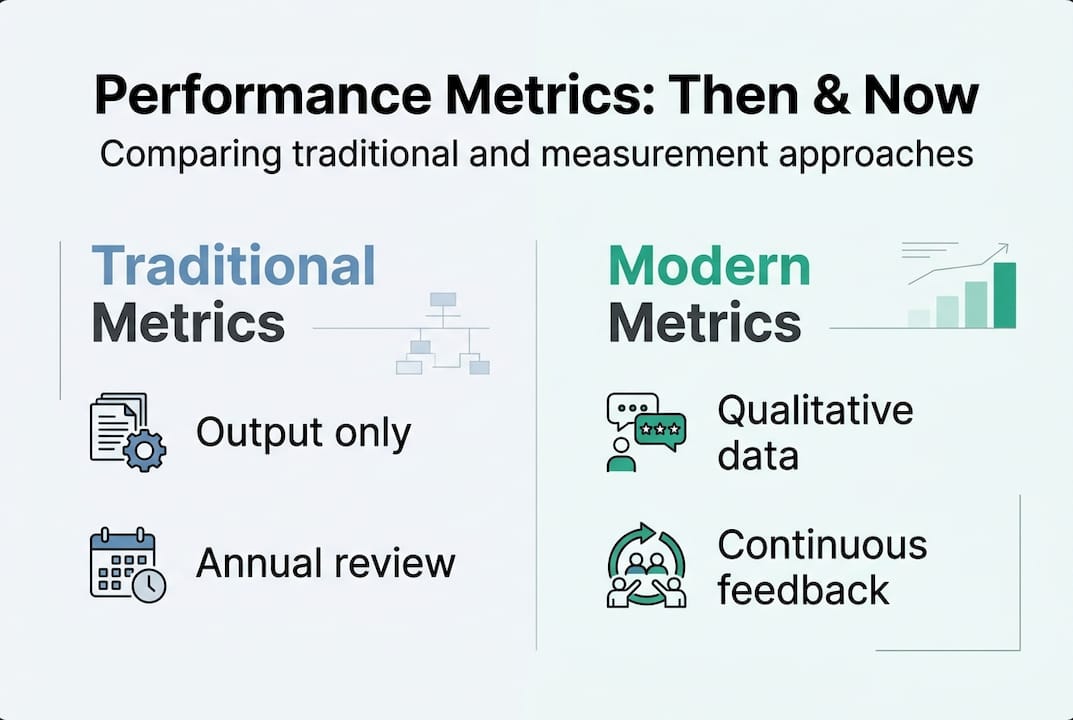
Here’s a quick look at both worlds:
| Traditional metrics | Modern metrics |
|---|---|
| Attendance and punctuality | Engagement scores |
| Task completion rate | 360-degree feedback |
| Sales or output volume | Goal achievement rate |
| Error rate | Collaboration quality |
| Annual review scores | Continuous feedback loops |
The most commonly tracked metrics today include:
- Goal achievement rate: Are employees hitting the targets set with their managers?
- Engagement scores: How connected and motivated does someone feel at work?
- 360-degree feedback: Peer, manager, and self-assessment combined for a fuller picture
- Error rate: Quality of output relative to volume
- Productivity efficiency: Output per hour or per resource invested
- Customer satisfaction scores: Especially relevant for client-facing roles
- Collaboration indicators: Participation in cross-functional projects, peer ratings
Why does this matter strategically? Because companies focused on performance are 4.2x more likely to outperform their peers. And teams with low engagement show 18 to 43% higher turnover rates. Those aren’t small margins. They represent real hiring costs, lost institutional knowledge, and disrupted team momentum.
📈 The key insight here is that blending quantitative and qualitative data gives you a far more accurate picture than either alone. Reviewing your employee engagement checklist alongside hard output data, for example, helps you spot disengagement before someone hands in their notice. Pairing that with the right HR team management tools makes the whole system easier to sustain.
How to measure performance effectively
Knowing what to measure is only half the battle. The real challenge is building a measurement system that’s fair, transparent, and actually useful for decision-making. Here’s a step-by-step process that works:
- Identify business-aligned goals. Start with what the organization needs to achieve, then work backward to what each role must contribute.
- Select meaningful metrics. Choose metrics that reflect real performance, not just what’s easy to count. Relevance to the role matters enormously.
- Co-create with employees. When people help define their own success criteria, they’re far more invested in meeting them.
- Set short review cycles. Monthly or quarterly check-ins beat annual reviews every time. Continuous feedback keeps performance on track rather than waiting for a year-end surprise.
- Document and report consistently. Use a repeatable format so managers and employees can track progress over time without reinventing the wheel each cycle.
For the math side of things, simple formulas go a long way. Goal completion rate = (completed goals / assigned goals) x 100. Engagement scores can be averaged from pulse survey responses on a 1 to 10 scale. These don’t need to be complicated to be effective.
| Metric | Formula | Review frequency |
|---|---|---|
| Goal completion rate | Completed / assigned x 100 | Monthly |
| Engagement score | Average pulse survey rating | Quarterly |
| Error rate | Errors / total output x 100 | Monthly |
| 360-degree score | Average of all rater inputs | Bi-annually |
One finding that stands out: high-quality recognition built on five consistent pillars can reduce turnover by 45%. That’s not a minor perk. It’s a structural advantage.

Pro Tip: Limit each role to 5 to 10 core metrics. More than that and you dilute focus, overwhelm managers, and make it nearly impossible to have meaningful performance conversations. Use your employee development tools to map metrics to growth pathways, and lean on an employee potential evaluation guide to make sure you’re measuring growth, not just output.
Pitfalls and mistakes in employee performance measurement
Even well-intentioned metric systems can backfire. Here are the most common failure modes and how to spot them before they damage your culture.
Goodhart’s Law in action. When a measure becomes a target, it stops being a good measure. This is the core problem with over-optimization. Over-optimization leads to gaming the system, and ambiguous goals drive disengagement and turnover. The Wells Fargo scandal is a textbook case: employees opened millions of unauthorized accounts to hit sales targets. The metric was clear. The outcome was catastrophic.
Ambiguous goals. Vague expectations are one of the biggest hidden drivers of disengagement. Consider this:
“Only 47% of employees strongly agree they know what’s expected of them at work.†— Gallup
That means more than half your workforce may be working without a clear target. No metric system fixes that if the underlying goals aren’t communicated well.
Productivity surveillance. Tracking keystrokes, monitoring screen time, or flagging idle minutes creates a culture of distrust. It shifts focus from outcomes to optics. People start performing for the camera rather than for the customer.
Here are the most common mistakes to watch for:
- Setting metrics without employee input
- Using annual-only reviews with no interim feedback
- Measuring activity instead of impact
- Applying the same metrics across wildly different roles
- Using performance data to punish rather than coach
Pro Tip: Personalize OKRs (Objectives and Key Results) to each role rather than applying a company-wide template. Review and update them at least quarterly. This keeps targets fresh and discourages gaming.
The fix for most of these pitfalls is transparency and co-creation. When employees understand why a metric exists and helped shape it, they’re far less likely to game it. Pairing that with strong talent retention strategies and data-driven talent management gives you a system that’s both rigorous and human. And revisiting your hiring process best practices ensures you’re bringing in people who are set up to succeed within your metric framework from day one.
Integrating metrics into hiring and retention strategies
Performance metrics shouldn’t live only in the review cycle. The most forward-thinking HR teams connect them to every stage of the employee lifecycle, starting with hiring.
Here’s how to build that connection:
- Map metrics to hiring criteria. If collaboration quality is a key performance indicator for a role, build interview questions and assessments that evaluate collaborative tendencies before someone joins.
- Use onboarding goals as early metrics. Set 30, 60, and 90-day targets that mirror the long-term performance framework. This gives new hires clarity and gives you early signals.
- Flag flight risks early. Drops in engagement scores, missed goals, or declining 360-degree feedback are often leading indicators of someone considering leaving. Act on them early.
- Spot high-potential hires. Consistent overperformance on qualitative metrics, especially collaboration and learning velocity, often predicts future leaders better than output numbers alone.
- Close the feedback loop. Connect exit interview data back to your metric system. If people consistently cite unclear expectations as a reason for leaving, that’s a metric design problem.
âš¡ï¸ One statistic worth building your entire manager training around: 70% of the variance in team engagement is driven by manager effectiveness. Metrics that assess manager behavior, not just employee output, are one of the most underused levers in HR.
A few practical integration tips:
- Co-create metrics with new hires during onboarding, not after
- Communicate the purpose of every metric clearly and honestly
- Use metrics for coaching conversations, not performance punishment
- Review your metric framework at least twice a year
Aligning metrics to business and human outcomes with continuous feedback directly improves retention. Your employee potential checklist is a great starting point for building that alignment across your team.
A smarter approach: What most companies miss about performance metrics
Here’s something most metric guides won’t tell you: the system itself is rarely the problem. The problem is what surrounds it.
We’ve seen organizations invest heavily in performance dashboards and still watch turnover climb. Why? Because metrics without transparency are just surveillance with better branding. And metrics without growth focus become a ceiling instead of a ladder.
The companies that get this right share a few traits. They treat metrics as a conversation starter, not a verdict. They review them jointly with employees, not just in manager-only meetings. And they build them around potential, not just past performance.
Most leaders rely on surface-level analytics or the latest HR technology, assuming the tool will do the heavy lifting. But culture and job clarity are far bigger drivers of performance than any dashboard. Co-creating metrics with your teams, rather than handing them down from the top, builds genuine buy-in. People protect what they helped build.
The real shift is this: metrics should empower people to grow, not give managers ammunition for discipline. When you approach potential-driven evaluations with that mindset, performance data becomes something employees actually want to engage with. 💡
Explore innovative HR tools for smarter performance measurement
If you’re ready to move beyond outdated reviews and build a performance system that actually drives results, Sparkly is designed for exactly that.

Sparkly’s approach goes deeper than skills. We assess personality first, because skills can be learned but personality shapes how someone performs, collaborates, and grows over time. By merging human insight, AI, psychometric assessments, and Human Design, Sparkly gives HR teams higher-probability data they can actually use in interviews and team decisions. Explore how SaaS in HR for employee potential can reshape your approach, browse our top talent evaluation tools, or start with our employee fit assessment guide to see where your current system has gaps.
Frequently asked questions
What are the most effective employee performance metrics for reducing turnover?
Engagement scores, goal clarity, and regular feedback most consistently predict and reduce employee turnover. These metrics surface dissatisfaction early, giving managers time to intervene before someone decides to leave.
How often should performance metrics be reviewed?
Short cycles and continuous feedback outperform annual reviews in both accuracy and impact. Quarterly or monthly check-ins keep performance conversations relevant and actionable.
How do you prevent employees from gaming performance metrics?
Blend qualitative and quantitative data, update targets regularly, and co-create goals with employees. Goodhart’s Law shows that people game metrics when those metrics become the sole focus, so transparent processes and mixed data sources reduce that risk.
How many performance metrics should we use per role?
Limit to 5 to 10 core metrics per role, developed with input from the employee. Fewer, better-chosen metrics lead to more focused conversations and fairer evaluations than sprawling scorecards.