
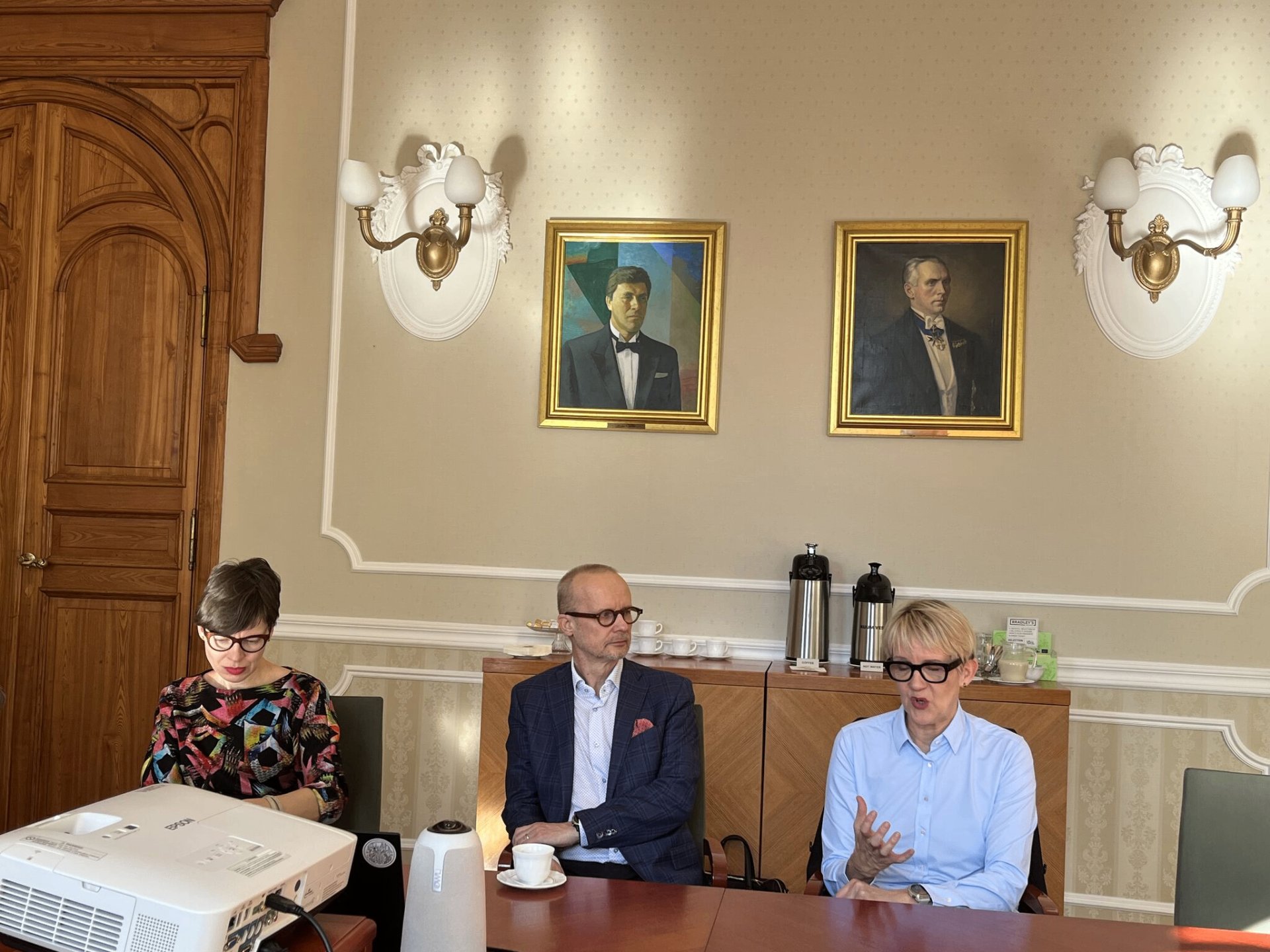
Age-based hiring and sex-based hiring are, fundamentally, discrimination. Most HR leaders agree with that sentence in the abstract — and then, at a recent Rise and Shine! breakfast hosted by the Estonian Chamber of Commerce and Industry with Reetta Rajala and Piret Potisepp, we heard just how deeply the bias is still wired into our day-to-day decisions. Regardless of age, sex or nationality, it shapes who gets shortlisted, who gets promoted, and who quietly gets pushed out.
“The bias has rooted deep in our daily thinking — no matter the age, sex or nationality of the person making the decision.”
The 55+ workforce is not a problem to be solved
Across Europe, demographics make this conversation unavoidable. Estonia is no exception: the share of 55+ professionals in the labour market is growing every year, and the cost of pushing them aside — through subtle exclusion, unspoken role design or "we needed fresher energy" justifications — is no longer something organisations can absorb.
The framing matters. The 55+ cohort is not a problem to be solved or a charity case to be tolerated. It is a deep pool of judgement, networks, calm under pressure, and pattern recognition that younger teams literally cannot replicate yet — by definition.
Where bias actually hides
The breakfast surfaced something we see every week in our HR work: bias rarely shows up as an openly hostile statement. It hides inside small, "reasonable-sounding" sentences:
- "We need someone with high energy for this team."
- "We're looking for a digital native."
- "Cultural fit might be tricky."
- "They're probably overqualified."
- "We want someone who'll grow with us for the next 10 years."
None of these sentences mention age. All of them, in practice, can quietly filter out the 55+ candidate before the conversation even begins. The same mechanism — different words — quietly filters out women returning from parental leave, candidates with non-Estonian names, and very young candidates whose CVs do not yet "look the part".
Production year vs. capability
One phrase from the breakfast has stayed with us: stop treating people as if they had a production year. A person is not a car model. The relevant question is not "when were they made" but "what can this person do for this team and this organisation, in this environment, right now."
This is exactly where Sparkly's work begins. We help hiring managers and HR leaders look past the production year and uncover the hidden superpowers and personality strengths a person actually brings. Not "are they 28 or 58", but: how do they think under pressure, what energises them, where do they hold the room, and where do they need a complementary teammate next to them.
Respect is the operating system
Reetta Rajala spoke about respect as an operating principle, not a soft value. Respect, in practice, means:
- Designing roles around what a person can contribute, not what we assume they can no longer do.
- Asking 55+ professionals what kind of work gives them energy now — and listening when the answer is different from what it was at 35.
- Separating physical capability from cognitive capability from motivational fit. Lumping them together is where most age-bias errors are born.
- Building career paths that allow people to stay longer at work in roles that match where they are in life — mentoring, advisory, depth specialisation — rather than forcing a binary "still climbing or already gone".
Physical, cognitive, motivational — three different conversations
One of the most useful distinctions raised at the breakfast was that "55+" is not a single profile. The conversation has at least three layers, and conflating them is what produces bad decisions:
- Physical capability — relevant for a narrow set of roles, and even there it varies enormously between individuals. Default assumptions are almost always wrong.
- Cognitive capability — research is clear: crystallised intelligence, judgement and pattern recognition continue to grow well into late career. Speed of raw recall changes; quality of thinking does not collapse.
- Motivation and life stage — what a person wants from work at 58 is often genuinely different from what they wanted at 32. Not less. Different. Role design has to follow.
Staying longer at work — by choice, not by force
Pension reforms across Europe are pushing the formal retirement age upward. That is a policy lever, not a workforce strategy. The real workforce question is whether people want to stay longer — and the answer depends almost entirely on whether the work still gives them energy.
This is the same control question we apply to every hire and every existing employee: at the end of the day, are you drained or are you energised? If a 58-year-old senior is drained, the answer is not "they are too old" — the answer is the role no longer fits. Redesign the role and you often get another 10 high-quality years from the same person. Refuse to redesign and you lose the person — and the institutional memory walks out with them.
What HR leaders and hiring managers can do this quarter
- Audit your last 20 rejected candidates. How many were 55+? How many of the rejection reasons would survive being read out loud in a public room?
- Rewrite three role descriptions. Replace age-coded language ("digital native", "high-energy", "10-year horizon") with capability-coded language ("able to debug a complex stakeholder situation in one meeting").
- Add the energy question to every internal review, regardless of age: "What part of your role energises you, and what part drains you?" Use the answers to redesign work, not to push people out.
- Separate the three layers — physical, cognitive, motivational — explicitly when discussing any 55+ hire. Make the team name the layer they are actually worried about.
In closing
Thank you to the Estonian Chamber of Commerce and Industry, to Reetta Rajala, and to Piret Potisepp for hosting a conversation that managed to be both calm and uncompromising. Bias against the 55+ workforce — and against the very young, and against women returning to work, and against non-Estonian names — is not solved by a single training session. It is solved by changing the questions we ask in every role description, every shortlist meeting and every performance review.
The deeper we dig into this, the more we see how much can be done better — and how often the answer is not "hire differently" but "look at people differently". That is the work Sparkly is built for.