Replacing an employee who leaves within their first year can cost your organization up to 30% of their annual salary, yet many HR teams still struggle to assess candidate potential accurately before making offers. The challenge lies not just in evaluating current skills but in predicting future performance, cultural fit, and readiness for growth. This guide reveals how innovative personality assessment frameworks, particularly the Performance–Potential–Readiness model, combined with advanced testing methods that resist candidate faking, can dramatically improve your hiring precision and slash early turnover rates. You will learn which personality traits predict success, how to overcome validity challenges in high-stakes testing, and actionable steps to implement these insights in your 2026 talent strategy.
Table of Contents
- Understanding The Performance-Potential-Readiness (P–P–R) Model
- How Personality Traits Impact Candidate Potential And Job Performance
- Challenges In Personality Assessment Validity And How To Improve Accuracy
- Applying Candidate Potential Assessments To Reduce Turnover And Optimize Hiring In 2026
- Enhance Hiring Success With Innovative HR SaaS Solutions
- Frequently Asked Questions
Key takeaways
| Point | Details |
|---|---|
| P–P–R model provides three-dimensional assessment | Evaluates performance, potential, and readiness timing to match candidates with roles precisely |
| Five personality traits strongly predict job success | Extraversion, conscientiousness, agreeableness, openness, and emotional stability correlate with better performance |
| High-stakes testing reduces personality assessment validity | Candidate faking in job applications significantly lowers test accuracy compared to low-stakes contexts |
| Advanced test formats mitigate faking effects | Forced-choice designs and gamified assessments resist manipulation better than traditional questionnaires |
| Personality-role alignment reduces turnover costs | Matching candidate profiles with job requirements boosts engagement and retention rates |
Understanding the performance-potential-readiness (P–P–R) model
The Performance–Potential–Readiness model transforms how organizations evaluate candidates by adding a critical third dimension to traditional assessment approaches. Where older frameworks measured only current performance or vague future potential, P–P–R distinguishes between someone who could excel in a role eventually versus someone ready to step in immediately. This precision matters enormously when you need to fill leadership positions or specialized roles where timing impacts team productivity.
Large enterprises have adopted P–P–R over the past two decades specifically to improve succession planning and reduce the risk of costly appointment failures. The model creates a clear three-dimensional visualization: performance captures current results and competencies, potential assesses capacity for growth and complexity, and readiness indicates how soon someone can transition successfully. This framework gives you actionable guidance rather than abstract ratings.
Implementing P–P–R in your hiring process means evaluating each candidate across all three axes simultaneously. You might discover a high-potential candidate who needs six months of development before promotion, allowing you to plan onboarding and training strategically. Alternatively, you identify someone with moderate potential but immediate readiness who can solve urgent staffing needs. Check out this employee potential checklist for 2026 to integrate P–P–R into your evaluation workflows.
P–P–R assessment dimensions:
- Performance: Demonstrated results, skill execution, and current role effectiveness
- Potential: Capacity for increased responsibility, adaptability, and learning agility
- Readiness: Timeline for successful transition into target role or level
| Dimension | Low | Medium | High |
| — | — | — |
| Performance | Struggles with current role | Meets expectations consistently | Exceeds targets regularly |
| Potential | Limited growth capacity | Can handle one level up | Ready for multiple advancement levels |
| Readiness | Needs 18+ months development | Ready in 6-12 months | Can transition immediately |
Pro Tip: Map your current team members on a P–P–R grid quarterly to identify succession gaps before they become urgent hiring crises.
How personality traits impact candidate potential and job performance
Research consistently demonstrates that five personality traits significantly impact performance: extraversion, conscientiousness, agreeableness, openness to experience, and emotional stability. These traits predict success across task execution, adaptive problem-solving, and contextual performance like teamwork and organizational citizenship. Understanding which traits align with specific roles in your organization allows you to screen candidates more effectively than relying solely on resume credentials or interview impressions.

Conscientiousness stands out as particularly predictive because it correlates with reliability, attention to detail, and goal persistence. Employees high in conscientiousness complete projects thoroughly and meet deadlines consistently. Extraversion benefits roles requiring collaboration, client interaction, or team leadership. Openness to experience predicts innovation capacity and willingness to learn new systems, making it valuable for rapidly evolving industries or organizations undergoing transformation.
Conversely, neuroticism shows persistent negative correlation with performance outcomes across studies. High neuroticism links to stress reactivity, emotional volatility, and difficulty managing workplace pressure. While everyone experiences stress, candidates with lower neuroticism handle setbacks more constructively and maintain productivity during challenging periods. This insight helps you identify potential retention risks early.
Integrating personality assessment into your hiring process yields measurable benefits beyond gut-feel interviews. When you match candidate personality profiles with role requirements and team dynamics, you increase engagement, reduce conflict, and improve retention rates. Explore these personality-focused assessment strategies to build a systematic evaluation framework.
“Companies ought to use personality tests in their hiring, team-building, and performance-management plans to optimize workforce effectiveness and reduce turnover costs.”
Key personality traits and their workplace impact:
- Extraversion: Energizes team collaboration, client relationships, and leadership presence
- Conscientiousness: Drives task completion, quality standards, and deadline adherence
- Agreeableness: Facilitates cooperation, conflict resolution, and supportive team culture
- Openness: Fuels innovation, learning agility, and adaptation to change
- Emotional Stability: Enables stress management, consistent performance, and resilience
Challenges in personality assessment validity and how to improve accuracy
The effectiveness of personality tests drops significantly in high-stakes hiring contexts because candidates often present idealized versions of themselves. Validity is significantly lower in high-stakes settings compared to low-stakes research contexts where respondents have no incentive to manipulate results. When a job offer depends on assessment outcomes, many candidates consciously or unconsciously adjust their responses to match perceived ideal profiles.
This faking behavior creates serious problems for HR teams trying to make data-driven hiring decisions. Faking in high-stakes assessments attenuates validity enough that poorly designed tests may provide little more insight than random selection. The challenge intensifies because detecting faking through traditional means like lie scales produces high false-positive rates, potentially eliminating honest candidates who happen to score unusually.
Fortunately, innovative test designs offer solutions. Forced-choice formats, where candidates must select between equally desirable options, make faking substantially harder because there is no obvious “right” answer. Gamified assessments that measure personality through behavioral tasks rather than self-report questions bypass conscious manipulation entirely. These advanced formats maintain better validity in high-stakes contexts while often providing better candidate experience than lengthy questionnaires.
Your organization should evaluate assessment tools based on their resistance to faking and validation in hiring contexts specifically. Review this talent management checklist to ensure your personality assessments meet current validity standards.
| Test Format | Faking Resistance | Candidate Experience | Implementation Complexity |
|---|---|---|---|
| Traditional Questionnaire | Low | Familiar but tedious | Simple |
| Forced-Choice | High | Moderately engaging | Moderate |
| Gamified Assessment | Very High | Highly engaging | Complex |
| Situational Judgment | Moderate | Realistic and relevant | Moderate |
Pro Tip: Combine multiple assessment methods rather than relying on a single test format to triangulate personality insights and reduce the impact of faking on any individual measure.
Steps to improve personality assessment accuracy:
- Select tests specifically validated for high-stakes employment settings, not research contexts
- Implement forced-choice or gamified formats that resist conscious manipulation
- Use response pattern analysis to flag inconsistent or extreme responding
- Combine personality data with structured interviews and work samples for holistic evaluation
- Track assessment results against actual job performance to validate predictive accuracy over time
Applying candidate potential assessments to reduce turnover and optimize hiring in 2026
Transforming assessment insights into hiring improvements requires systematic integration of personality data with your existing talent processes. Start by mapping which personality profiles succeed in each role category within your organization. Analyze your top performers to identify common trait patterns, then use those profiles as benchmarks when evaluating candidates. This evidence-based approach replaces subjective hiring decisions with data-driven predictions.
Large enterprises have adopted P–P–R to improve succession decisions and reduce appointment risk precisely because it combines personality insights with performance data and readiness timing. Your implementation should follow a similar integration strategy. Evaluate candidates on personality fit first to screen for fundamental compatibility, then assess performance capabilities and readiness for the specific role level and transition timeline.
Selecting the right assessment technology matters enormously for execution success. Modern SaaS platforms automate scoring, generate comparison reports, and integrate with applicant tracking systems to streamline workflows. Prioritize tools offering validated assessments, clear interpretation guidance for hiring managers, and candidate-friendly interfaces that enhance your employer brand. Poor user experience on assessments can deter top talent from completing your hiring process.
Tracking outcomes completes the improvement cycle. Monitor which personality profiles correlate with longer tenure, higher performance ratings, and faster productivity ramps in your specific organization. Use this data to continuously refine your ideal candidate profiles and assessment cutoff scores. Over time, you build proprietary insights about what predicts success in your unique culture and business model. Explore this employee fit assessment guide for 2026 for detailed implementation frameworks.
Implementation roadmap for personality-driven hiring:
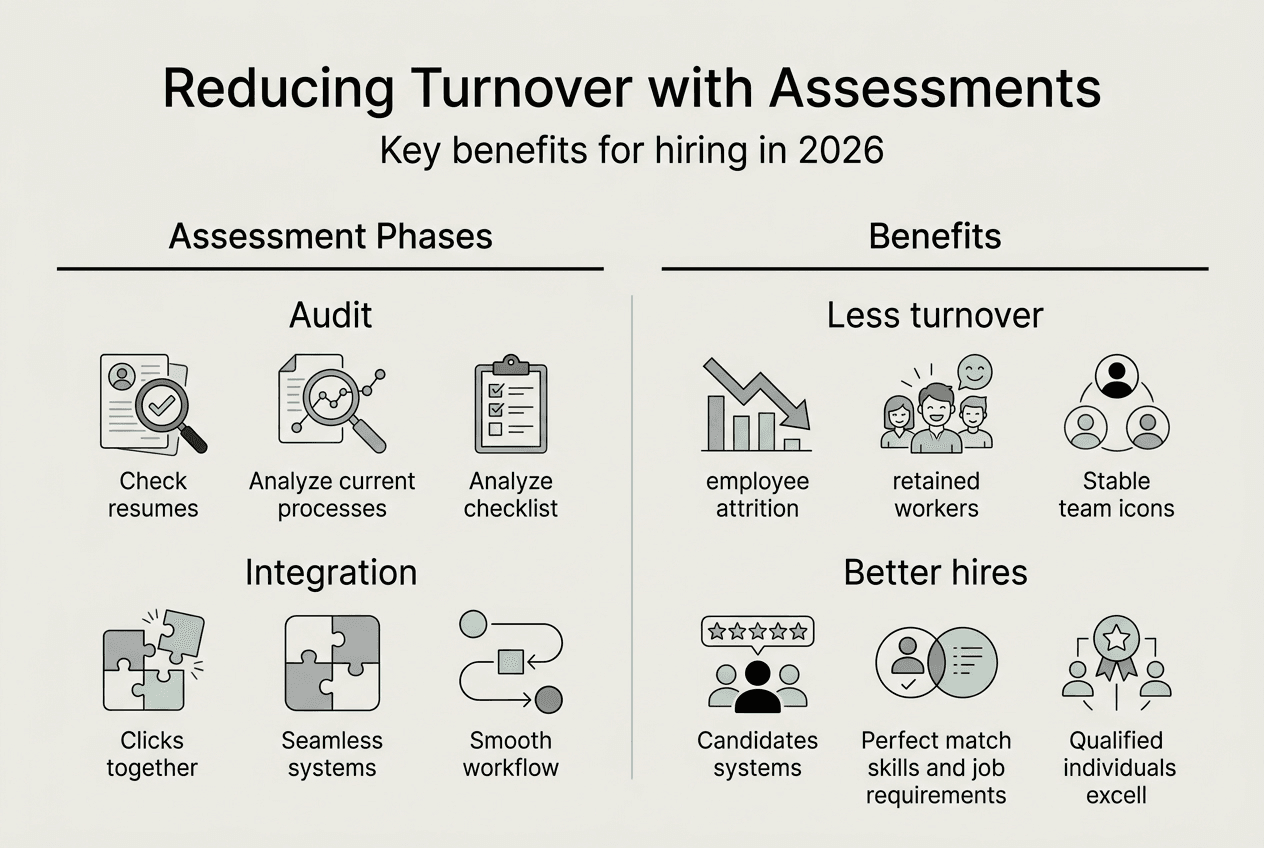
- Audit current assessment practices to identify gaps in personality evaluation and validity
- Select validated assessment tools with strong faking resistance and candidate experience
- Develop role-specific personality profiles based on analysis of current top performers
- Train hiring managers to interpret assessment results and integrate with interview data
- Pilot the enhanced process with one department, measure results, and refine before scaling
- Track turnover rates, time-to-productivity, and performance ratings by personality profile
- Iterate assessment criteria quarterly based on accumulating performance data
| Implementation Phase | Timeline | Key Activities | Success Metrics |
|---|---|---|---|
| Assessment Audit | 2-4 weeks | Review current tools, identify validity gaps | Comprehensive gap analysis |
| Tool Selection | 4-6 weeks | Evaluate vendors, pilot test formats | Vendor selected, contracts signed |
| Profile Development | 6-8 weeks | Analyze top performers, create benchmarks | Role profiles documented |
| Manager Training | 3-4 weeks | Educate on interpretation and integration | Training completion rates |
| Pilot Program | 8-12 weeks | Test with one department, gather feedback | Pilot completion, initial metrics |
| Full Rollout | 12-16 weeks | Scale across organization, monitor results | Adoption rates, early outcomes |
| Continuous Optimization | Ongoing | Track performance, refine profiles quarterly | Turnover reduction, engagement scores |
Pro Tip: Start your personality assessment program with roles experiencing the highest turnover rates to demonstrate ROI quickly and build organizational buy-in for broader adoption.
Beyond hiring, personality data drives retention through personalized development. When you understand each employee’s trait profile, you can tailor job design, assign projects that energize them, and provide coaching that resonates with their natural tendencies. This approach transforms personality assessment from a one-time hiring tool into an ongoing talent optimization strategy. Learn more about reducing turnover with personality insights to maximize your assessment investment.
Enhance hiring success with innovative HR SaaS solutions
Implementing the advanced assessment strategies covered in this guide becomes significantly easier with purpose-built technology platforms. Sparkly HR offers cutting-edge SaaS solutions specifically designed for personality-based talent evaluation that goes beyond traditional skills testing. Our platform merges insights from psychometric assessments, AI analysis, human judgment, and Human Design to extract higher-probability data that dramatically improves hiring precision and reduces costly early turnover.
Unlike conventional assessment tools that candidates can easily game, Sparkly incorporates the P–P–R framework and advanced test designs that resist faking while providing engaging candidate experiences. Our technology helps you match personality profiles with job requirements and team dynamics systematically, transforming subjective hiring decisions into evidence-based talent optimization. Explore our SaaS solutions for employee potential or review these top talent evaluation platforms to find the right fit for your organization. Discover how our personality-focused assessment strategies can reduce your turnover costs starting in 2026.
Frequently asked questions
What is candidate potential assessment and why does it matter?
Candidate potential assessment evaluates not just current skills but future capacity for growth, adaptability to complexity, and readiness timing for advancement. This matters because poor hiring decisions cost up to 30% of first-year salary when employees leave early. Integrating personality testing with frameworks like P–P–R allows you to predict long-term success and cultural fit more accurately than resume screening or unstructured interviews alone. Organizations using comprehensive potential assessments experience lower turnover, faster productivity ramps, and stronger succession pipelines. Learn more through this employee potential evaluation guide.
Which personality traits most influence job performance?
Five personality traits significantly impact performance: extraversion, conscientiousness, agreeableness, openness to experience, and emotional stability. Conscientiousness shows the strongest correlation with task completion and reliability. Extraversion benefits collaborative and client-facing roles. Openness predicts innovation and learning agility. Emotional stability enables consistent performance under pressure. Neuroticism consistently correlates negatively with job success across studies. Screening for these traits during hiring helps you identify candidates likely to thrive in specific roles and organizational cultures.
How do high-stakes testing situations affect personality assessment accuracy?
Validity is significantly lower in high-stakes settings because candidates often fake responses to appear more desirable. When job offers depend on assessment results, many people consciously or unconsciously adjust answers to match perceived ideal profiles. This faking behavior attenuates the predictive power of traditional questionnaires substantially. Choosing forced-choice formats, gamified assessments, or situational judgment tests helps maintain validity in hiring contexts. Combining personality data with structured interviews and work samples provides additional validation.
What are the best practices to reduce early employee turnover through assessments?
Use multidimensional frameworks like P–P–R to evaluate performance, potential, and readiness simultaneously rather than relying on single-dimension screening. Match candidate personality profiles tightly with role requirements and team dynamics based on analysis of your top performers. Select assessment formats with strong validity in high-stakes contexts to minimize faking effects. Track which personality profiles correlate with longer tenure and higher performance in your specific organization, then refine hiring criteria quarterly. This systematic approach transforms subjective hiring into evidence-based talent optimization. Implement these strategies using this employee fit assessment guide for 2026.