Employees who shift roles internally stay 53% longer than those who don’t move within their organizations. This powerful statistic reveals a critical truth for HR professionals battling high turnover in medium-sized US businesses. Internal talent shifts offer a practical, cost-effective solution by realigning employees with roles that match their personality and potential. This guide explains how to implement personality-driven job redesign strategies that boost retention, reduce recruitment costs, and unlock your workforce’s full potential.
Table of Contents
- Understanding Why Internal Talent Shifts Matter
- The Role Of Personality In Effective Job Redesign And Talent Shifts
- Common Misconceptions About Internal Talent Shifts
- Comparing Internal Talent Shifts With External Hiring
- Building Practical Internal Talent Shifts Frameworks For HR
- Bridging Understanding To Action: Benefits And Business Impact
- Explore Effective Tools To Harness Internal Talent Shifts
- Why Internal Talent Shifts Matter: FAQs
Key takeaways
| Point | Details |
|---|---|
| Internal mobility extends tenure | Organizations with strong internal mobility programs experience 53% longer employee tenures, making internal talent shifts crucial for retention in 2026. |
| Personality trumps skills | Matching roles to personality traits drives motivation and engagement because skills can be learned but personality fit determines long-term success. |
| Cost savings are substantial | Internal recruitment reduces costs by up to 20% compared to external hiring while shortening onboarding times. |
| Misconceptions block progress | Only 25% of companies feel confident in their internal mobility strategies, revealing widespread misconceptions that hinder adoption. |
| Technology enables scale | AI-powered talent marketplaces and leadership incentives make internal mobility practical and measurable for medium-sized organizations. |
Understanding why internal talent shifts matter
High turnover in medium-sized US businesses isn’t just expensive. It drains institutional knowledge, disrupts team dynamics, and creates endless recruitment cycles that steal time from strategic work. The root cause? 70% of employees are likely to leave their job due to a lack of growth and learning opportunities, highlighting the need for internal talent reassessment and redesign focusing on development.
Internal talent shifts address this problem head-on by creating new role opportunities within your existing workforce. When employees see clear paths for growth and development, they stay longer and contribute more. This approach transforms potential flight risks into engaged contributors by repositioning them where their personality and potential can thrive.
The financial impact is equally compelling. External recruitment involves advertising costs, agency fees, interview time, and productivity losses during lengthy onboarding periods. Internal moves eliminate most of these expenses while preserving valuable company knowledge. Your existing employees already understand your culture, processes, and systems.
Beyond cost savings, internal mobility builds organizational agility. Medium-sized businesses need to pivot quickly in response to market changes. A workforce comfortable with internal transitions adapts faster than one dependent on external hiring for every role change. This flexibility becomes a competitive advantage when responding to new opportunities or challenges.
Consider these reasons why internal talent shifts reduce turnover:
- Employees gain fresh challenges without leaving the organization
- Career development becomes visible and achievable rather than abstract
- Company-specific knowledge gets retained and applied in new contexts
- Cultural fit remains strong because employees already align with organizational values
- Learning opportunities multiply as employees explore different functions and teams
The evidence is clear. Organizations with strong internal mobility programs experience 53% longer employee tenures, directly addressing the turnover crisis facing HR teams today. By implementing talent retention strategies centered on internal movement, you create a workplace where growth happens internally rather than externally.
The role of personality in effective job redesign and talent shifts
Skills matter, but personality determines whether an employee will thrive in a specific role long term. You can train someone to use new software or master technical processes. You can’t easily change whether they’re naturally detail-oriented or big-picture focused, introverted or extroverted, risk-averse or comfortable with ambiguity.
Employee engagement is directly tied to matching job roles with personality traits, as skills can be learned but personality fits drive motivation and retention. When you place an analytical introvert in a role requiring constant client-facing interaction, no amount of skills training compensates for the fundamental mismatch. That employee experiences daily friction, leading to stress, disengagement, and eventual departure.
Personality-based job redesign flips this dynamic. By assessing personality traits first, you identify roles where employees will naturally excel and feel energized. A meticulous, process-oriented person thrives in compliance or quality control. A creative, relationship-focused individual flourishes in client success or partnership development. The right fit creates motivation that skills training alone never achieves.
This approach proves especially powerful for internal mobility. When evaluating existing employees for new roles, you already have performance data and cultural fit confirmation. Adding personality insights completes the picture, revealing hidden potential and preventing costly mismatches. HR leaders predict that by 2026, addressing employee engagement and burnout through internal mobility and growth opportunities will be pivotal to reducing turnover and sustaining workforce productivity.
Pro Tip: Before posting any internal opening, map the personality traits that predict success in that specific role. Compare candidates based on personality alignment first, then evaluate skills and experience as secondary factors. This sequence prevents the common mistake of promoting based solely on past performance in a fundamentally different role.
The business benefits extend beyond retention:
- Reduced burnout as employees work in roles aligned with their natural tendencies
- Higher productivity because tasks feel less like work and more like applying natural strengths
- Improved team dynamics when personality diversity is intentionally balanced
- Faster skill acquisition because motivated employees in the right roles learn eagerly
- Greater innovation as personality-matched employees contribute unique perspectives confidently
Combining personality data with skills assessments increases accuracy for role matching. Tools that integrate multiple data sources, including AI analysis, psychometric assessments, and structured human input, provide more reliable insights than any single method alone. This multi-source approach reduces the risk of hiring or shifting employees based on incomplete information. Explore personality insights for job redesign and personality-driven job fit to understand how this assessment strategy transforms internal mobility outcomes.
Common misconceptions about internal talent shifts
Many HR professionals resist internal mobility programs based on outdated assumptions or incomplete information. These misconceptions limit your organization’s ability to retain talent and reduce costs. Let’s address the most common myths blocking effective implementation.
Misconception one: External hiring is always cheaper and faster. The data contradicts this belief. Internal moves eliminate recruitment advertising, agency fees, and extensive background checks. New internal hires already understand company systems, culture, and processes, cutting onboarding time significantly. External candidates require months to reach full productivity, during which they consume training resources and mentorship time.
Misconception two: Internal candidates lack fresh perspectives. This concern assumes external hires automatically bring innovation while internal employees represent stagnation. Reality is more nuanced. Internal employees who shift roles bring deep company knowledge combined with new functional expertise. They spot opportunities and inefficiencies invisible to external hires still learning basic operations. Fresh perspectives come from new roles and challenges, not necessarily new employers.
Misconception three: Personality assessments are soft science without real impact. Only 25% of companies feel confident in their internal mobility strategies despite high talent loss, indicating misconceptions hinder adoption. Rigorous psychometric tools combined with AI analysis provide predictive insights about job fit and engagement. Organizations that integrate personality data into talent decisions report measurably higher retention and performance outcomes. The issue isn’t whether personality matters, but whether you’re measuring it effectively.
Misconception four: Managers will hoard top performers and block internal moves. This legitimate concern reflects poor incentive structures, not an inevitable reality. When leadership ties manager performance to team development and successful internal placements, hoarding behavior disappears. Creating a culture where growing talent for the broader organization is rewarded transforms managers from gatekeepers into talent developers.
Misconception five: Internal mobility programs work only in large enterprises. Medium-sized businesses actually benefit more from internal shifts because each employee represents a larger percentage of institutional knowledge. Losing key employees in a 200-person company hurts more than in a 10,000-person corporation. Internal mobility helps medium businesses compete for talent by offering growth opportunities comparable to larger employers.
Key misconceptions that limit internal mobility success:
- Believing skills-only assessments sufficiently predict job fit and retention
- Assuming internal moves simply shuffle problems rather than solve them
- Underestimating the cultural and knowledge advantages internal candidates possess
- Overlooking the cost and time savings from reduced external recruitment
- Failing to recognize that personality mismatches cause more turnover than skills gaps
Understanding these misconceptions helps HR teams adopt more effective internal talent shift strategies. Resources on misconceptions around internal mobility and personality assessment misconceptions provide deeper insights into overcoming these barriers and building data-driven talent strategies.
Comparing internal talent shifts with external hiring
When facing an open position, should you promote from within or recruit externally? The data strongly favors internal talent shifts for most scenarios, particularly in medium-sized US businesses where each hire significantly impacts culture and budget.
Cost differences are substantial. Internal hires reduce costs up to 20% compared to external recruitment. This saving comes from eliminated job board fees, recruiter commissions, background checks, and reduced interviewing time. Internal candidates require fewer interview rounds because you already understand their work quality, cultural fit, and reliability.
Time to productivity represents another critical advantage. External hires spend months learning company systems, building relationships, and understanding unwritten cultural norms. Internal employees shifting roles leverage existing knowledge, achieving productivity faster despite learning new functional skills. This accelerated ramp-up means less disruption to team performance and faster return on the role investment.
Retention rates favor internal moves significantly. Employees who receive internal opportunities demonstrate loyalty and engagement because the organization invested in their growth. External hires, particularly those recruited aggressively, often continue job shopping if a better offer appears. The 53% longer tenure statistic for internal movers reflects this loyalty dynamic.
| Factor | Internal Talent Shift | External Hiring |
|---|---|---|
| Cost | 20% lower on average | Higher due to recruitment fees and advertising |
| Time to productivity | 2-4 weeks for role-specific skills | 3-6 months for full cultural and operational integration |
| Cultural fit risk | Minimal, already proven | Moderate to high, difficult to assess in interviews |
| Retention likelihood | 53% longer average tenure | Higher turnover risk, especially in first 18 months |
| Knowledge preservation | Complete, company knowledge retained | None, institutional knowledge must be rebuilt |
| Team disruption | Low, existing relationships intact | High, team must build trust and communication patterns |
Internal talent shifts provide obvious advantages in these scenarios:
- When institutional knowledge is critical to role success
- During periods requiring rapid productivity without extended learning curves
- For leadership positions where cultural alignment determines effectiveness
- In tight labor markets where external recruiting becomes expensive and lengthy
- When developing internal talent pools for future strategic needs
External hiring remains appropriate for entirely new functional areas, when fresh perspectives are genuinely needed, or when internal candidates lack foundational qualifications. The key is making strategic choices rather than defaulting to external recruitment out of habit. Explore AI-enabled internal mobility tools and internal versus external hiring comparison resources to make data-driven decisions aligned with your organization’s specific needs and constraints.
Building practical internal talent shifts frameworks for HR
Understanding why internal mobility matters is different from implementing it effectively. You need practical frameworks that translate theory into systematic processes your HR team can execute consistently. The Four-Pillar Talent Shift Framework provides this structure.
Pillar one: Comprehensive personality and skills assessment. Start by evaluating your current workforce using tools that combine personality data, skills inventories, career aspirations, and performance history. This baseline reveals hidden potential and identifies employees ready for new challenges. Multi-source assessment methods that merge AI analysis, psychometric testing, manager input, and self-reflection provide higher reliability than single-method approaches.

Pillar two: Strategic job redesign based on personality insights. Analyze each role to identify the personality traits that predict success and engagement. Redesign job descriptions to emphasize these traits alongside technical requirements. This clarity helps employees self-select appropriately and enables better matching during internal recruiting. Roles redesigned around personality fit generate higher satisfaction and lower turnover.
Pillar three: Technology-enabled talent marketplaces. Implement systems where employees can explore internal opportunities, express interest in new roles, and understand skill gaps. AI-powered platforms match employee profiles with open positions based on personality alignment, transferable skills, and development potential. These marketplaces democratize access to opportunities rather than relying on informal networks that favor connected employees.
Pillar four: Managerial incentives and cultural support. Align manager performance metrics with successful internal talent development. Celebrate managers who develop employees for other departments. Create clear protocols for internal transfers that balance current team needs with employee growth. Without supportive systems, even well-designed frameworks fail due to managerial resistance.
Pro Tip: Address manager concerns about losing top performers by implementing a talent-sharing culture. When managers know their support for internal moves will be reciprocated with access to other departments’ talent, resistance drops significantly. Frame internal mobility as organizational strength rather than departmental loss.
Implement these frameworks through sequential steps:
- Conduct organization-wide personality and skills assessments to establish baseline talent data
- Map critical roles to identify personality traits that predict success and engagement
- Deploy an internal talent marketplace platform accessible to all employees
- Train managers on talent development expectations and supporting internal mobility
- Establish clear processes for internal transfers including timelines and transition support
- Create leadership incentives tied to internal talent development and successful placements
- Measure retention rates, time-to-fill metrics, and employee engagement scores to refine your approach
Prerequisites for successful implementation include executive sponsorship, transparent communication channels, and willingness to iterate based on feedback. Medium-sized businesses benefit from starting small with pilot programs in departments experiencing high turnover, then scaling successful approaches across the organization. Resources on implementing talent shift frameworks and personality-based frameworks provide detailed guidance for translating these concepts into operational systems tailored to your organization’s size and complexity.
Bridging understanding to action: benefits and business impact
Internal talent shifts deliver measurable business results beyond theoretical retention improvements. Medium-sized US businesses implementing personality-driven job redesign and systematic internal mobility programs report concrete outcomes across financial, operational, and cultural dimensions.
Recruitment cost reduction appears immediately. Eliminating external searches for even 30% of open positions saves tens of thousands annually in job board fees, recruiter commissions, and interview time. These savings compound as your internal mobility program matures and more positions fill internally. CFOs notice when recruitment budgets shrink while quality of hire metrics improve.
Employee loyalty and tenure increase measurably. Organizations tracking tenure before and after implementing internal mobility programs consistently report longer average employment periods. The 53% tenure extension statistic translates directly to reduced turnover costs, preserved institutional knowledge, and stronger team cohesion. Loyal employees also become brand ambassadors, improving your employer reputation and attracting higher-quality external candidates when external hiring is necessary.
Workforce agility improves as employees become comfortable with internal transitions. When market conditions shift or new opportunities emerge, organizations with strong internal mobility cultures adapt faster. You can quickly assemble project teams, launch new initiatives, or pivot business models by redeploying existing talent rather than waiting months for external recruitment. This flexibility proves especially valuable for medium-sized businesses competing against larger enterprises.
Employee engagement scores rise when people see authentic growth opportunities. Engagement surveys consistently show higher scores in organizations with visible internal mobility programs. Engaged employees deliver better customer experiences, generate more innovative ideas, and require less management oversight. The engagement boost creates a positive cycle where success breeds further success.
Key business metrics improved by internal talent shifts:
- Recruitment costs decline 15-20% as internal moves replace external searches
- Average employee tenure extends significantly, reducing turnover-related expenses
- Time-to-productivity for new role holders decreases due to existing company knowledge
- Employee engagement scores increase when growth paths become visible and achievable
- Organizational agility improves as internal talent redeployment becomes normalized
- Innovation accelerates when diverse personalities contribute from aligned roles
- Management time shifts from recruiting to strategic work as internal pipelines develop
These outcomes prove especially impactful for medium-sized businesses operating with leaner resources than large enterprises. Every dollar saved on recruitment, every percentage point of improved retention, and every engaged employee contributes meaningfully to competitive positioning. Internal talent shifts transform HR from a cost center managing turnover to a strategic function driving business performance. Discover more about employee potential and retention benefits to quantify the impact these strategies can deliver in your organization.
Explore effective tools to harness internal talent shifts
Implementing personality-driven internal mobility requires more than good intentions. You need technology that integrates multiple data sources, surfaces hidden potential, and matches employees with roles where they’ll thrive. Sparkly HR provides assessment and optimization tools specifically designed for medium-sized US businesses tackling high turnover through internal talent strategies.
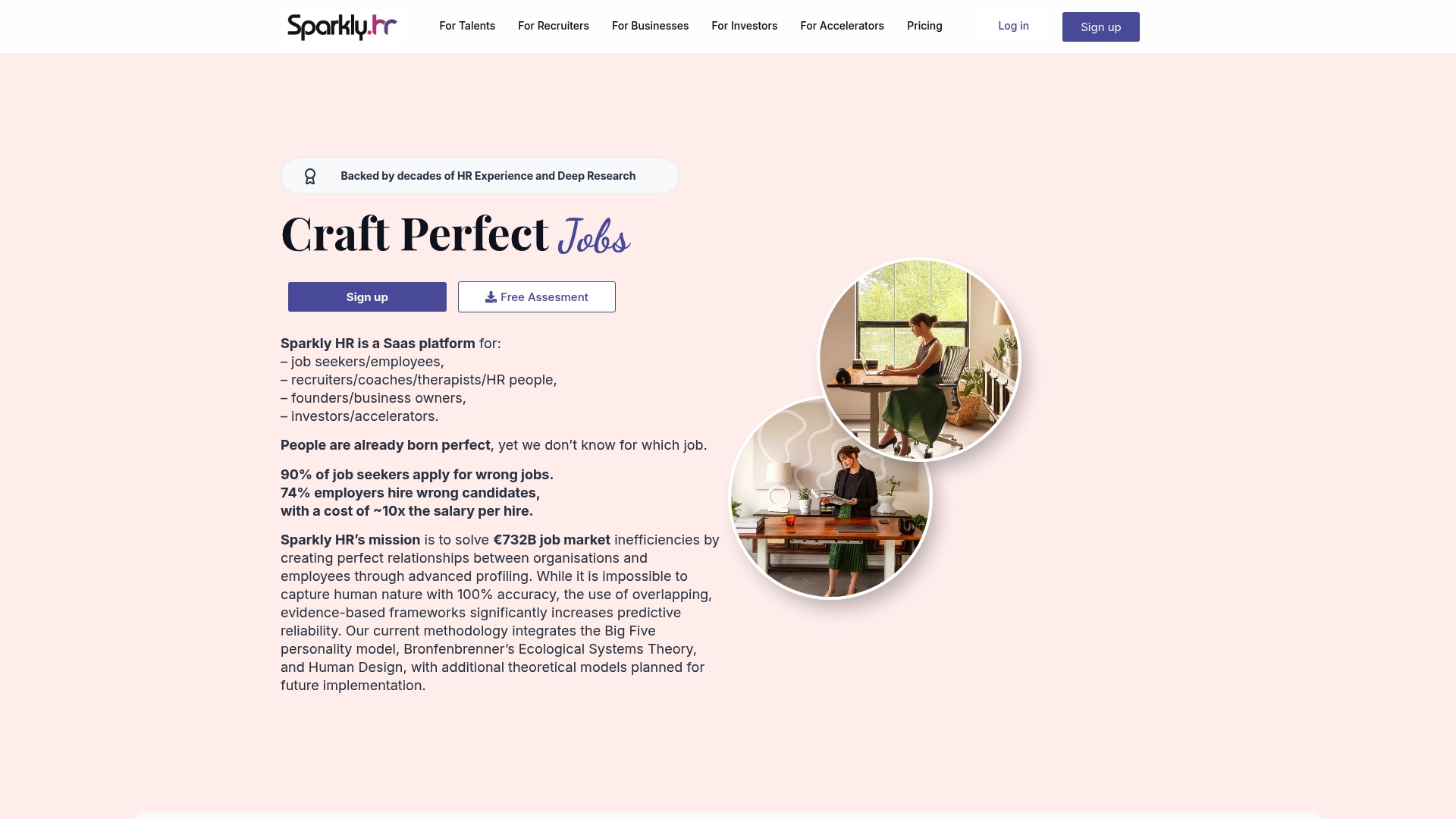
Our platform combines AI analysis, psychometric assessments, Human Design insights, and structured human input to generate reliable personality and potential data. This multi-source approach addresses the reliability limitations of single-method assessments, giving you confidence when making internal mobility decisions. The system identifies employees ready for new challenges and matches them with roles aligned to their personality traits.
Explore talent optimization solutions that streamline internal mobility workflows, from initial assessment through role matching and transition support. Discover tools to cut turnover with personality data designed for HR teams managing retention challenges in medium-sized organizations. Learn how AI-powered recruitment tools enhance both internal mobility and strategic external hiring when needed. These solutions help you implement the frameworks discussed throughout this guide, transforming internal talent shifts from concept to operational reality in your organization.
Why internal talent shifts matter: FAQs
What is an internal talent shift and how does it reduce turnover?
An internal talent shift moves existing employees into different roles within your organization based on personality fit and potential rather than just skills. This approach reduces turnover because employees gain growth opportunities without leaving the company, addressing the primary reason 70% of workers consider departing. Internal shifts extend tenure by an average of 53% compared to employees who remain in static roles.
How can personality assessments improve internal mobility outcomes?
Personality assessments predict motivation, engagement, and long-term job satisfaction more accurately than skills evaluations alone. When you match employees to roles aligned with their natural personality traits, they experience less friction, greater fulfillment, and stronger performance. Multi-source personality data combining psychometric tests, AI analysis, and human insight provides the reliability needed for confident internal mobility decisions that stick.
What are the biggest challenges in adopting internal talent shifts?
Managerial resistance tops the list, as supervisors worry about losing strong performers to other departments. Overcoming this requires incentive structures that reward talent development across the organization rather than just within teams. Other challenges include inadequate assessment tools, lack of visible internal opportunities, and cultural norms favoring external hiring. Only 25% of companies feel confident in their internal mobility strategies, indicating widespread implementation gaps.
How do internal moves compare cost-wise to external hiring?
Internal talent shifts cost approximately 20% less than external recruitment due to eliminated advertising fees, recruiter commissions, and reduced interview time. Internal candidates also reach full productivity faster because they already understand company systems and culture, further reducing the total cost of filling positions. These savings compound significantly when scaled across multiple hires annually in medium-sized organizations.
What metrics should HR track to measure internal talent shift success?
Track average employee tenure, percentage of roles filled internally, time-to-productivity for internal transfers, employee engagement scores, and recruitment cost per hire. Also monitor manager participation in internal mobility programs and employee satisfaction with career development opportunities. These metrics collectively reveal whether your internal talent shift strategy is delivering the intended retention and cost benefits while identifying areas needing refinement.