Future of Job Roles: Unlocking Personality Potential

Job titles might stay familiar, but what people actually do inside a role is shifting fast. For mid-sized tech companies, this brings new pressure as old hiring routines fail to explain why great engineers leave and unlikely stars stay. HR managers focused on retention need a deeper tool: understanding the personality-driven job design framework means fitting real people to real work, not dated job titles—a change that targets turnover where it actually begins.
Table of Contents
- Defining The Future Of Job Roles
- Shifting From Skills To Personality Fit
- Innovative Approaches To Role Assessment
- Implications For Turnover And Team Success
- Avoiding Pitfalls In Redesigning Roles
Key Takeaways
| Point | Details |
|---|---|
| Emphasize Personality Over Skills | Organizations should prioritize hiring based on personality fit rather than just technical skills, as personality drives long-term performance and retention. |
| Redesign Job Roles | Job roles need to be flexible and aligned with personality traits to enhance team dynamics and reduce turnover. |
| Innovate Assessment Methods | Utilize interactive and authentic assessments that reflect real job scenarios, capturing both capability and personality traits. |
| Build a Culture of Communication | Effective communication surrounding role changes is crucial; ensure all team members understand the rationale behind any restructuring. |
Defining the Future of Job Roles
Job roles aren’t static anymore. They’re evolving at speeds that traditional hiring processes can’t keep pace with. Organizations worldwide face a fundamental shift in how work gets done, who performs it, and what qualities actually matter.
The World Economic Forum’s research on technological and socio-economic trends reveals that entire job categories will transform within five years. Some roles expand rapidly while others contract or disappear entirely. But here’s what most organizations miss: the personality driving someone in a role matters far more than the job title itself.
Traditional job design assumes everyone in the same position needs identical skills. Reality works differently. A software developer thrives on complex problem-solving. Another developer excels at mentoring junior staff. Both are “developers,†but their personalities suit wildly different responsibilities.
What’s Actually Changing
Three major shifts are reshaping job roles right now:
- Role fluidity: Functions overlap and blend instead of staying siloed by department
- Skill obsolescence: Technical abilities become outdated, but personality traits like adaptability remain constant
- Team dynamics matter more: Organizational culture depends less on individual excellence and more on personality fit within groups
When you redesign jobs based on personality rather than titles, something shifts. Someone who loves process optimization naturally gravitates toward systematic work. Someone energized by relationships should lead client interactions. You’re not forcing square pegs into round holes anymore.
Personality traits drive performance consistency across different roles and industries. Skills fade, but how someone approaches challenges remains stable.
Consider the mid-sized tech company struggling with turnover. They hire talented engineers who meet all technical requirements, yet watch them leave within 18 months. The problem wasn’t missing skills—it was personality mismatch. The role demanded someone comfortable with ambiguity and rapid change. The hire preferred structure and clear processes. No amount of training fixes that fundamental disconnect.
Why HR Must Rethink Job Design
Your current job descriptions probably list technical requirements and experience levels. They don’t mention personality prerequisites. That’s your biggest vulnerability.
When you understand how personality data transforms hiring decisions, everything changes. You start asking different questions during interviews. You stop forcing people into boxes created decades ago. You match personalities to actual work instead of job titles to resumes.
HR teams in tech companies face a specific challenge: competing for talent when skills alone don’t differentiate candidates anymore. The organizations winning are those redesigning roles around personality first, then stacking skills on top.
The Personality-First Framework
Instead of defining a role and hoping to find someone who fits, flip it:
- Map personality traits to actual work responsibilities
- Identify gaps in team dynamics, not just skill gaps
- Match people to responsibilities based on personality strengths
- Create role flexibility so personalities shape how work flows
Smaller organizations benefit most from this approach because personalities either complement or clash immediately. Larger organizations gain bigger probability of finding quality matches. Both see dramatic improvements in retention when personalities align with roles.
Pro tip: Start by auditing your top performers and analyzing their personality traits using psychometric assessments and psychometric assessments, not just their job descriptions. You’ll spot patterns that reveal which personality types actually thrive in your environment.
Shifting From Skills to Personality Fit
You’ve been hiring wrong. Not because your process is broken, but because you’re optimizing for the wrong variable. Skills get outdated. Certifications expire. Personalities remain constant across a decade-long career.
The shift happening right now in talent management is fundamental. Organizations are moving away from credential-focused hiring toward matching people based on personality traits that predict career role preferences. Someone with the right personality for a role will learn the skills. Someone misaligned will quit after 18 months, no matter how technically skilled they are.
This isn’t soft HR talk. It’s biology. Personality drives how people approach problems, handle stress, collaborate, and adapt. Skills are tools they use, but personality is the hand holding the tool.
Why Skills Alone Are Insufficient
Consider what happened in your last hiring cycle. You probably ranked candidates by technical qualifications first. Experience came next. References maybe third. Personality fit? It was a footnote, if mentioned at all.

Here’s the problem: two candidates with identical skills will perform completely differently in the same role depending on personality alignment.
Skills-based hiring creates a false sense of security. You think someone meets the role because they’ve done the work before. But dynamic skills and personality traits critically determine how workers adapt to organizational changes. The environment shifts, the skill becomes partially irrelevant, and if personality doesn’t match the chaos, they leave.
Personality alignment predicts long-term retention better than any skill assessment because personality determines how someone handles uncertainty.
Mid-sized tech companies feel this acutely. You’re growing rapidly. Your processes change quarterly. You need people who thrive in ambiguity, not those who panic when yesterday’s playbook becomes useless.
Here’s how traditional and personality-centered hiring compare:
| Hiring Approach | Focus Area | Long-Term Impact | Common Pitfalls |
|---|---|---|---|
| Skills-Based | Technical abilities | High turnover risk | Skills quickly become stale |
| Personality-Centered | Role-personality fit | Improved retention | Requires deeper assessment |
The Three-Part Shift
Moving from skills to personality fit means restructuring how you think about hiring:
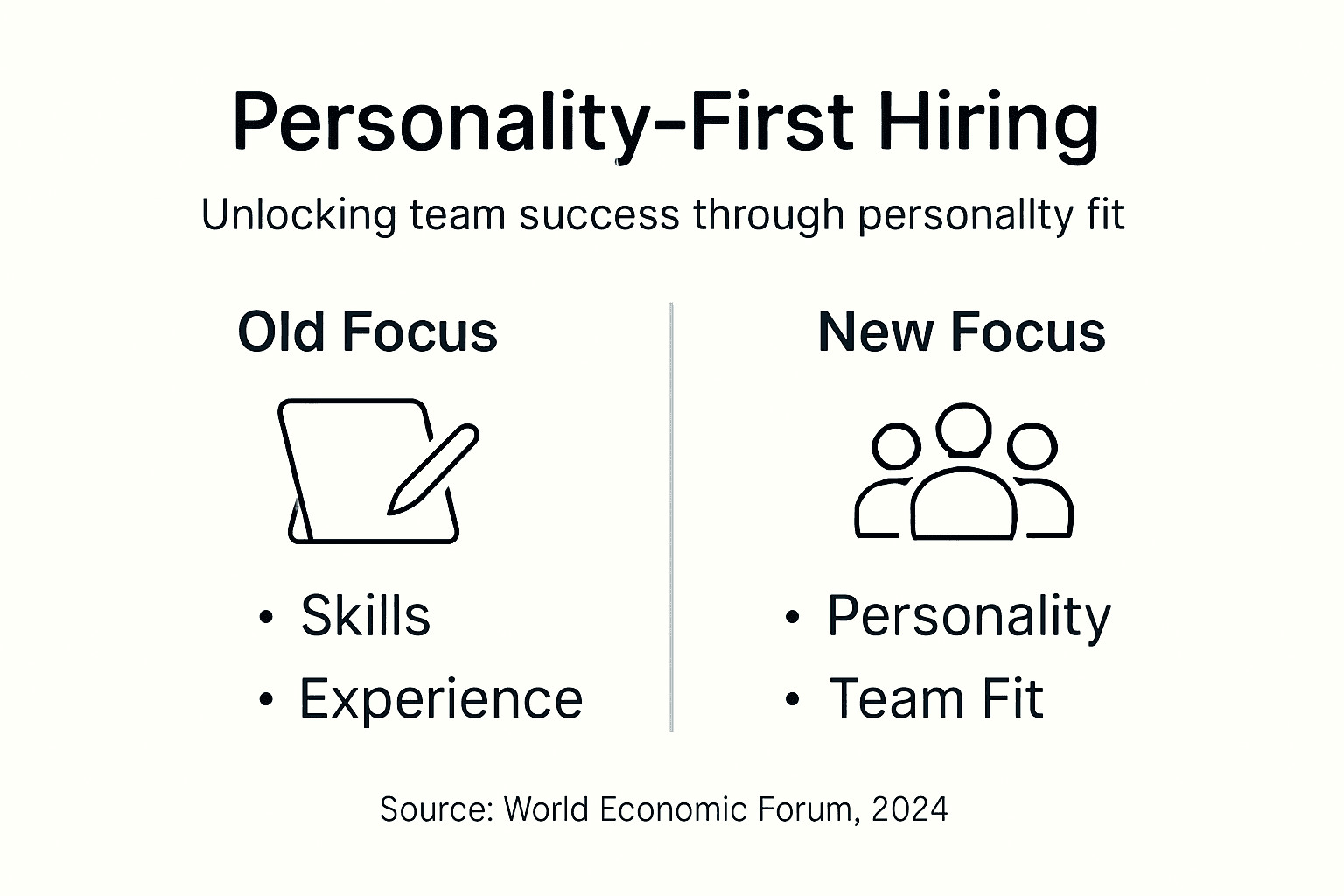
- Screen for personality compatibility first: Does this person’s traits match your culture and role demands?
- Assess skills as secondary factors: Can they learn what’s needed, or do they possess it already?
- Evaluate team dynamics: Will this personality complement or clash with existing team members?
Small organizations do this intuitively. Larger ones need structure. Using personality-driven job fit analysis helps you scale what successful teams do naturally.
The math works in your favor. Personality traits are relatively stable. Someone who’s analytical at hire will be analytical in year three. Someone who’s collaborative thrives in different environments because that trait transfers. You’re investing in something that doesn’t depreciate.
What This Means for Interviews
Your next interview needs to change. Stop asking about previous projects. Start asking about how they approach ambiguity, handle conflict, and energize themselves at work.
The candidates who light up describing complex problem-solving probably prefer deep technical work. The ones who animate when discussing team wins prefer collaborative environments. Watch which stories they tell. Personality leaks out there.
When you understand what personality you actually need before interviewing, everything clarifies. You’re not looking for the most skilled candidate anymore. You’re looking for the best fit who has sufficient skills.
Pro tip: Document the personality traits of your top three performers in each role, then use those as templates for future hiring. You’ll spot the personality patterns that actually drive success in your specific context.
Innovative Approaches to Role Assessment
Traditional assessments are broken. You’re measuring the wrong things in artificial conditions that don’t reflect real work. An interview question about problem-solving tells you nothing about how someone actually solves problems under pressure with incomplete information.
Innovative role assessment changes this fundamentally. Instead of hypothetical scenarios, you’re evaluating people in contexts that mirror actual job demands. You’re capturing richer performance data using technology and interactive methods. Most importantly, you’re assessing personality and capability together, not separately.
The organizations winning talent wars aren’t using outdated evaluation methods. They’re building assessments that reveal authentic capability and personality fit simultaneously.
Why Traditional Assessments Fail
Your current process probably involves resumes, phone screens, and technical interviews. Candidates prepare answers. They perform. You make decisions based on polished presentations, not genuine capability.
This approach misses critical signals. Interactive assessments using authentic designs capture complex skills like problem-solving and collaboration better than traditional methods. Someone who talks eloquently about teamwork might freeze in actual group problem-solving. Someone quiet in interviews might drive results when given autonomy.
You’re not seeing personality leakage. You’re seeing performance anxiety, interview confidence, or prepared scripts. None of those predict actual job performance.
The Four Elements of Effective Assessment
Innovative assessments share common characteristics:
- Authenticity: Tasks mirror real work situations, not hypothetical scenarios
- Technology-enabled: Platforms capture behavioral data you can’t observe in traditional interviews
- Personality-integrated: Assessment reveals both capability and personality traits simultaneously
- Interactive and dynamic: Assessments adapt based on responses, creating personalized evaluation paths
Technology-enhanced methods enable organizations to measure complex skills aligned with modern role requirements. You’re not just testing knowledge. You’re observing how someone thinks under pressure, handles ambiguity, and collaborates with others.
Authentic assessments in real-world contexts reveal personality and capability far more accurately than traditional interviews.
Consider how you’d assess a product manager candidate. Traditional approach: ask them to describe their product strategy. Innovative approach: give them a real scenario with incomplete data, conflicting stakeholder input, and tight deadlines. Watch how they prioritize, communicate, handle pressure, and adapt when challenged. Personality emerges naturally.
Key elements for effective role assessments at a glance:
| Element | What It Measures | Organizational Benefit |
|---|---|---|
| Authenticity | Real job behaviors | Reveals true work adaptation |
| Tech Integration | Response patterns | Uncovers unseen strengths |
| Personality Fit | Behavioral responses | Predicts team compatibility |
| Interactivity | Adaptability under stress | Tests problem-solving in motion |
Implementing Personality-Centered Assessment
Start by clarifying what personality traits actually matter for your role. Not generic traits—specific ones tied to real job demands.
Then redesign your assessment to observe those traits in action:
- Identify core personality requirements for the role
- Create realistic scenarios that demand those traits
- Use interactive platforms that capture behavioral data
- Evaluate how candidates respond to pressure and uncertainty
- Compare personality profiles with successful current performers
Smaller tech organizations benefit immediately because personality clashes become obvious fast. Larger organizations gain statistical advantage—bigger data sets reveal stronger personality-performance correlations.
Pro tip: Record candidate assessments when possible and review them in a week. First impressions often mislead. Watching someone’s second response to a challenge after thinking overnight reveals more than their initial reaction.
Implications for Turnover and Team Success
Turnover costs you money. A mid-sized tech company loses 50% to 200% of an employee’s annual salary when they leave. That’s recruitment, training, lost productivity, and team disruption all stacked together.
But the real damage isn’t financial. It’s organizational. When someone leaves, team dynamics collapse. Relationships fracture. Institutional knowledge walks out the door. The remaining team absorbs the shock while you scramble to hire replacements.
Personality-driven role design fixes this at the root. Instead of treating turnover as inevitable, you prevent it by ensuring personalities actually fit roles and teams.
The Turnover-Team Performance Connection
Strong leadership and effective teamwork significantly reduce employee turnover intentions while enhancing overall team performance. This isn’t coincidence. When teams function well, people want to stay. When they don’t, people leave.
Here’s where most organizations fail: they assume team performance depends on individual skill. It doesn’t. It depends on how personalities interact. A brilliant engineer on a team where she doesn’t fit culturally will underperform and eventually leave.
Personality misalignment creates silent turnover risk. Someone stays physically but checks out mentally. They’re unhappy. They’re not contributing fully. Then one day they announce they’re leaving, and you act shocked.
What Organizational Commitment Actually Means
Organizational commitment emerges from alignment with supervisors, team dynamics, and organizational culture, not just formal employment contracts. Someone committed to their team will stay even during rough periods. Someone committed only to salary will leave at the first opportunity.
This distinction matters enormously. You want people committed to their work and teammates, not just to paychecks.
Personality fit creates that commitment naturally. Someone energized by collaborative problem-solving stays on a team that does exactly that. Someone who thrives on autonomy leaves a micromanaged environment regardless of pay.
Personality alignment with team dynamics predicts commitment and retention far better than compensation alone.
Building Teams That Keep People
The path forward has three components:
- Match personalities to roles intentionally: Stop placing people based on skills alone
- Assess team dynamics, not just individuals: Does this person complement the existing team?
- Create flexibility for personality expression: Allow people to work in ways that suit them
When you use personality-based retention strategies, something shifts. People feel seen. Their work style is valued. They’re not fighting against their nature to fit a role.
Smaller teams feel this immediately. One personality clash derails everything. Larger organizations can absorb mismatches longer, but the cost accumulates. Either way, personality alignment reduces turnover dramatically.
The Ripple Effect on Team Success
When people stay, institutional knowledge compounds. New team members learn from veterans. Relationships deepen. Trust builds. These factors multiply team performance exponentially.
You’re not just reducing turnover costs. You’re building teams that execute better, innovate faster, and sustain competitive advantage.
Pro tip: Before hiring replacements for people who left, analyze their personality profile and why they left. Was it role fit, team dynamics, or something else? Use those insights to ensure their replacement actually stays.
Avoiding Pitfalls in Redesigning Roles
Role redesign sounds simple. Identify what needs to change. Restructure the work. Watch performance improve. Reality is messier. Most redesign efforts fail because organizations skip crucial steps or ignore human factors entirely.
You can have the perfect personality-based framework and still sabotage it with poor execution. The difference between success and failure often comes down to avoiding predictable mistakes that derail otherwise solid strategies.
Let’s cover what actually kills redesign initiatives and how to protect yours.
The Top Mistakes Organizations Make
Most redesigns fail because they ignore people implications. You restructure roles but don’t address how personalities will interact in the new setup. You change job descriptions without preparing people for the transition. You focus on structure and ignore culture.
Organizations must avoid rigid job descriptions and delayed upskilling as roles evolve with technological change. Static job titles don’t work anymore. Personality-based roles are fluid. They need flexibility built in.
Another critical mistake: redesigning without clear business strategy alignment. You shift roles around, but nobody understands why. Goals aren’t connected to the changes. Teams become confused and resistant.
Redesign failure happens when organizations change structure without addressing culture, communication, and people implications.
Six Pitfalls to Avoid
Specific mistakes derail most redesigns:
- Misalignment with business strategy: Changes don’t connect to organizational goals or direction
- Structure-only thinking: Assuming reorganization solves culture problems it doesn’t
- Poor communication: Failing to explain why changes matter and what they mean for individuals
- Ignoring people implications: Not considering personality fit in the new setup
- Inadequate diagnosis: Rushing into redesign without understanding root problems
- Lack of stakeholder involvement: Excluding leaders, teams, and individuals from the process
Careful diagnosis before initiating redesign prevents misaligned changes that don’t serve business needs. You need to understand what’s actually broken before trying to fix it.
Small tech organizations often rush this. You’re moving fast, growing rapidly, and restructure feels urgent. But without proper diagnosis, you redesign the wrong things. Then you wonder why performance didn’t improve.
Getting Redesign Right
Start with diagnosis, not action. Map current personalities to roles. Identify actual mismatches. Understand why turnover happens in specific teams.
Then communicate relentlessly. Explain business strategy. Show how new roles connect to goals. Describe what personality traits actually matter. Involve people in designing their own roles where possible.
Build in flexibility. Don’t create rigid new job descriptions. Design roles that allow personality expression. Create space for people to work in ways that suit them.
Finally, prepare for the transition. Upskill leaders. Coach managers. Support individuals through change. This takes time, but it prevents the chaos that derails redesigns.
Pro tip: Before announcing any redesign, pilot it with one team first. Watch what actually happens when personalities interact in the new structure. Fix problems in the pilot before rolling out organization-wide.
Unlock the True Potential of Your Workforce with Personality-Centered Talent Solutions
The challenge highlighted in the article reveals how outdated hiring methods focused only on skills lead to high turnover and poor team dynamics. Skills become obsolete but personality drives consistent performance, engagement, and retention. If you are ready to stop guessing and start matching people to roles based on their true personality fit then Sparkly HR is your solution. We go beyond traditional evaluations by merging data from humans, AI, psychometric assessments, and Human Design to deliver the most reliable insights that help you redesign jobs and build cohesive teams.
Explore how to transform your hiring and role design with Sparkly HR by visiting https://sparkly.hr. Discover how our personality-first approach turns abstract concepts of role fit into actionable strategies that reduce turnover and elevate team success. Start now by browsing through our Uncategorized - Sparkly HR resources and see why organizations embracing personality-driven talent management are winning the future of work.
Frequently Asked Questions
What is the importance of personality in job roles?
Understanding personality is crucial because it drives performance consistency across different roles and industries. Skills may become outdated, but how individuals approach challenges remains stable, impacting long-term retention and job satisfaction.
How can organizations redesign job roles based on personality?
Organizations can redesign job roles by mapping personality traits to responsibilities, identifying gaps in team dynamics, and matching individuals to roles that play to their personality strengths. Flexibility in roles ensures that work adapts to natural tendencies.
Why are traditional hiring processes insufficient?
Traditional hiring processes often focus on skills and experience, neglecting personality fit. This can result in high turnover rates as individuals may excel technically but fail to adapt or thrive in the organizational culture.
What role do assessments play in identifying personality fit?
Innovative assessments that mirror real job situations can evaluate both capability and personality traits effectively. These assessments capture genuine performance data and help ensure that candidates are a good fit for the team dynamics and role demands.