
Talent Forecasting: Shaping the Future Workforce Fit

Hiring the right people is only half the battle for mid-sized tech companies juggling constant change. Talent forecasting is often mistaken for basic headcount planning, yet the real challenge is predicting not just who you need but who will stay and thrive within your teams. This matters because an accurate, personality-driven talent forecast can mean the difference between high turnover and lasting team fit. Uncovering the myths and strategies behind effective talent forecasting empowers you to connect your workforce planning to actual business results, not just spreadsheets.
Table of Contents
- Talent Forecasting Defined and Common Myths
- Major Types: Quantitative vs. Qualitative Forecasting
- How Talent Forecasting Works in Practice
- Personality-Driven Approaches for Team Fit
- Risks, Common Mistakes, and How to Avoid Them
- Choosing Advanced Tools for Smarter Talent Insights
Key Takeaways
| Point | Details |
|---|---|
| Talent Forecasting vs. Talent Management | Talent forecasting specifically predicts future workforce needs, while talent management encompasses the entire employee lifecycle from recruitment to retirement. |
| Combining Quantitative and Qualitative Approaches | Effective talent forecasting merges quantitative data with qualitative insights, allowing organizations to align workforce needs with strategic goals. |
| Importance of Personality Fit | Prioritizing personality fit over skills during hiring ensures better team dynamics and long-term employee success, reducing turnover. |
| Ongoing Forecasting Process | Treat talent forecasting as an ongoing practice with regular reviews to adapt to organizational changes and emerging workforce needs. |
Talent Forecasting Defined and Common Myths
Talent forecasting is the process of predicting your future workforce needs based on business strategy, market conditions, and employee capability. It goes beyond simply counting heads or identifying skill gaps. Instead, it connects organizational vision with actual people capable of delivering that vision. At its core, talent forecasting answers three critical questions: Who do you need? When do you need them? And what kind of personalities and characteristics will thrive in those roles?
The confusion starts when organizations treat talent forecasting as identical to talent management broadly. These are not the same thing. Talent management covers everything from recruiting through retirement, while talent forecasting specifically focuses on predicting future needs and matching available talent to those needs. Many companies also oversimplify the problem by assuming talent scarcity or supply issues follow predictable, linear patterns. This misconception leads to reactive hiring instead of strategic workforce design. Complex forecasting involving cognitive and cultural factors reveals that talent availability and capability are shaped by far more than market trends alone. You need to understand the people already in your organization, their personality traits, their hidden potential, and how they could thrive in different roles before you start hunting for external candidates.
Here’s where most talent forecasting efforts fail: they focus on skills instead of personality. Skills can be learned. Personality fit cannot. A developer with the right technical certifications but misaligned personality traits will underperform and eventually leave. Meanwhile, an employee with complementary personality traits but different current skills can be retrained, repositioned, or paired with teammates who naturally handle what they struggle with. This is why understanding talent analytics for HR decision making matters so much. Real forecasting requires merging data from multiple sources: human intuition, psychometric assessments, behavioral patterns, and analytical tools. Organizations that attempt forecasting with only one or two data sources end up with incomplete pictures that lead to poor hiring decisions and high turnover.
Pro tip: Before building your talent forecast, audit your current team by personality traits and role fit rather than job titles alone—you’ll likely discover people in the wrong roles and untapped potential hiding in plain sight.
Major Types: Quantitative vs. Qualitative Forecasting
Your talent forecasting approach breaks into two distinct camps: quantitative and qualitative. Think of them as different tools in your toolkit. Quantitative forecasting relies on hard numbers, historical data, and statistical models. You’re looking at turnover rates, promotion timelines, headcount trends, and applying mathematical formulas to predict future needs. This approach works best for short-term forecasting when you have solid historical data and relatively stable business conditions. Qualitative forecasting, on the other hand, taps into expert judgment, intuition, and subjective assessment. HR leaders, department heads, and team managers contribute their knowledge about future strategic directions, upcoming projects, and organizational changes. This method excels in long-term planning and scenarios where data is sparse or unpredictable.
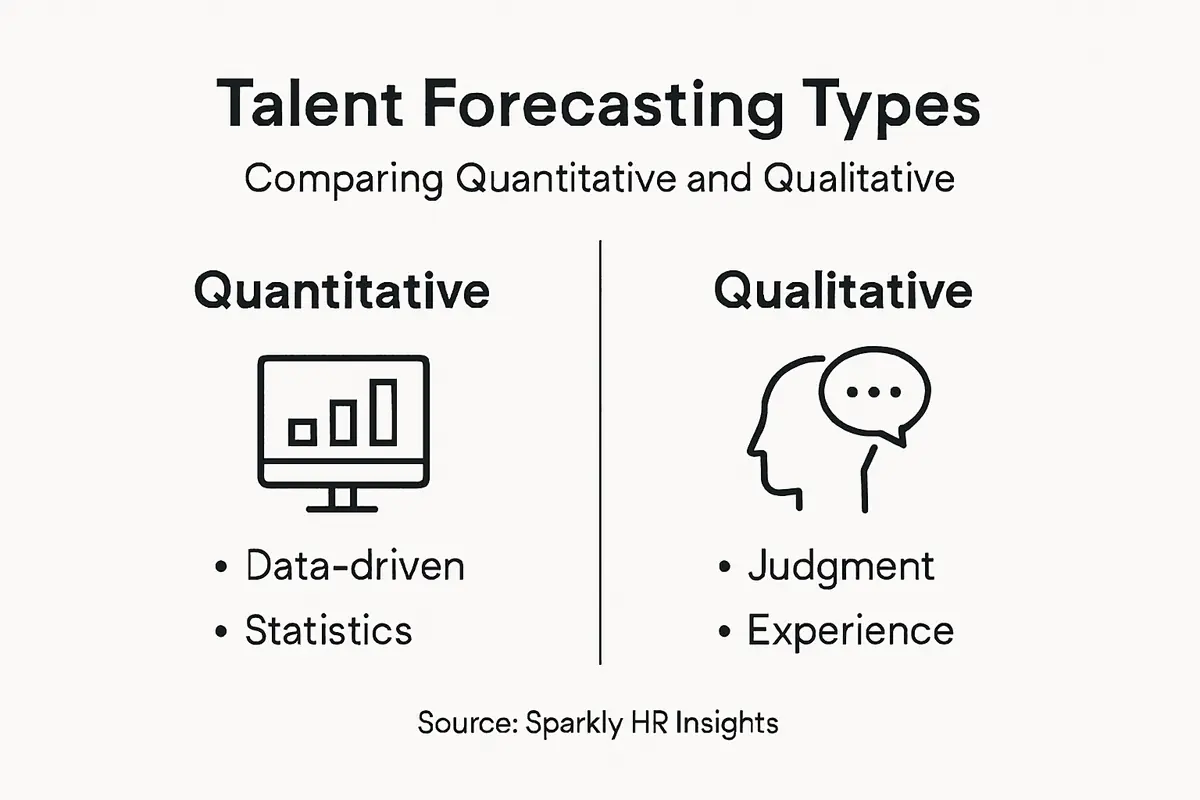
Quantitative methods using statistical modeling provide precision for immediate hiring needs. If you need to fill three senior developer roles within six months based on your current attrition patterns, quantitative analysis gives you solid numbers. You examine historical departure rates, average tenure in those positions, and project forward. But here’s the trap: numbers alone don’t capture organizational strategy shifts. A startup pivoting toward AI services needs different personality types than one focused on legacy system maintenance. Raw data won’t tell you that. This is where qualitative forecasting becomes invaluable. Your product leadership knows the company is moving into a new market segment requiring risk takers and innovators, not maintainers. That insight shapes which personalities you should develop internally and which skills you need to hire externally.
The real power emerges when you combine both approaches. Synthesizing data-driven insights with managerial judgment creates forecasts that reflect both reality and strategy. Start with quantitative analysis to understand your baseline: turnover patterns, skill gaps, promotion velocities, and demographic trends. Then layer in qualitative insights from experienced managers about future direction, emerging team dynamics, and personality fit requirements for upcoming roles. A mid-sized tech company might discover quantitatively that they lose 20 percent of developers annually within two years of hire. Qualitatively, they discover these departures cluster among people who struggle with their rigid process culture and thrive better in fluid, autonomous environments. That insight drives both recruitment changes and internal role redesign.
Pro tip: Start with quantitative data on your current workforce patterns, then schedule structured conversations with department leads about upcoming strategic shifts—this combination surfaces forecasting blind spots neither approach alone would catch.
Here’s a comparison of quantitative versus qualitative talent forecasting approaches:
| Aspect | Quantitative Forecasting | Qualitative Forecasting |
|---|---|---|
| Basis | Historical data and statistics | Expert judgment and intuition |
| Best Use Case | Short-term workforce planning | Long-term, strategic forecasting |
| Strength | Precision and objectivity | Flexibility and scenario adaption |
| Limitation | Misses cultural and strategic shifts | Lacks statistical validation |
How Talent Forecasting Works in Practice
Talent forecasting starts with a clear-eyed look at your current state. You cannot predict where you need to go without understanding where you are. This means collecting data on your workforce composition, turnover patterns, skill inventories, and performance profiles across all levels. But the data collection goes beyond spreadsheets. You need to understand personality fit, team dynamics, and how people actually work together. Many organizations pull historical HR records: who left, when they left, how long they stayed, which departments experienced the most attrition. This quantitative baseline reveals patterns. A tech company might discover that senior engineers consistently leave within 18 months, or that junior developers hired from certain universities adapt better to their culture. These patterns become predictive signals. Predictive modeling and workforce analysis techniques help organizations identify which roles will face critical shortages and what skill combinations matter most for future success.
The next step involves forecasting both demand and supply. Demand forecasting asks: What roles will the business need in 12, 24, and 36 months based on strategic plans? Supply forecasting asks: How many people can we retain and develop internally to fill those roles? This is where strategic alignment becomes crucial. You meet with department heads, product leaders, and executives to understand upcoming initiatives. A team planning to launch into a new market segment needs problem solvers and risk takers. A team maintaining legacy systems needs detail-oriented processors who excel with structure. Workforce planning processes that identify critical roles and forecast demand connect organizational strategy to actual staffing decisions. You examine internal promotion pipelines, identify people with hidden potential for advancement, and determine where you must hire externally versus developing existing talent. The personality piece matters enormously here. Can you develop the personality traits your future roles need, or must you recruit them?
Implementation requires integrating all these insights into actionable decisions. You identify critical talent gaps, prioritize which positions pose the greatest risk if unfilled, and develop sourcing and development strategies. For roles you can fill internally, you redesign jobs to match personality strengths. For roles requiring external hiring, you shift your recruitment criteria to emphasize personality fit alongside skills. You also create succession plans for key positions and development plans for high-potential employees whose personalities align with future needs. The teams that succeed at this treat forecasting as an ongoing conversation, not a once-annual exercise. Quarterly reviews of actual versus forecasted needs allow you to adjust strategy, refine your predictions, and catch emerging talent risks early. This prevents the reactive scramble that derails most organizations when unexpected departures occur.
Pro tip: Schedule quarterly forecasting reviews where you compare predicted talent needs against actual business changes and departures—this keeps your forecasts grounded in reality and catches surprises before they become crises.
Personality-Driven Approaches for Team Fit
Here’s what most talent forecasting misses: a team full of technically skilled people can still underperform if their personalities clash or create friction. You need people who not only can do the work but also mesh with how your team operates and communicates. Personality-driven approaches flip the traditional hiring and team-building process on its head. Instead of asking “Can this person do the job?” first, you ask “Will this person thrive with these teammates and in this environment?” The answer to the second question determines long-term success far more than credentials alone. Personality traits and their influence on team dynamics reveal that certain personality combinations enhance communication, collaboration, and problem-solving, while other combinations create tension and miscommunication despite everyone having strong individual capabilities.

There are two distinct personality fit concepts that matter for team forecasting. Complementary fit happens when team members have different personalities that balance each other. A team of all detail-oriented planners struggles with creativity and risk-taking. Add a few visionary personalities who see possibilities and challenge assumptions, and the team becomes more dynamic. Supplementary fit occurs when personalities align around shared values and work styles. Teams where everyone operates with similar conscientiousness and communication preferences tend to have smoother workflows and fewer interpersonal conflicts. The key insight is that different team situations call for different personality mixes. A startup scaling rapidly needs more risk-takers and adaptable personalities. A fintech compliance team needs personalities strong in conscientiousness and process orientation. Person-team personality alignment enhances collaborative processes and directly impacts whether teams innovate effectively or execute reliably.
When you’re forecasting future talent needs, personality-driven approaches force you to think differently about internal mobility and external hiring. Don’t ask which high performers to promote without considering personality fit with their new team. A stellar individual contributor with low collaboration scores might become a poor manager of a team-dependent project. Instead, assess personality requirements for the role alongside skill requirements, then identify who in your current organization has the personality fit for development. For external hiring, this means optimizing talent through personality-driven role design and team reassignment becomes your strategy. You deliberately shift people between roles or teams to create better personality matches, or you target external candidates whose personalities complement existing team compositions. This prevents the toxic culture problem where technically strong hires disrupt team dynamics and ultimately fail or leave.
Pro tip: Before filling any open role or planning team restructuring, map the personality profiles of current team members, identify which personality traits are missing or in excess, then either develop existing people into those gaps or recruit candidates who naturally possess those traits.
Risks, Common Mistakes, and How to Avoid Them
Talent forecasting looks straightforward in theory but derails quickly in practice. The most damaging mistake organizations make is focusing exclusively on replacing departing star players rather than building bench strength across the entire organization. You lose your top engineer and panic, immediately pouring resources into external recruiting to find a replacement with identical skills and experience. Meanwhile, three solid mid-level engineers on your team could have been developed into that role, and now you have demoralized people who watched external candidates get fast-tracked. This creates a vicious cycle where your best internal talent feels undervalued and starts looking elsewhere. Common transformation talent mistakes including failure to focus on critical roles reveal that organizations relying too heavily on star players create burnout and fragility. When that one critical person leaves, the entire operation suffers. The solution is deliberate role prioritization combined with diversified talent development. Identify which roles truly matter to your strategy, then systematically develop multiple people capable of filling them. This distributes risk and creates psychological safety for your high performers.
Another critical mistake is treating talent forecasting as a one-time annual exercise rather than an ongoing conversation. You run a forecasting project in January, create a hiring plan, then ignore emerging signals until next January. Meanwhile, your market shifted, key departures surprised you, and your forecast became obsolete by March. Real forecasting requires quarterly reviews where you compare predicted talent needs against actual business changes, track which forecasts proved accurate and which missed, and adjust accordingly. You also miss the personality dimension entirely by relying solely on skill assessments and interview impressions. A candidate looks great on paper, you hire them, and six months later they’re miserable because their working style clashes with team norms. They either leave or poison team dynamics. The fix requires assessing personality fit alongside skills, both for external candidates and existing employees being considered for new roles.
The third major risk is underestimating the cost of personality mismatch. Many organizations believe they can hire anyone with the right credentials and hope they’ll adapt to the culture. They cannot. A highly skilled person with wrong personality fit will eventually leave or underperform, creating turnover costs, lost productivity, and team disruption that dwarf the investment in finding the right person initially. Additionally, organizations often fail to recognize hidden potential in current employees because they only look at current job performance. Someone thriving as an individual contributor might have personality traits perfectly suited for leadership if given the chance to develop. Conversely, someone struggling in their current role might flourish in a completely different position that matches their personality better. The solution is systematic personality profiling of your current workforce combined with honest conversations about where people actually thrive versus where they’re stuck.
Pro tip: Conduct a post-mortem analysis on your last five departures to identify whether they left due to skill mismatches, personality clashes, or lack of development opportunity—this reveals which forecasting blind spots are costing you the most talent.
Below is a summary of top risks and how proactive strategies help avoid common talent forecasting mistakes:
| Risk Factor | Impact on Organization | Proactive Solution |
|---|---|---|
| Star player replacement | Creates team fragility and burnout | Develop internal bench strength |
| Annual-only forecasting | Forecasts quickly become outdated | Schedule regular quarterly reviews |
| Ignoring personality fit | Higher turnover and culture disruption | Profile team personalities before hiring |
Choosing Advanced Tools for Smarter Talent Insights
Manual talent forecasting through spreadsheets and intuition hits a ceiling fast. As your organization grows, managing personality data, turnover patterns, skill inventories, and future projections across hundreds or thousands of employees becomes impossible without technology. The right tools transform raw data into actionable insights that inform smarter hiring and development decisions. But not all talent analytics platforms deliver equal value. You need solutions that combine multiple data sources—psychometric assessments, performance data, retention indicators, and behavioral patterns—into unified insights. Too many platforms focus solely on historical metrics, showing you what already happened rather than predicting what will happen. Advanced tools go further. They identify flight risk before people start job hunting, highlight personality mismatches before costly hires go wrong, and reveal hidden talent ready for advancement before competitors poach them.
Advanced talent analytics platforms utilizing AI and machine learning enable organizations to move beyond traditional HR reporting into predictive and prescriptive forecasting. These solutions analyze massive datasets to identify patterns invisible to human analysis. A platform might reveal that employees hired during certain quarters consistently underperform, or that specific personality trait combinations predict three-year retention rates with 87 percent accuracy. Machine learning models continuously refine predictions as new data arrives, getting smarter over time. The best platforms also integrate external labor market data, showing you not just what you have internally but how your compensation, benefits, and culture compare to what competitors offer. This prevents the surprise departure where you only discover afterward that your salary lagged market rates by 15 percent.
When evaluating tools, focus on three critical capabilities. First, does the platform assess personality alongside skills and experience? Tools that only measure technical competencies miss the personality dimension that Sparkly emphasizes as foundational to workforce fit. Second, can the platform unify data from multiple sources including your HR system, performance management system, psychometric assessments, and external labor market data? Disconnected data sources create blind spots. A candidate scores perfectly on technical skills but personality assessments reveal low collaboration tendency, yet if these datasets don’t connect in your tool, you miss the conflict until after hire. Third, does the platform enable scenario planning? Real forecasting isn’t about predicting one future. You need to model multiple scenarios: what if we lose our top three engineers, what if we scale the product team by 50 percent, what if market conditions force us to pivot. Tools should let you build these scenarios and see talent implications before they become crises. AI-driven technologies facilitating data unification and predictive analytics empower teams to derive evidence-based insights that move beyond guesswork into strategy.
Pro tip: Before purchasing any talent analytics platform, require vendors to demonstrate how they assess personality fit and whether their data sources integrate—run a pilot with your most critical forecasting challenge to validate the tool delivers actual insights, not just dashboards.
Unlock Your Workforce Potential with Personality-Driven Talent Forecasting
The article highlights a key challenge in talent forecasting: traditional methods focus too much on skills and overlook personality fit. This leads to costly hiring mistakes, high turnover, and missed internal development opportunities. If you want to move beyond reactive hiring and build teams designed for long-term success Sparkly offers a unique approach that prioritizes personality as the foundation for workforce fit. By merging insights from humans AI psychometric assessments and Human Design we provide predictive data you can trust to align your talent strategy with organizational goals.
Discover how our employee assessment SaaS helps you redesign jobs shift team members and unlock hidden potential within your existing workforce. Avoid common pitfalls like ignoring personality fit or relying solely on skill exams. Explore practical solutions for strategic talent forecasting and make smarter hiring and development decisions today.
Ready to experience a new level of talent forecasting accuracy and team fit? Visit us now at Sparkly HR and dive deeper into our innovative approach. For more insights check out our Uncategorized - Sparkly HR category where we discuss how personality-driven strategies reshape workforce planning. Start building your future workforce with confidence.
Frequently Asked Questions
What is talent forecasting?
Talent forecasting is the process of predicting future workforce needs based on business strategy, market conditions, and employee capabilities. It aims to align organizational vision with the right talent.
How does quantitative forecasting differ from qualitative forecasting in talent management?
Quantitative forecasting relies on historical data and statistics for short-term workforce planning, while qualitative forecasting utilizes expert judgment and subjective assessment for long-term planning and scenarios.
Why is personality fit important in talent forecasting?
Personality fit is crucial because a technically skilled employee may underperform if their personality does not align with team dynamics. Assessing personality can lead to better team collaboration and higher overall performance.
What common mistakes should organizations avoid in talent forecasting?
Organizations should avoid focusing only on replacing star players, treating forecasting as a one-time exercise, and underestimating the impact of personality mismatches. Continuous assessment and development of internal talent are essential for effective forecasting.
Recommended
- Talent Development Steps for Engaged Tech Teams
- Talent Optimization Explained: Reducing Turnover Faster
- Recruitment Technology Trends 2026: Smarter Hiring, Lasting Teams
- Why Talent Analytics Matters for HR Leaders
- Future Planning Explained: Strategies and Best Practices – Optio Station: Best Project Management App for Prioritization