
Every tech startup leader knows the sting of hiring a candidate who looks perfect on paper but struggles to mesh with the team. In a world where organizational agility and innovation make or break success, personality-centric assessment is emerging as the backbone of smart talent investment. By prioritizing individual fit over rigid skills matching, startups unlock new pathways to retention and sustained growth—an approach backed by growing research highlighting the power of human potential when strategically nurtured.
Table of Contents
- Defining Talent Investment For Tech Startups
- Types Of Talent Assessments And Their Impact
- How Personality-Centric Assessment Works
- Integrating SaaS Platforms In Talent Evaluation
- Financial And Cultural ROI Of Personality Fit
- Common Mistakes And Pitfalls In Talent Investment
Key Takeaways
| Point | Details |
|---|---|
| Talent Investment as a Strategy | Tech startups should view talent investment as a strategic necessity, prioritizing the development and retention of employees to foster innovation. |
| Holistic Talent Assessment | Utilizing comprehensive personality-centric assessments can reveal deeper insights into employee potential beyond traditional skills. |
| Integration of Technology | Leveraging SaaS platforms can enhance talent evaluation by providing data-driven insights that optimize workforce management. |
| Avoiding Common Pitfalls | Organizations must consciously avoid treating skills as static and implement adaptive career pathways to support continuous employee growth. |
Defining Talent Investment for Tech Startups
Talent investment represents a strategic approach where tech startups deliberately allocate resources to attract, develop, and retain exceptional employees who drive innovation and organizational growth. Unlike traditional hiring models, this approach prioritizes understanding individual potential over simply matching skills to job descriptions.
In the competitive landscape of tech startups, talent investment means viewing employees as critical assets rather than replaceable resources. Strategic talent management practices demonstrate significant correlations between deliberate talent development and breakthrough innovation capabilities. The core philosophy centers on recognizing that human potential, when properly nurtured, becomes a startup’s most sustainable competitive advantage.
Key components of effective talent investment include:
- Comprehensive personality assessments beyond traditional skills evaluation
- Flexible job design that matches individual traits with organizational needs
- Continuous learning and development opportunities
- Creating environments that encourage intrapreneurial thinking
- Building team dynamics that leverage complementary personality traits
Startups must move beyond viewing talent as a transactional relationship. The most successful organizations understand that strategic talent investment requires a holistic approach that considers individual growth, team chemistry, and organizational culture simultaneously. Tailored talent management approaches enable smaller teams to create outsized impact by matching the right people with the right opportunities.
Pro tip: Conduct personality assessments before job design to ensure optimal team alignment and individual satisfaction.
Types of Talent Assessments and Their Impact
Talent assessments have evolved far beyond traditional skills-based evaluations, transforming into sophisticated tools that help tech startups understand the deeper potential of their workforce. These multidimensional approaches go beyond surface-level competencies to explore an individual’s unique personality traits, work preferences, and potential for innovation.
Organizational factors significantly influence the effectiveness of talent management practices, requiring nuanced and adaptive assessment methods. Modern talent assessments typically encompass several key dimensions that provide a holistic view of an employee’s capabilities:
- Personality profiling that reveals inherent strengths and work style preferences
- Cognitive ability tests measuring problem-solving and analytical skills
- Emotional intelligence assessments evaluating interpersonal and leadership potential
- Situational judgment tests exploring real-world decision-making capabilities
- Skill competency evaluations measuring technical and soft skill levels
Tech startups benefit most from integrated assessment approaches that combine multiple evaluation methods. By leveraging tools like psychometric tests, behavioral interviews, and performance simulations, organizations can create a comprehensive talent profile that predicts future potential more accurately than traditional hiring practices.
The ultimate goal of advanced talent assessments is not just to evaluate current capabilities, but to identify and nurture hidden potential. Successful tech companies recognize that innovative talent cannot be discovered through standardized metrics alone, but requires a dynamic, contextual understanding of individual capabilities.
Pro tip: Design talent assessments that measure both technical skills and intrinsic motivational drivers to uncover true organizational potential.
How Personality-Centric Assessment Works
Personality-centric assessment represents a revolutionary approach to understanding workforce potential, moving beyond traditional skill-based evaluations to explore the deeper psychological characteristics that drive individual performance. This methodology recognizes that technical skills can be learned, but core personality traits fundamentally shape an employee’s ability to innovate, collaborate, and thrive within a specific organizational context.
Psychological traits offer critical insights into employee behavior, motivation, and cultural alignment. Modern personality-centric assessments leverage sophisticated tools that evaluate multiple dimensions of an individual’s professional persona:
- Motivational drivers that reveal intrinsic work preferences
- Communication style indicators highlighting interpersonal dynamics
- Stress response patterns that predict workplace resilience
- Decision-making frameworks demonstrating cognitive processing
- Collaborative potential measuring team interaction capabilities
Tech startups particularly benefit from this approach, as early-stage companies require team members who can adapt quickly and complement each other’s strengths. Entrepreneurial personality assessments help organizations identify candidates who not only possess technical skills but also demonstrate the agility and innovative mindset crucial for startup success.
The most effective personality-centric assessments integrate multiple evaluation methods, including psychometric testing, behavioral interviews, situational judgment scenarios, and advanced AI-powered analysis. By creating a holistic profile that goes beyond traditional metrics, organizations can make more informed decisions about talent placement, team composition, and individual development strategies.
Pro tip: Implement a multi-dimensional assessment approach that balances quantitative personality metrics with qualitative behavioral insights.
Here’s a comparison of traditional vs. personality-centric talent assessment approaches in tech startups:
| Approach | Focus Area | Key Benefit | Main Limitation |
|---|---|---|---|
| Traditional Assessment | Technical skills matching | Fast screening process | Overlooks human potential |
| Personality-Centric Approach | Behavioral and cultural fit | Improves team collaboration | Requires nuanced analysis |
Integrating SaaS Platforms in Talent Evaluation
SaaS platforms are revolutionizing talent evaluation by transforming traditional human resource processes into data-driven, dynamic systems that provide unprecedented insights into workforce potential. These technological solutions go beyond simple performance tracking, offering sophisticated tools that enable organizations to understand, develop, and optimize their most critical asset: their people.
Technological innovation drives talent development through scalable, intelligent platforms that merge multiple data sources to create comprehensive employee profiles. Modern SaaS talent evaluation systems typically incorporate several advanced features:
- Real-time performance analytics that track individual and team productivity
- Predictive assessment algorithms mapping potential career trajectories
- Continuous feedback mechanisms enabling ongoing professional development
- Personalized learning pathway generators
- Cross-functional skill matching tools
Startups particularly benefit from these integrated platforms, as they provide actionable insights with minimal administrative overhead. Collaborative tools support startup innovation by enabling faster, more strategic talent management decisions that align directly with organizational goals and growth strategies.

The most effective SaaS platforms break down traditional talent evaluation silos, creating interconnected systems that provide a holistic view of an organization’s human capital. By leveraging advanced machine learning and data analytics, these platforms transform raw performance data into meaningful insights that drive strategic workforce planning and individual career development.
Pro tip: Select SaaS platforms that offer seamless integration, advanced analytics, and customizable assessment frameworks to maximize talent potential.
Financial and Cultural ROI of Personality Fit
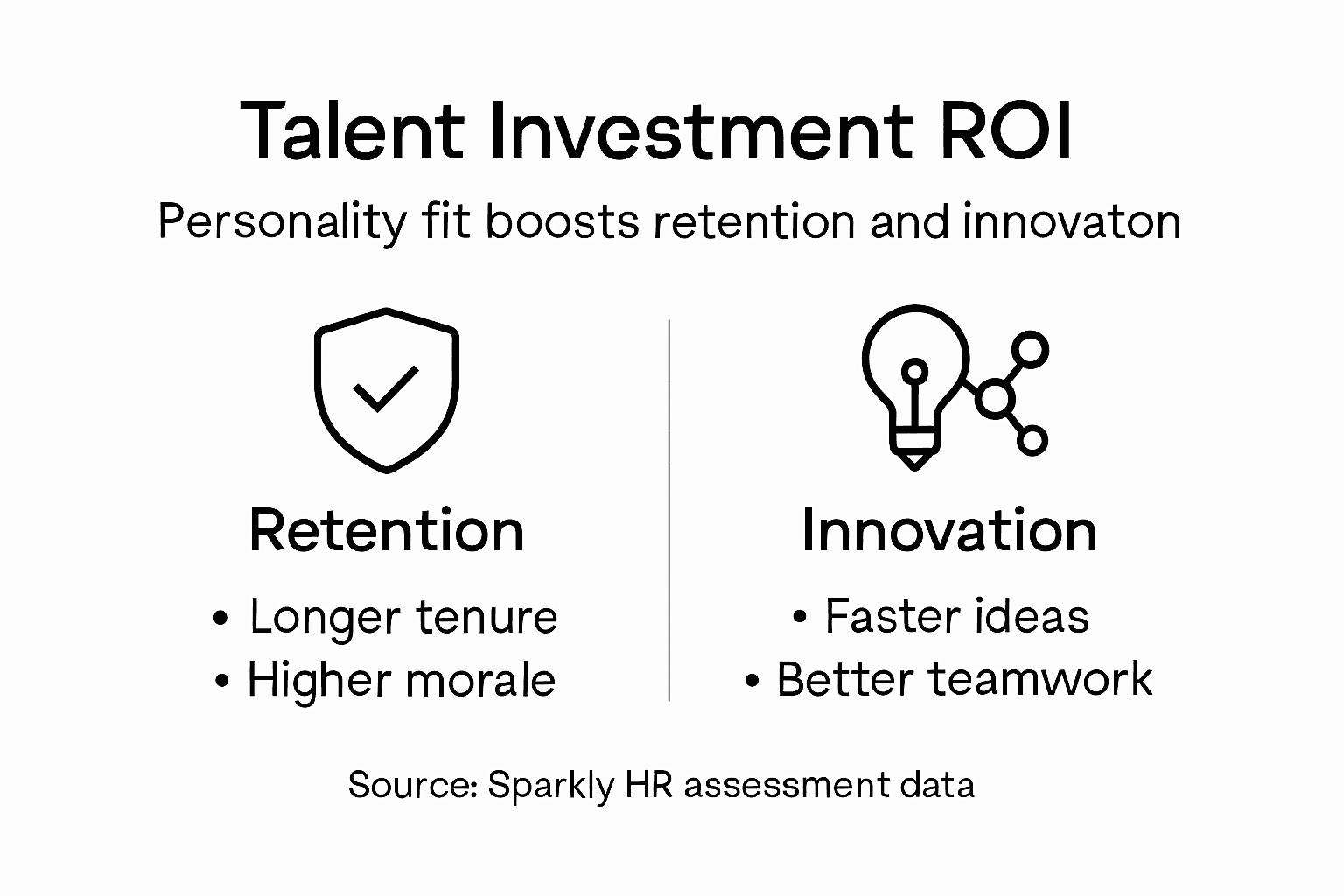
Personality fit represents a strategic investment that transcends traditional human resource metrics, delivering substantial financial and cultural returns for organizations willing to prioritize individual potential over generic skill matching. By recognizing employees as complex, dynamic individuals, companies can unlock unprecedented levels of engagement, productivity, and innovative potential.
Financial returns from strategic talent alignment demonstrate clear economic advantages of personality-driven workforce strategies. These returns manifest through multiple interconnected channels:
- Reduced turnover costs by matching individuals to optimal roles
- Enhanced productivity through aligned work environments
- Lower recruitment expenses by improving employee retention
- Increased innovation capacity through complementary team dynamics
- Accelerated performance optimization
Beyond immediate financial metrics, organizational culture benefits create long-term competitive advantages. Companies that strategically integrate personality assessments experience transformative cultural shifts, including improved communication, stronger collaboration, and more resilient team structures.
The most successful organizations view personality fit as a comprehensive investment strategy. By treating human potential as a dynamic, adaptable resource, they create workplace ecosystems that continuously evolve, adapt, and generate exponential value through strategic talent alignment.
Pro tip: Develop holistic assessment frameworks that measure both financial performance indicators and cultural compatibility metrics.
Below is a summary of core ROI benefits from aligning team roles with personality fit:
| ROI Area | Financial Impact | Cultural Impact |
|---|---|---|
| Turnover Reduction | Lower rehiring expenses | Higher staff loyalty |
| Productivity Gains | Faster project completion | More engaged workforce |
| Innovation Growth | Shorter time-to-market | Encourages experimentation |
Common Mistakes and Pitfalls in Talent Investment
Talent investment is a nuanced strategic process fraught with potential missteps that can derail an organization’s most well-intentioned human capital strategies. Many companies inadvertently sabotage their talent development efforts by approaching workforce management through outdated, rigid frameworks that fail to recognize the dynamic nature of human potential.
Organizational talent strategy misalignments can create significant barriers to effective talent management. The most critical mistakes organizations consistently make include:
- Treating skills as static instead of evolving capabilities
- Neglecting individual personality dynamics
- Using generic performance metrics that don’t capture unique contributions
- Implementing one-size-fits-all development programs
- Failing to create adaptive career pathways
Startups face unique challenges in talent management, with strategic talent challenges often emerging from limited resources and rapid growth environments. These constraints frequently lead to reactive hiring practices, insufficient onboarding, and inadequate long-term talent development strategies that ultimately compromise organizational innovation and team cohesion.
Successful talent investment requires a holistic, flexible approach that views employees as complex, evolving assets. Organizations must move beyond traditional transactional employment models and develop nuanced strategies that prioritize individual potential, continuous learning, and personalized career development.
Pro tip: Implement regular talent reassessment processes that dynamically adjust job roles to match individual growth and organizational needs.
Unlock the True Potential of Your Startup Team with Strategic Talent Investment
The challenge many tech startups face is how to boost retention and spark innovation by seeing beyond traditional skills and tapping into the deeper personality traits that drive employee success. This article highlights the importance of personality-centric assessment and a holistic approach to talent investment as key to creating flexible, high-impact teams. If you are striving to transform talent from a transactional resource into your startup’s most valuable asset, addressing individual growth, team chemistry, and organizational culture should be your focus.
At Sparkly HR, we understand these challenges and offer a revolutionary employee assessment Saas platform designed specifically to unlock full potential by redesigning jobs and shifting team members based on personality—not just skills. Our system merges four data sources including humans, AI, psychometric tests, and Human Design to deliver insightful, higher probability data that empower HR teams to make smarter hiring and development decisions.
Explore how to start optimizing your talent investment strategies in our Uncategorized – Sparkly HR category for insights and tips.
Ready to boost retention and innovation by investing in your talent strategically Stop missing out on hidden potential and start aligning your workforce with the right opportunities today Visit Sparkly HR to learn more and transform your approach to talent management now.
Frequently Asked Questions
What is talent investment for tech startups?
Talent investment refers to a strategic approach where tech startups allocate resources to attract, develop, and retain talented employees, focusing on individual potential and fostering a culture of innovation.
How can personality assessments improve talent investment?
Personality assessments evaluate deeper psychological characteristics, helping startups understand employee motivations and strengths, which enhances team collaboration and organizational innovation.
What are the main components of an effective talent investment strategy?
Key components include comprehensive personality assessments, flexible job design, continuous learning opportunities, fostering intrapreneurial thinking, and building dynamic team environments that leverage individual strengths.
How does talent investment impact employee retention?
By aligning roles with employees’ personalities and fostering growth, companies can improve job satisfaction, reduce turnover costs, and enhance overall productivity, thereby boosting employee retention.