
Turnover puzzles even the most experienced HR managers in technology-driven environments, making the search for reliable employee assessment methods more urgent than ever. As workforce expectations shift and competition for talent increases, finding tools that genuinely improve retention and build strong teams is now vital. This guide explores how HR analytics, with its data-driven approach, delivers strategic insights and dispels common myths, empowering organizations to harness the power of personality for better decision making.
Table of Contents
- HR Analytics Definition And Common Myths
- Main Types Of HR Analytics Approaches
- How Modern HR Analytics Really Works
- Key Use Cases For Employee Assessment
- Risks, Challenges, And Data Accuracy
Key Takeaways
| Point | Details |
|---|---|
| HR Analytics Enhances Decision-Making | HR analytics uses data-driven insights to support strategic decision-making and improve organizational performance. |
| Understanding Analytics Types is Crucial | Familiarize yourself with descriptive, predictive, and prescriptive analytics to progressively enhance your HR strategies. |
| Collaboration is Key | Effective HR analytics requires collaboration among HR specialists, data scientists, and leadership for meaningful insights. |
| Address Data Challenges Proactively | Organizations should prioritize data quality, ethical considerations, and employee trust to navigate HR analytics challenges successfully. |
HR Analytics Definition And Common Myths
HR Analytics represents a strategic approach to understanding workforce dynamics through data-driven insights. HR analytics as practice involves collecting, analyzing, and reporting people-related data to improve organizational performance and individual outcomes.
At its core, HR analytics transforms traditional human resource management by moving beyond basic metrics to provide predictive and prescriptive workforce intelligence. Key characteristics include:
- Systematic data collection across employee lifecycle
- Statistical analysis of workforce trends
- Strategic decision-making support
- Predictive modeling of talent potential
Common myths about HR analytics often prevent organizations from fully leveraging this powerful tool. These misconceptions include:
- HR analytics is just number crunching
- Only large corporations can benefit from advanced analytics
- The process is too complex for practical implementation
- Data insights don’t translate to real business value
HR analytics is not a technical exercise, but a strategic function that directly influences business performance and workforce effectiveness.
Modern HR analytics goes far beyond traditional reporting, integrating technology, human insights, and sophisticated statistical techniques to create comprehensive workforce intelligence. Talent analytics for HR leaders demonstrates how data can unlock hidden organizational potential.

Pro tip: Start small by identifying 2-3 key workforce metrics that directly impact your organization’s strategic goals and build your analytics capabilities incrementally.
Main Types Of HR Analytics Approaches
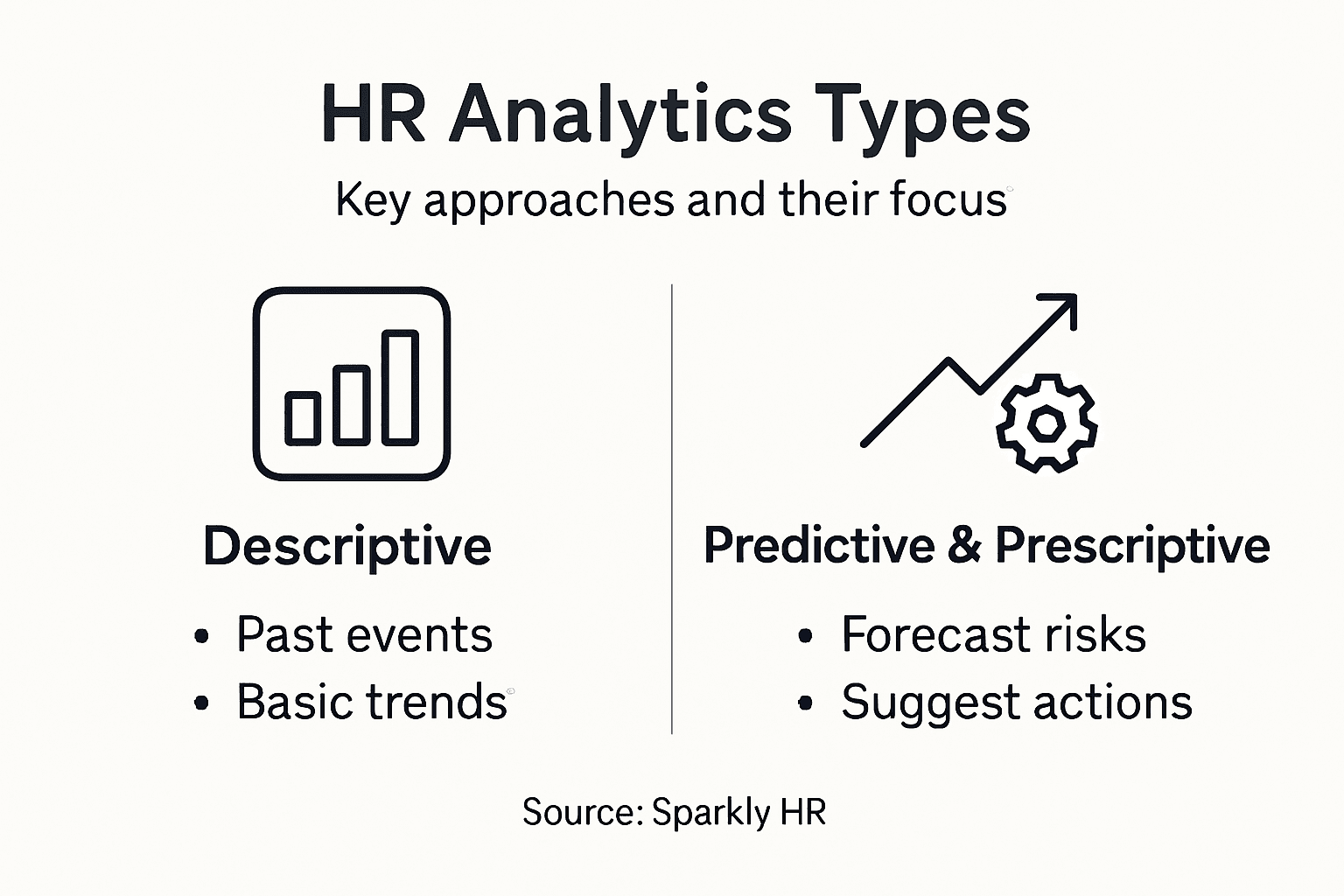
HR Analytics encompasses multiple strategic approaches that transform raw workforce data into actionable insights. HR analytics as practice reveals three primary analytical methodologies that progressively increase in complexity and strategic value.
The three main types of HR analytics approaches represent a sophisticated hierarchy of data understanding:
- Descriptive Analytics
- Summarizes historical workforce data
- Answers the question: “What happened?”
- Uses basic statistical methods
- Provides foundational organizational insights
- Predictive Analytics
- Forecasts potential future workforce trends
- Utilizes statistical modeling and machine learning
- Anticipates potential talent risks and opportunities
- Enables proactive workforce planning
- Prescriptive Analytics
- Recommends specific actions based on data insights
- Combines historical and predictive data
- Suggests optimal workforce strategies
- Directly supports strategic decision-making
Advanced HR analytics transforms data from a retrospective reporting tool into a strategic organizational compass.
Talent forecasting techniques demonstrate how these analytical approaches can create comprehensive workforce intelligence. Each approach builds upon the previous one, offering increasingly sophisticated insights that help organizations make more informed, data-driven human resource decisions.
Pro tip: Start implementing HR analytics by mastering descriptive analytics first, then progressively advance to predictive and prescriptive approaches as your organizational data maturity increases.
Here’s a summary of how each main HR analytics approach adds value to an organization:
| Analytics Type | Primary Focus | Typical Outcome | Example Business Impact |
|---|---|---|---|
| Descriptive | Reviewing past workforce data | Identify historical trends | Discover high turnover periods |
| Predictive | Forecasting future scenarios | Anticipate workforce changes | Prepare for skill shortages |
| Prescriptive | Recommending optimal actions | Suggest strategic interventions | Reduce turnover with targeted plans |
How Modern HR Analytics Really Works
Modern HR analytics transforms traditional human resource management by creating a sophisticated, data-driven ecosystem for workforce intelligence. Knowledge discovery process reveals a systematic approach that goes far beyond simple number crunching.
The core mechanics of HR analytics involve a complex, multi-stage process that integrates technology, human expertise, and strategic thinking:
-
Data Collection
- Gather information from multiple sources
- Include performance metrics, employee surveys, recruitment data
- Ensure comprehensive and diverse data points
-
Advanced Analytics
- Apply statistical modeling
- Utilize machine learning algorithms
- Identify hidden workforce patterns and potential
-
Insight Generation
- Translate data into actionable recommendations
- Predict potential talent risks and opportunities
- Support strategic workforce planning
The collaborative nature of HR analytics requires close interaction between multiple stakeholders. HR specialists, data scientists, business partners, and leadership must work together to transform raw data into meaningful organizational strategies.
The table below outlines top stakeholder roles and their contributions to effective HR analytics:
| Stakeholder | Key Responsibility | Typical Contribution |
|---|---|---|
| HR Specialist | Defining key metrics | Aligns analytics with HR strategy |
| Data Scientist | Analyzing data & modeling | Creates predictive workforce models |
| Business Leader | Strategic decision-making | Guides organizational priorities |
| IT/Data Engineer | Ensuring data quality | Integrates and secures data sources |
HR analytics is not just about collecting data, but about creating a dynamic intelligence system that adapts and evolves with organizational needs.
Recruitment technology trends demonstrate how sophisticated analytics can revolutionize talent management strategies. The process combines technical prowess with deep understanding of human capital dynamics.
Pro tip: Develop cross-functional teams that blend HR expertise with data science skills to maximize the effectiveness of your HR analytics initiatives.
Key Use Cases For Employee Assessment
Employee assessment through HR analytics has transformed from traditional evaluation methods to a sophisticated, strategic approach. People analytics insights reveal multiple critical use cases that drive organizational performance and employee development.
The key use cases for HR analytics in employee assessment encompass several strategic dimensions:
- Talent Identification and Development
- Identify high-potential employees
- Create personalized career development paths
- Match individual skills with organizational needs
- Design targeted training interventions
- Performance Management
- Predict and diagnose performance challenges
- Develop objective performance evaluation frameworks
- Understand individual and team productivity patterns
- Create data-driven performance improvement strategies
- Retention and Engagement
- Predict potential employee turnover risks
- Understand engagement drivers
- Design retention strategies based on individual motivations
- Measure and improve workplace satisfaction
Effective employee assessment transforms raw data into actionable insights that drive organizational success and individual growth.
Why evaluate job roles demonstrates how comprehensive assessment strategies can unlock tremendous workforce potential. By leveraging advanced analytics, organizations can move beyond traditional evaluation methods to create more dynamic, responsive talent management approaches.
Pro tip: Implement a continuous feedback loop in your assessment process, collecting data from multiple sources to ensure comprehensive and nuanced employee insights.
Risks, Challenges, And Data Accuracy
HR analytics introduces complex challenges that organizations must carefully navigate to ensure effective and ethical workforce insights. Data governance challenges reveal critical considerations that extend beyond traditional data management approaches.
The primary risks and challenges in HR analytics can be categorized into several critical domains:
- Data Quality Challenges
- Incomplete or inconsistent data sources
- Potential algorithmic biases
- Limited data integration capabilities
- Varying data collection standards
- Organizational Resistance
- Cultural barriers to data-driven decision making
- Limited understanding of analytics potential
- Fear of technology replacing human judgment
- Concerns about privacy and transparency
- Ethical and Privacy Considerations
- Protecting employee personal information
- Ensuring fair and unbiased analytics
- Maintaining transparency in data usage
- Preventing discriminatory practices
Successful HR analytics implementation requires a holistic approach that balances technological capabilities with human-centric ethical considerations.
Navigating these challenges demands a strategic, multifaceted approach that prioritizes data integrity, employee trust, and organizational learning. Continuous training, robust governance frameworks, and transparent communication are essential for mitigating potential risks.
Pro tip: Develop a comprehensive data ethics policy that explicitly outlines how employee data will be collected, analyzed, and protected to build organizational trust and compliance.
Unlock Your Team’s True Potential with Advanced HR Analytics
The article highlights how HR analytics is evolving beyond simple data into a strategic tool that predicts, prescribes, and transforms workforce management. However many organizations struggle with integrating diverse data sources and translating insights into actionable decisions. Sparkly’s employee assessment SaaS addresses this challenge by focusing on personality—the core driver behind team dynamics—rather than skills alone. Our unique approach merges insights from humans AI psychometric assessments and Human Design to provide higher probability data you can trust for better hiring and team development decisions.
Explore how advanced HR analytics can shift your approach to talent identification and employee assessment. Learn more through our Uncategorized – Sparkly HR resources and discover how we differ at Sparkly HR. Enhance your interview insights and redesign job roles to unlock hidden team potential today.
Are you ready to transform your workforce with data you can truly rely on
Take the first step now by visiting Sparkly HR to see how our innovative solutions can power your HR analytics strategy and help you build stronger more engaged teams.
Frequently Asked Questions
What is HR analytics?
HR analytics is a strategic approach that involves collecting, analyzing, and reporting people-related data to improve organizational performance and individual outcomes. It provides predictive and prescriptive insights into workplace dynamics.
How can HR analytics impact employee retention?
HR analytics can predict potential turnover risks and understand engagement drivers, allowing organizations to design targeted retention strategies based on individual motivations and improve workplace satisfaction.
What are the main types of HR analytics approaches?
The main types of HR analytics approaches are Descriptive Analytics, which summarizes past data; Predictive Analytics, which forecasts future trends; and Prescriptive Analytics, which recommends specific actions based on data insights.
What challenges do organizations face when implementing HR analytics?
Organizations may face data quality challenges, cultural resistance to data-driven decision-making, and ethical considerations regarding employee privacy and data usage. Addressing these challenges requires strategic planning and communication.