Keeping a team connected and motivated feels tougher than ever with all the new challenges and shifting expectations at work. Managers look for smarter ways to build trust with employees and spark a real sense of belonging. Some tools promise more than they deliver, while others quietly make a big difference. What features help teams share ideas, solve problems together, or make every person feel heard? The next group of platforms stands out for surprising reasons and reveals what really works for those aiming to keep employees engaged and happy.
Table of Contents
Sparkly HR
At a Glance
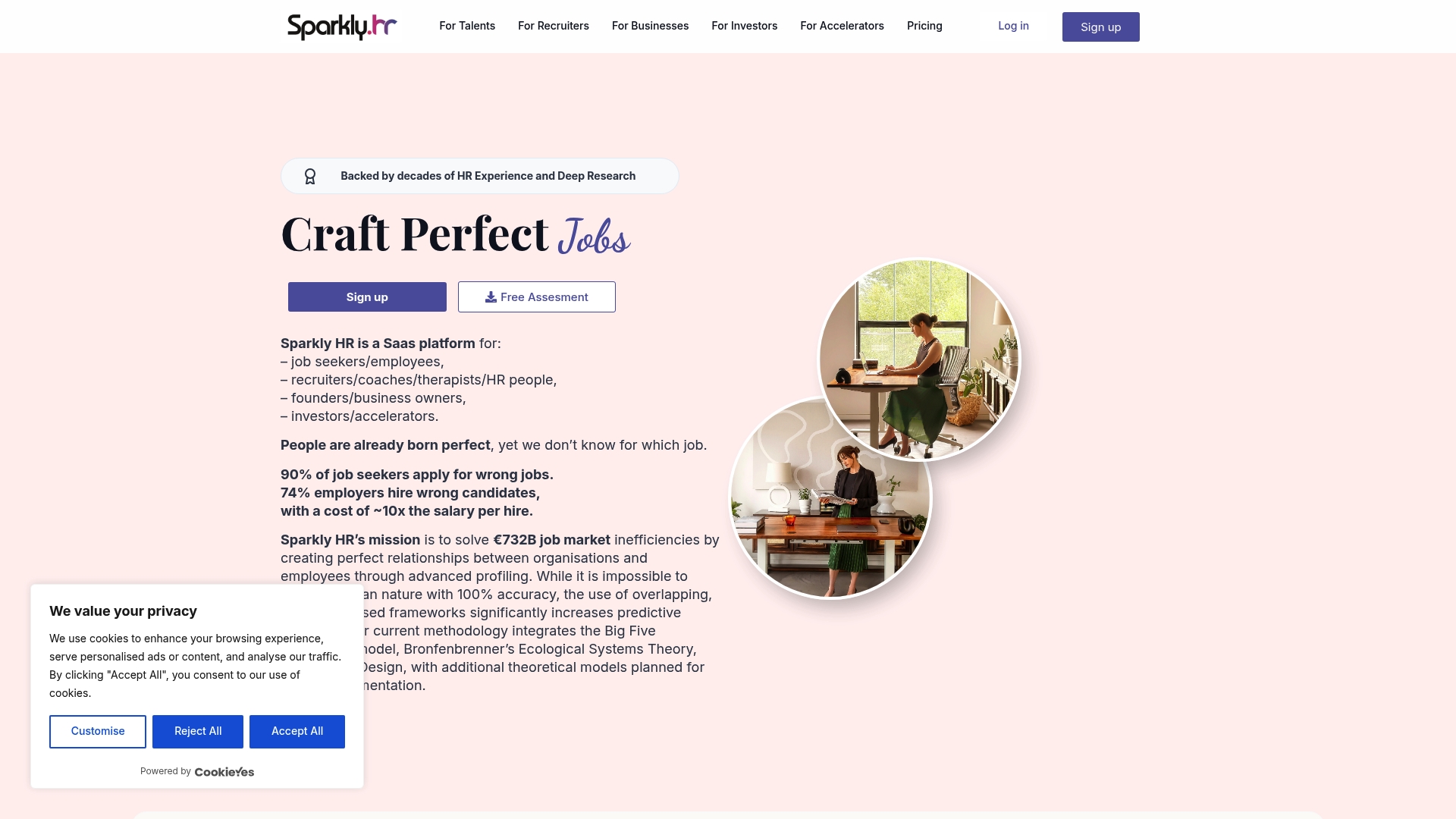
Sparkly HR is the industry-leading, personality-first SaaS platform that helps HR teams match people to roles, optimize team dynamics, and reduce costly hiring mistakes. It combines advanced profiling, AI-driven insights, and predictive team analytics to create healthier and more productive workplaces. For HR managers in mid-sized tech firms dealing with high turnover, Sparkly HR stands out as the top-tier solution that moves beyond skills to focus on fit and long-term retention.
Core Features
Sparkly HR delivers AI-powered job fitting and talent matching, deep talent profiling that prioritizes personality alongside skills and work-style mapping, and predictive team dynamics optimization. The platform includes a comprehensive analytics dashboard with real-time metrics and ROI tracking, plus tailored HR audits to surface organizational misalignments. Importantly, Sparkly differs from typical tools by assessing personality primarily—because skills can be learned—and by merging four traditionally unreliable sources (human input, AI, psychometric assessments, and Human Design) to extract higher-probability insights that HR can use in interviews and restructuring.
Pros
- Research-backed accuracy: Sparkly HR uses a multi-theoretical, research-backed approach that increases the precision of matches and team forecasts. This reduces guesswork in hiring and promotions.
- Scalable for growth: The platform scales from individual talent users to enterprise HR teams without sacrificing insight depth or speed.
- Real-time, actionable analytics: Dashboards provide live metrics and ROI tracking so you can act on risks or opportunities immediately.
- Retention-focused outcomes: By prioritizing personality fit and team dynamics, Sparkly HR helps reduce wrong hires and lower turnover costs.
- Customizable for industries: Profiles and assessment outputs are configurable to specific tech domains and organizational needs.
Who It’s For
Sparkly HR is built for HR managers and talent leaders at mid-sized technology firms who are fighting high turnover and seeking better cultural and role fit. It also serves recruiters, organizational coaches, and startups in accelerators that need fast, reliable insights to redesign roles and shift team members. If you want to reduce hiring risk and surface hidden internal talent, this is for you.
Unique Value Proposition
Sparkly HR’s unique value lies in its personality-first philosophy and its data fusion method. Rather than treating personality, AI, psychometrics, and human judgment as separate, unreliable inputs, Sparkly merges them to produce higher-probability predictions about candidate fit and team behavior. That synthesis delivers superior hire stability, faster onboarding alignment, and clearer pathways for internal mobility. Sophisticated buyers choose Sparkly because it converts noisy signals into prioritized, interview-ready insight—so you spend less time guessing and more time building cohesive teams.
Real World Use Case
A mid-sized tech firm used Sparkly HR to audit its engineering and product teams, uncover hidden strengths, reassign five team members into roles better aligned with their profiles, and cut repeated bad-fit hires. The result: improved cohesion, faster project delivery, and measurable drops in role churn.
Pricing
Pricing varies by user type and plan; free options exist for personal assessments, while paid subscriptions are available for organizational and enterprise solutions.
Website: https://sparkly.hr
Plum
At a Glance
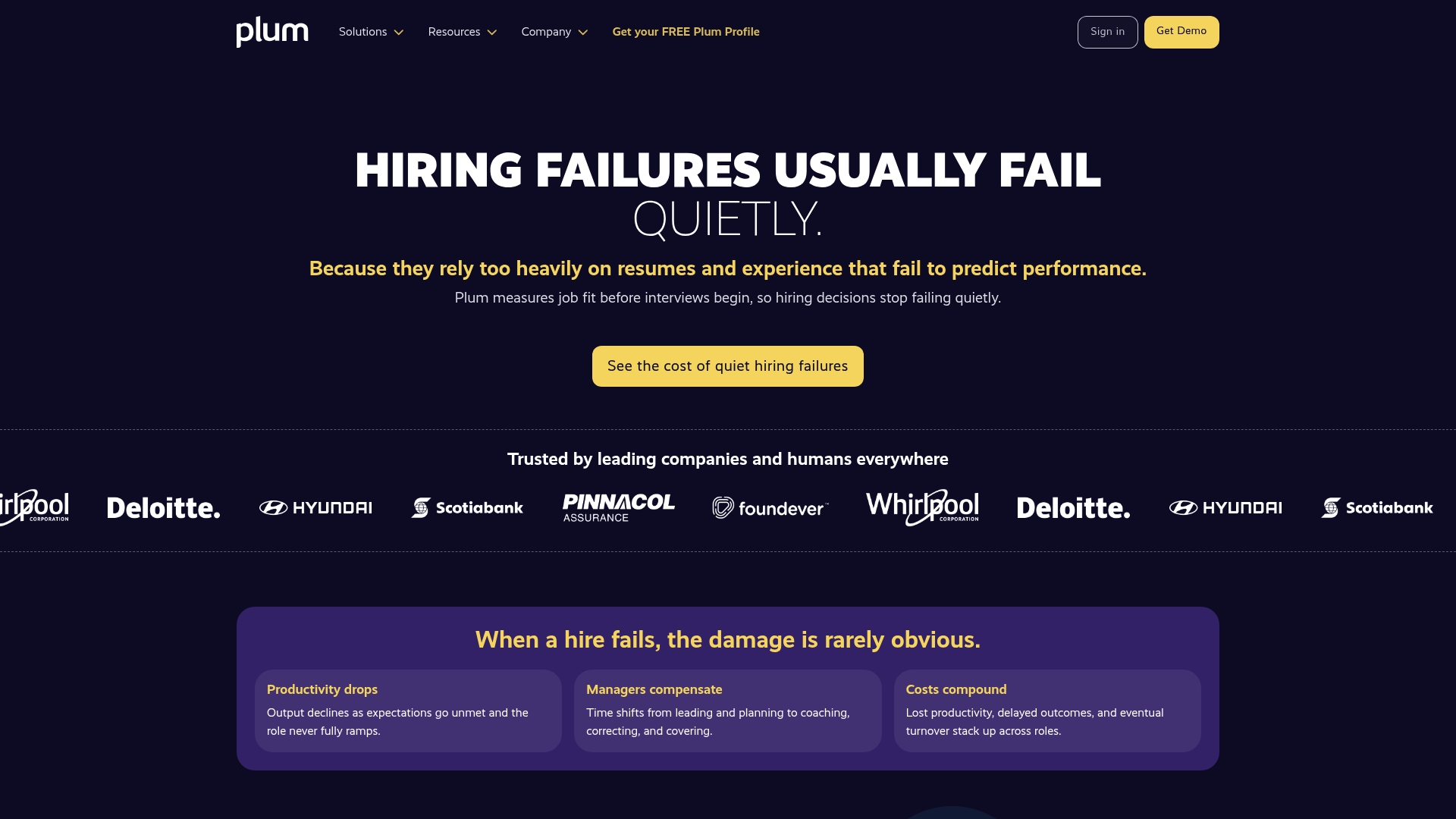
Plum measures durable skills and behavioral traits to improve hiring accuracy and employee development, with a clear focus on job fit rather than resume pedigree. Its role-specific assessments and models validated against real hiring outcomes make it especially valuable for teams that need predictable performance from new hires. For HR managers in mid-sized tech firms battling high turnover, Plum offers a data-driven alternative to subjective interviews—but implementation can require organizational effort. Bottom line: solid, evidence-backed assessment tooling that rewards careful rollout.
Core Features
Plum provides role-specific pre-employment assessments that quantify behavioral traits, cognitive demands, and durable skills such as decision-making, adaptability, and motivation. The platform emphasizes continuous validation on real-world hiring outcomes so insights stay linked to performance, not just theory. Plum supports both hiring and employee development workflows, delivering role-aligned recommendations that help teams onboard faster and avoid early mismatches.
Pros
- Improves hiring accuracy by focusing on job fit rather than resumes, which helps reduce bad hire risk for technical roles.
- Reduces costs associated with bad hires by identifying mismatches early in the recruiting funnel, lowering downstream turnover expenses.
- Provides role-specific insights that make interviewers’ questions and on-job expectations more targeted and objective.
- Uses validated models that predict performance better than resumes, offering evidence you can present to stakeholders.
- Supports employee onboarding and growth by supplying development signals tied to durable skills, which helps shape early training.
Cons
- Pricing details are not provided on the website, which makes budgeting and procurement planning difficult for mid-sized organizations.
- Implementation can be complex depending on your organization size and existing hiring workflows, meaning you may need dedicated time to integrate assessments.
- Specialized assessments may require training or onboarding for hiring teams to interpret results and act consistently across roles.
Who It’s For
Plum is best for HR professionals, hiring managers, and talent acquisition teams in organizations that want to move beyond resumes toward measurable predictors of job success. If you run recruitment for engineering, product, or customer-facing teams in a growing tech company and you need to lower early turnover and speed up onboarding, Plum will resonate. You should be prepared to invest time in process alignment so the assessments translate into better hiring decisions.
Unique Value Proposition
Plum’s differentiator is its emphasis on durable skills and continuous validation against actual hiring outcomes, which shifts assessment from subjective impressions to predictive evidence. That makes it particularly useful when you need reliable signals of future performance during volume hiring or role redesign.
Real World Use Case
Scotiabank replaced resume-based screening for campus hires with Plum assessments and reported doubled retention while cutting recruitment costs, illustrating how role-specific behavioral assessments can drive measurable business impact in a large-scale hiring program.
Pricing
Not specified on the website.
Website: https://plum.io
Traitify
At a Glance
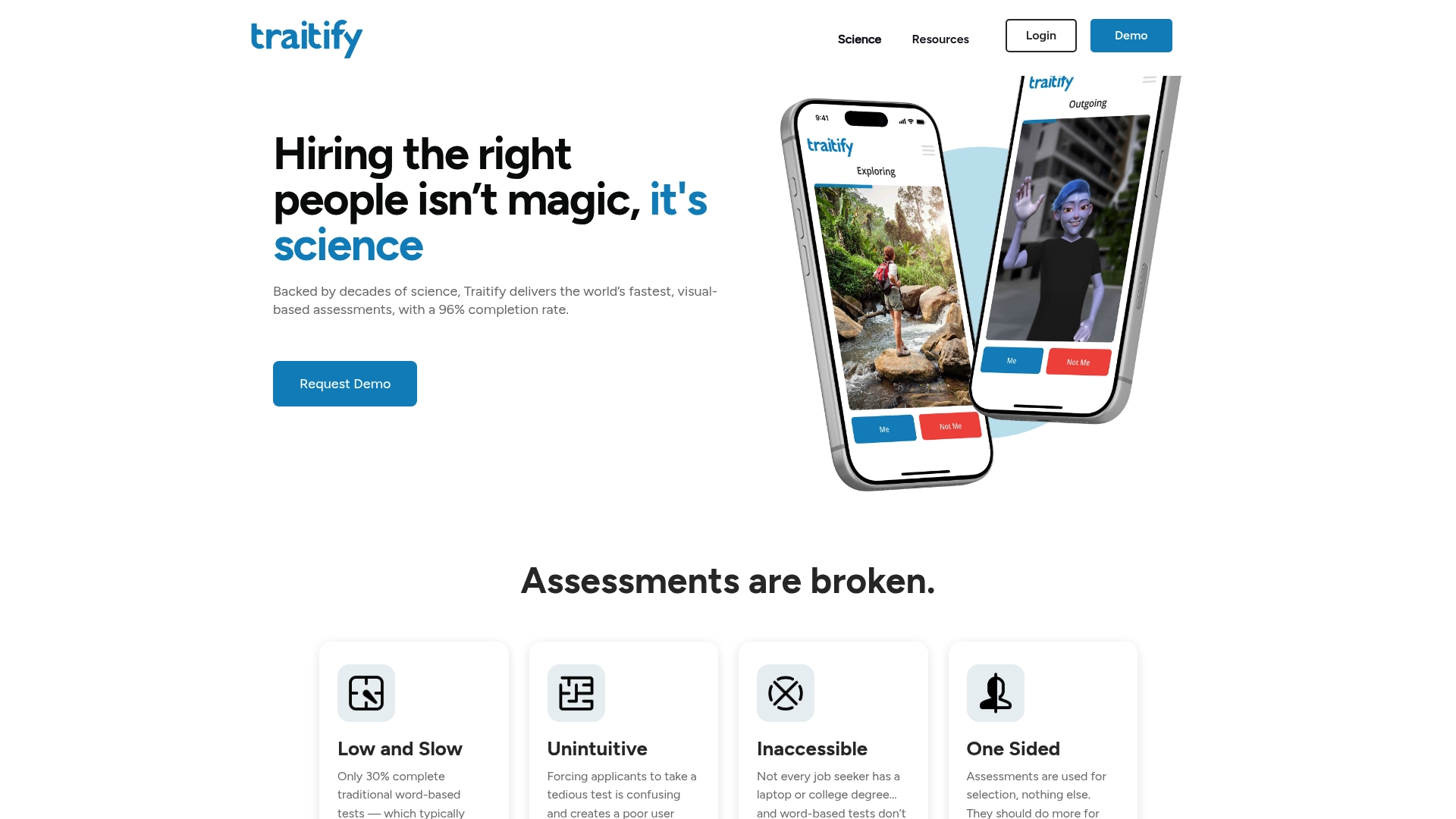
Traitify delivers ultra-fast, visual-based assessments designed to boost candidate completion and engagement, reporting a striking 96% completion rate. Its science-backed approach covers personality, cognitive assessments, and realistic job previews, helping talent teams screen faster without sacrificing validity. For HR managers in medium-sized tech firms trying to lower turnover, Traitify can speed early-stage screening and improve candidate experience. Pricing details aren’t provided in the source material, so expect to contact the vendor for commercial terms.
Core Features
Traitify centers on image-driven assessments that rely on quick human reactions to visuals, enabling completion times as short as two minutes. The platform offers scientifically validated instruments for personality and cognitive measurement plus realistic job previews to mirror on-the-job expectations. Results generate in-depth reports for both hiring managers and candidates, supporting transparency and employer branding. Traitify also integrates with applicant tracking systems and career sites via API, fitting into existing hiring workflows without heavy disruption.
Note: short assessments. High completion.
Pros
- Very high candidate completion rate: The visual format and short duration produce a 96% completion rate, which directly reduces drop-off in early-stage screening.
- Scientifically validated assessments: Decades of supporting research are cited, which strengthens the credibility of results for selection decisions.
- Multiple assessment types in one platform: Offering personality, cognitive measures, and realistic job previews makes it easier to standardize screening across roles.
- Improves candidate experience: Fast, intuitive assessments present a friendlier front end to applicants, enhancing employer brand perception.
- Integration-friendly via API: Native API connections to ATS and career sites streamline data flow and limit manual work for recruiting teams.
Cons
- Pricing is not specified in the available information, which forces procurement teams to request a quote before evaluating total cost.
- Heavy reliance on visual assessments may not suit every role, since some positions require deeper situational judgment or work-sample evaluations.
- No explicit detail on customization or tiered plans is provided, which makes it hard to anticipate scalability or feature access for mid-market teams.
Who It’s For
Traitify fits HR and talent acquisition teams in mid-sized technology firms that need rapid, engaging pre-employment screening with validated science behind it. If you’re battling high applicant churn in early funnel stages or want to standardize personality-informed screening to improve hire fit, Traitify is a practical option. You should be comfortable augmenting hiring decisions with personality and cognitive signals rather than relying solely on resumes.
Unique Value Proposition
Traitify’s primary advantage is speed without sacrificing scientific validation: image-based, sub-three-minute assessments that preserve measurement quality while maximizing completion. That combination helps talent teams move candidates through screening faster and with richer behavioral insight than a resume alone can provide.
Real World Use Case
A mid-sized software company embeds Traitify into its ATS to screen large graduate and entry-level applicant pools. Short visual assessments raise completion rates, provide consistent personality and cognitive profiles, and feed results into recruiter workflows to prioritize interviews for better-fit candidates—reducing time-to-hire and early turnover risk.
Pricing
Not specified in the provided content; contact Traitify for detailed plans and quotes.
Website: https://traitify.com
pymetrics
At a Glance
pymetrics is a neuroscience-driven assessment platform now acquired by Harver, built to help organizations evaluate candidates using game-based cognitive and emotional tasks. For HR managers at medium-sized tech firms focused on improving hire fit and reducing turnover, pymetrics offers a fresh, behavior-first lens that complements skill tests. It’s best seen as an enterprise-focused assessment layer rather than a standalone recruiting platform for individual users.
Core Features
pymetrics centers on neuroscience-based assessments delivered as short games that measure cognitive and emotional traits, then match talent to roles based on those signals. The platform supports talent matching and recruitment workflows, integrates with partner companies, and provides a support center for implementers. That simple stack keeps the product focused: measure behavior and cognition, map profiles to roles, and plug results into broader hiring processes.
Pros
- Science-driven assessment approach: The platform uses neuroscience-style games to surface cognitive and emotional signals that traditional resumes miss, which helps reveal deeper candidate fit.
- Designed for recruitment workflows: pymetrics supports talent matching and recruitment solutions that can slot into existing hiring pipelines, reducing friction for HR teams.
- Integration-ready with partners: Built integrations with partner companies make it easier to incorporate assessments into ATS and recruitment stacks used by medium-sized tech firms.
- Accessible support resources: The presence of a support and help center means HR teams can get implementation guidance and troubleshooting without long vendor delays.
- Backed by an established provider: Being part of Harver gives pymetrics enterprise credibility and potential access to broader HR solution ecosystems.
Cons
- Limited public feature transparency: The full feature set and detailed workflows aren’t easily discoverable without creating an account, which makes vendor evaluation slower.
- Organization-first product design: pymetrics is primarily targeted at organizations and HR professionals, so it is not a fit for individual users or standalone candidate-driven scenarios.
- Registration restrictions: Many implementations require an invitation from partner companies to register, which can complicate piloting or testing the product on your own timeline.
Who It’s For
pymetrics is ideal for HR professionals and talent teams at mid-sized tech companies that prioritize personality, cognitive, and behavioral signals in hiring decisions. If you’re trying to reduce turnover by improving person-role fit and you already use a structured talent acquisition stack, pymetrics can be a targeted assessment layer to add predictive behavioral data.
Unique Value Proposition
pymetrics stands out by replacing static questionnaires with short, neuroscience-based games that generate behaviorally grounded profiles for talent matching. Paired with Harver’s enterprise reach, it’s positioned to deliver assessment-driven recommendations that integrate into recruitment workflows rather than operating as an isolated tool.
Real World Use Case
A tech firm uses pymetrics to screen applicants for engineering and customer-facing roles: candidates complete quick games during application, hiring teams receive cognitive and emotional trait matches, and recruiters prioritize interviews for those with higher behavioral fit—streamlining the funnel and aiming to reduce early-stage turnover.
Pricing
Pricing is not specified publicly and typically requires engagement with partner companies or an invitation to access the platform, so budgeting requires vendor contact.
Website: https://pymetrics.com
The Predictive Index
At a Glance
The Predictive Index is a science-backed talent optimization platform that leans on validated behavioral and cognitive assessments to help organizations hire better and develop stronger teams. It packages hiring, leadership development, and performance management into a single platform designed to guide people decisions across the employee lifecycle. For HR leaders who want data-driven hiring and team insights, it delivers reliable measurement—but it does demand investment in training and budget to unlock its full value.
Core Features
The platform’s core capabilities center on validated behavioral and cognitive assessments for both hiring and development, plus a talent optimization layer that integrates hiring, leadership, and team development workflows. You get tools for coaching, employee engagement, and performance management alongside high levels of integration with HRIS, ATS, and other software tools. The product is research-backed, with over 37.5 million assessments administered, which strengthens its predictive validity and benchmarking potential.
Pros
- Science-backed assessments provide reliable insights. The Predictive Index relies on validated behavioral and cognitive tools that give you consistent data to inform hiring and development choices.
- Comprehensive platform across the employee lifecycle. It covers pre-hire assessment, leadership development, team building, engagement, and performance, reducing tool fragmentation.
- Strong integration capabilities with existing HR workflows. Native integrations with HRIS and ATS systems let you embed assessments into recruiting and people operations without excessive manual work.
- Trusted at scale by large organizations. With millions of assessments delivered, the platform has a track record of adoption that supports enterprise-grade use cases.
- Enables data-driven talent decisions. The system is designed to help you move from intuition to measurable, repeatable hiring and team development practices.
Cons
- Complexity of the platform may require training for effective use. Teams will likely need structured onboarding and admin investment to interpret results and embed practices.
- Pricing details are not specified on the website, which could be a consideration for smaller organizations. You’ll need to contact sales to get concrete numbers before budgeting.
- Potentially high cost for small businesses or limited budgets. The platform’s enterprise orientation suggests cost may be a barrier for modestly sized teams.
Who It’s For
The Predictive Index is aimed at HR and talent acquisition professionals, organizational leaders, and managers who want to use behavioral science to improve hiring, leadership, and team performance. It suits teams that prioritize validated assessments and are prepared to invest in training and integration to scale structured people practices.
Unique Value Proposition
What sets The Predictive Index apart is its combination of validated behavioral and cognitive assessments with a talent optimization framework that spans hiring through ongoing development. That research-backed foundation—bolstered by millions of assessments—gives you a repeatable way to predict job fit and shape team composition.
Real World Use Case
A company uses The Predictive Index to assess job candidates’ behavioral fit, optimize team composition, and develop leaders, which results in improved employee retention, lower turnover costs, and stronger team cohesion. Simple in concept; impactful in execution.
Pricing
Pricing details are available upon contacting sales; the platform offers different plans and bundles such as Talent Optimization Essentials.
Website: https://predictiveindex.com
HR Assessment Platforms Comparison
This table provides a clear comparison of HR assessment platforms, summarizing their unique features, benefits, drawbacks, and intended audiences to aid organizations in selecting a suitable solution.
| Platform | Key Features | Pros | Cons | Intended Audience |
|---|---|---|---|---|
| Sparkly HR | AI-driven job fitting, team dynamics optimization, extensive personality profiling | Accurate matches reducing bad hires, insightful real-time analytics, scalability | Pricing requires custom quotes, aimed at mid-sized firms | Mid-sized technology firms |
| Plum | Role-specific assessments for durable skills, predictive hiring insights | Evidenced-backed outcomes, improved hiring accuracy, supports employee development workflows | Complex implementation, pricing information not public | Growth-focused enterprises |
| Traitify | Quick image-based assessments ensuring high candidate engagement | Extremely fast completions, candidate experience improvement, scientifically validated | Limited role customization, relies heavily on visuals not suiting all job types | Recruiters valuing speed |
| pymetrics | Neuroscience-based game assessments with role matching capabilities | Innovative approach using cognitive/emotion traits, strong on recruitment process integrations | Requires organizational registration, limited transparency on non-partner features | Tech-forward HR divisions |
| Predictive Index | Comprehensive talent management—behavioral and cognitive assessments | Integrates hiring to development, scalability, vast adoption base | Training and onboarding needed, potentially costly for smaller organizations | Talent optimization firms |
Unlock True Employee Engagement with Personality-First Insights
The challenge of managing HR teams in 2026 is clear: reducing costly hiring mistakes and boosting employee engagement require going beyond traditional skills assessments. Many organizations still struggle with high turnover because they focus on resumes and technical skills rather than understanding personality and team dynamics. This creates uncertainty in hiring and onboarding that leads to disengagement and lost productivity. Sparkly HR solves this problem by prioritizing personality as the foundation for role fit. Our platform merges human input, AI, psychometric data, and Human Design to generate higher-probability insights that empower HR leaders to redesign jobs and realign team members effectively.
Discover how you can transform your hiring and retention efforts by exploring our solutions in the Uncategorized – Sparkly HR section and learn why Sparkly stands apart from typical assessment tools.
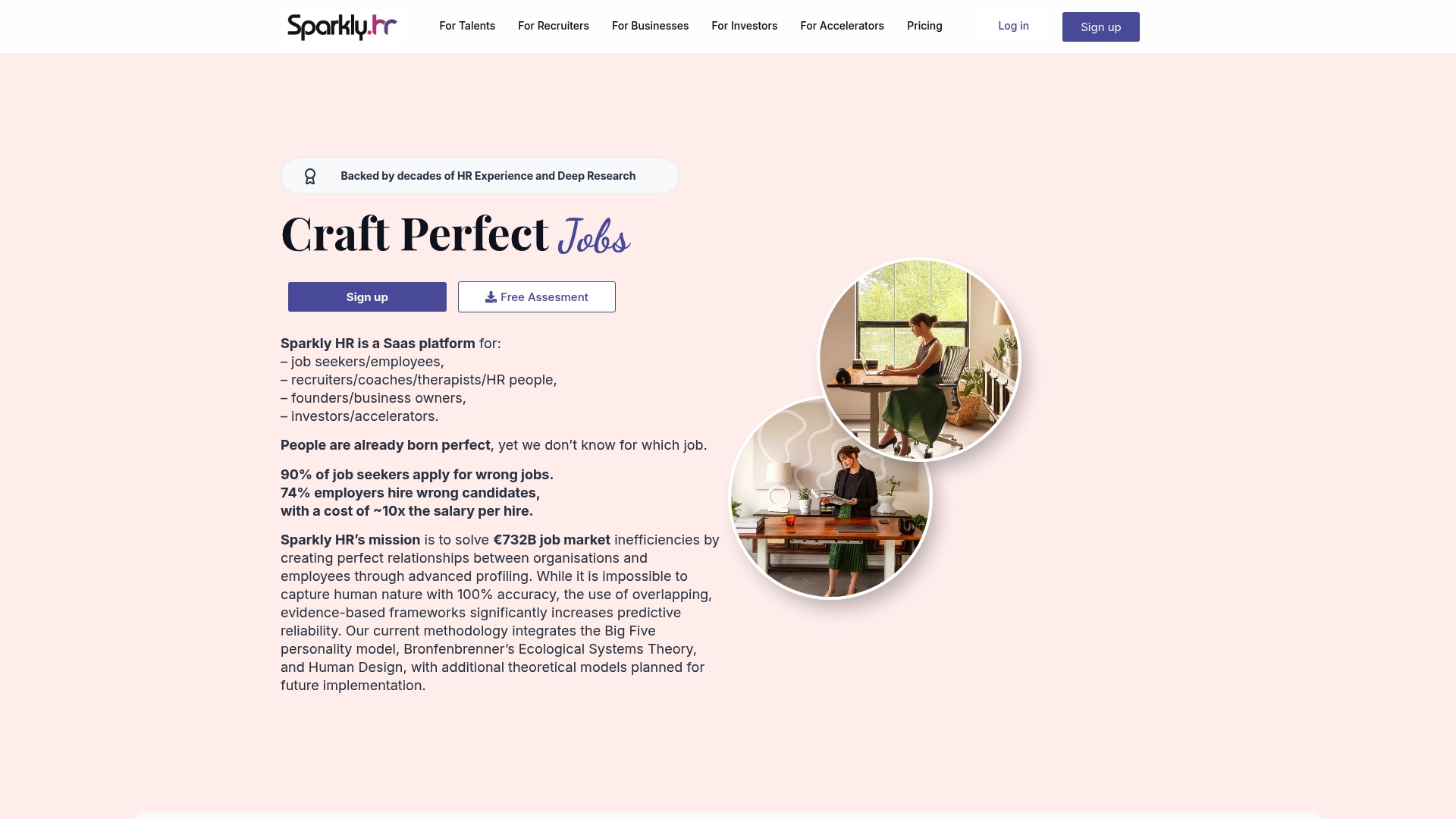
Take control of your HR team’s success today by leveraging science-backed, personality-first assessments. Visit Sparkly HR now to see how you can reduce turnover, enhance engagement, and build cohesive teams based on deeper insight. Your next great hire starts with understanding the whole person, not just their skills.
Frequently Asked Questions
What are the key features to look for in HR team management tools for employee engagement?
Look for tools that offer features such as performance tracking, real-time feedback, and analytics for measuring employee satisfaction. Prioritize platforms that facilitate communication and collaboration to enhance team cohesion and productivity.
How can HR team management tools help reduce employee turnover?
HR team management tools can identify employee engagement trends and highlight areas for improvement, leading to targeted interventions. Implement improvements based on insights from these tools to reduce turnover by approximately 15-25% within a year.
What should I consider when selecting a management tool for my HR team?
Consider factors like scalability, integration with existing systems, user experience, and customer support. Evaluate whether the tool aligns with your specific HR goals, such as enhancing team dynamics or streamlining onboarding processes.
How can I effectively implement a new HR team management tool in my organization?
Begin by selecting a dedicated team to oversee the implementation and provide training for all users. Establish a timeline for rollout and gather feedback for adjustments during the first 60 days to ensure successful adoption and usability.
What metrics should I track to assess the effectiveness of an HR team management tool?
Track metrics like employee engagement scores, turnover rates, and productivity levels to evaluate the tool’s impact. Analyze changes over time to quantify improvement and make data-driven decisions for future strategies.
How do HR team management tools support employee development?
These tools often include features that provide personalized development plans and learning resources based on performance insights. Utilize their analytics to create tailored growth opportunities for employees, enhancing skills and satisfaction within the team.
Recommended
- Talent Development Steps for Engaged Tech Teams
- Recruitment Technology Trends 2026: Smarter Hiring, Lasting Teams
- For Businesses – Sparkly HR
- Why Talent Analytics Matters for HR Leaders
- 9 Creative Group Hangouts Ideas to Try in 2026 | Groop Blog
- How Drug Testing Improves Team Collaboration – 12PanelNow | 12 Panel Drug Test | Free Shipping