Struggling to retain top talent is a persistent headache for many HR leaders in fast-paced tech environments, especially across global hubs like Silicon Valley and Berlin. High turnover often signals a deeper issue with how job fit is assessed and understood. By redefining what true alignment means between employees and their roles, this guide breaks down common myths and introduces practical approaches that support lasting engagement and real culture growth—moving well beyond the limits of resumes and standard interviews.
Table of Contents
- Defining Job Fit And Common Misconceptions
- Types Of Job Fit: Personality, Skills, Values, Culture
- How Personality-Driven Assessment Enhances Job Fit
- Job Redesign And Team Shifting Strategies
- Risks Of Poor Job Fit And Common Pitfalls
Key Takeaways
| Point | Details |
|---|---|
| Understanding Job Fit | Job fit is more than matching skills; it involves aligning personality traits, preferences, and culture with job requirements. |
| Importance of Personality Assessment | Utilizing personality-driven assessments enhances recruitment, employee engagement, and reduces turnover by aligning roles with psychological traits. |
| Consequences of Poor Fit | Poor job fit leads to decreased engagement, productivity, and increased turnover, significantly affecting organizational health and resource allocation. |
| Job Redesign and Team Shifting | Proactively modifying job roles to match individual strengths promotes employee satisfaction and enhances overall organizational performance. |
Defining Job Fit and Common Misconceptions
Job fit is far more nuanced than simply matching skills to a role description. At its core, job fit represents the alignment between an individual’s personality traits, work preferences, and organizational culture with specific job requirements. Unlike traditional hiring approaches that prioritize technical skills, modern research emphasizes the critical role of personality and psychological compatibility.
Traditionally, organizations have misunderstood job fit as a superficial matching process. Comprehensive organizational fit research reveals that many hiring managers rely on subjective criteria like perceived personal chemistry or arbitrary similarities, which can inadvertently introduce significant bias. This flawed approach not only reduces workplace diversity but also undermines genuine talent assessment.
True job fit involves multiple dimensions beyond basic skill requirements. Person-job alignment studies demonstrate that effective matching encompasses psychological characteristics, work style preferences, motivation levels, and intrinsic personality traits. Successful job fit means creating an environment where employees can leverage their natural strengths, feel genuinely engaged, and experience meaningful professional satisfaction.
Pro tip: Conduct periodic personality assessments to understand how individual team members naturally align with their current roles and identify potential internal transitions that might better suit their inherent work preferences.
Types of Job Fit: Personality, Skills, Values, Culture
Job fit is a multidimensional concept encompassing several critical elements that determine an employee’s potential success within an organization. Organizational fit research reveals four primary dimensions of job fit: personality alignment, skills compatibility, values congruence, and cultural integration.
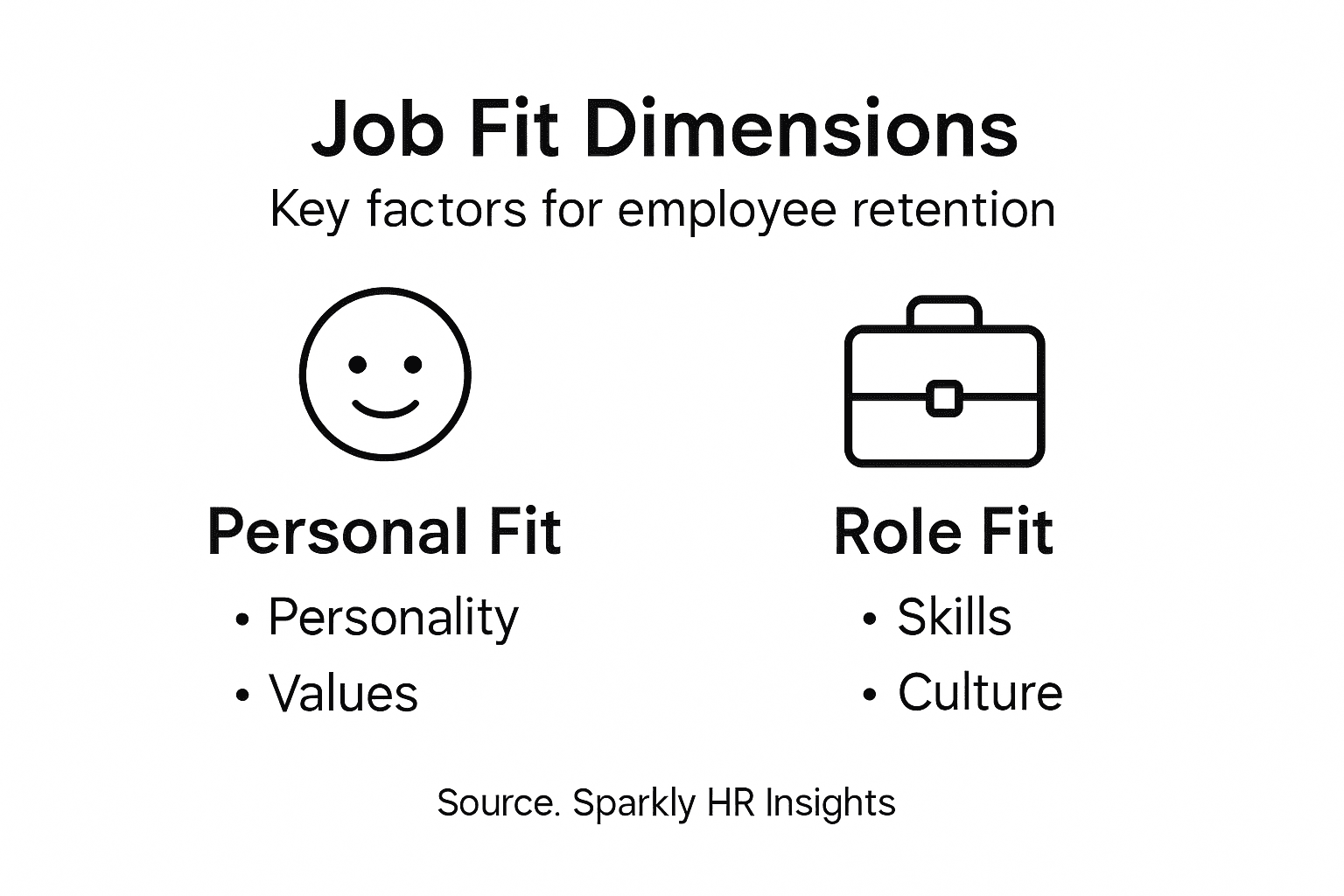
Personality Fit represents the psychological compatibility between an individual’s inherent traits and job requirements. This dimension examines how natural behavioral tendencies match specific role expectations. For instance, an introverted data analyst might thrive in roles requiring deep concentration, while an extroverted sales professional excels in relationship-building positions.
Skills Fit focuses on technical and professional competencies required for job performance. While essential, skills alone do not guarantee success. Professional labor market studies emphasize that skills must be complemented by other fit dimensions to ensure meaningful workplace engagement. This approach recognizes that skills can be developed, but core personality traits remain relatively stable.
Values and cultural fit represent the deeper psychological alignment between an individual’s belief system and the organization’s core principles. This dimension explores how an employee’s fundamental motivations, ethical standards, and worldview synchronize with the company’s mission and operational philosophy. Misalignment in this area can lead to decreased job satisfaction, reduced productivity, and higher turnover rates.
Pro tip: Implement comprehensive assessment tools that evaluate multiple fit dimensions simultaneously, allowing for a more holistic understanding of candidate and employee potential beyond traditional resume screening.
Here’s a summary of the four key dimensions of job fit and their importance:
| Dimension | What It Focuses On | Example of Alignment |
|---|---|---|
| Personality Fit | Matching traits to job requirements | Introvert excels in analysis |
| Skills Fit | Technical/professional competencies | Certified engineer in IT role |
| Values Fit | Shared beliefs and motivations | Employee supports company mission |
| Cultural Fit | Integration with workplace culture | Adaptable worker in agile team |
How Personality-Driven Assessment Enhances Job Fit
Personality-driven assessment represents a transformative approach to understanding employee potential beyond traditional hiring metrics. Dynamic person-job fit research demonstrates that aligning individual personality traits with specific job requirements can dramatically improve long-term organizational performance and employee engagement.

Psychological Profiling goes far deeper than standard skills assessment. By mapping an individual’s inherent behavioral tendencies, organizations can predict job satisfaction, performance potential, and likelihood of successful role adaptation. For example, an analytical personality might excel in roles requiring systematic problem-solving, while a creative individual would thrive in positions demanding innovative thinking.
Innovative work behavior studies confirm that personality alignment directly correlates with enhanced trust, engagement, and organizational commitment. The assessment process involves sophisticated psychological mapping that considers traits like emotional intelligence, adaptability, communication style, and intrinsic motivational patterns. This nuanced approach allows companies to design roles that not only match technical requirements but also provide psychological fulfillment.
By prioritizing personality-driven assessment, organizations can create more targeted recruitment strategies, reduce turnover, and develop highly engaged workforce ecosystems. The key is moving beyond surface-level skill matching to understand the deeper psychological dynamics that drive individual performance and satisfaction.
Pro tip: Develop a comprehensive personality assessment framework that integrates multiple evaluation dimensions, allowing for more holistic and predictive talent management strategies.
Job Redesign and Team Shifting Strategies
Job crafting strategies represent a dynamic approach to optimizing organizational performance by intentionally reshaping job roles to match individual employee strengths. This proactive method goes beyond traditional job descriptions, empowering employees to modify their work environment and responsibilities to better align with their unique personality traits and professional aspirations.
Task Modification is a critical component of job redesign. By allowing employees to strategically adjust their work responsibilities, organizations can create more engaging and personalized roles. This might involve redistributing tasks among team members based on individual strengths, enabling employees to spend more time on activities that leverage their natural talents and psychological preferences.
Recruiter job redesign approaches demonstrate that team shifting can be a powerful retention strategy. This involves carefully reallocating team members to roles where their inherent personality characteristics are most likely to flourish. For instance, an analytically minded employee might be shifted from a customer-facing role to a data analysis position, dramatically improving both individual satisfaction and organizational productivity.
Successful job redesign requires a nuanced understanding of each employee’s psychological profile, motivation drivers, and potential for growth. By creating flexible job architectures that can adapt to individual strengths, organizations can build more resilient, engaged, and high-performing teams that are less likely to experience burnout or seek opportunities elsewhere.
Pro tip: Conduct quarterly personality assessments and hold open discussions with employees about potential role adjustments that could better align with their evolving professional goals and inherent strengths.
Risks of Poor Job Fit and Common Pitfalls
Person-job fit research reveals profound consequences when organizations fail to align employee personalities with job requirements. Poor job fit creates a cascade of negative outcomes that extend far beyond simple performance metrics, impacting individual psychological well-being and organizational health.
Psychological Consequences of misalignment are particularly devastating. Employees trapped in roles incompatible with their inherent traits experience heightened stress, diminished motivation, and accelerated burnout. This misalignment can trigger a destructive cycle where reduced engagement leads to decreased productivity, creating a self-reinforcing pattern of professional dissatisfaction.
Organizational fit challenges highlight additional risks beyond individual experience. Systematic mismatches can perpetuate harmful workplace dynamics, including social exclusion, unconscious bias, and reduced diversity. When hiring processes prioritize subjective perceptions over substantive personality assessment, organizations risk creating homogeneous teams that lack cognitive diversity and innovative potential.
The financial implications of poor job fit are equally significant. High turnover rates, reduced productivity, and increased recruitment costs can drain organizational resources. Employees who feel fundamentally misaligned with their roles are more likely to seek opportunities elsewhere, creating expensive and disruptive talent churn.
Below is a comparison of outcomes between strong and poor job fit in organizations:
| Outcome Area | Strong Job Fit | Poor Job Fit |
|---|---|---|
| Employee Engagement | High motivation and involvement | Disinterest and low morale |
| Productivity | Increased efficiency and output | Frequent errors and low performance |
| Retention | Low turnover, long tenure | High turnover, early exits |
| Organizational Health | Positive culture, innovation thrives | Bias, exclusion, and resource drain |
Pro tip: Implement comprehensive personality assessment protocols that evaluate candidate-role compatibility across multiple dimensions, moving beyond traditional skills-based screening to understand deeper psychological alignment.
Unlock True Job Fit by Embracing Personality-Driven Assessment
The challenge of poor job fit discussed in this article highlights the urgent need for employers to move beyond traditional skills matching. The pain points of reduced employee engagement, high turnover, and mismatch with organizational culture are critical hurdles that can only be overcome by aligning personality traits to job roles. Concepts like personality fit, cultural integration, and psychological profiling are essential to boost retention and deliver real business value.
At Sparkly HR, we understand that skills can be learned but personality forms the foundation of job fit. Our employee assessment SaaS merges human expertise, AI, advanced psychometric assessments, and Human Design to generate higher probability insights. These insights empower HR professionals to redesign jobs and shift team members in ways that maximize engagement and satisfaction.
Discover how our unique approach addresses these challenges and elevates your hiring and talent management processes with personality-focused insights. Explore more in our Uncategorized – Sparkly HR section and visit our homepage to get started today.
Ready to transform your retention strategy with personality data instead of just resumes Start leveraging Sparkly’s powerful personality-based assessments now to create roles that truly fit your people Visit https://sparkly.hr to see how personality-driven job fit can unlock your team’s full potential.
Frequently Asked Questions
What is job fit, and why is it important?
Job fit is the alignment between an individual’s personality traits, work preferences, and the organizational culture with specific job requirements. It is essential because it leads to increased employee engagement, satisfaction, and retention.
How can personality-driven assessments improve job fit?
Personality-driven assessments help organizations map employees’ behavioral traits to job requirements, enhancing job satisfaction and performance. By understanding psychological compatibility, businesses can create targeted recruitment strategies and reduce turnover.
What are the main dimensions of job fit?
The main dimensions of job fit include personality fit, skills fit, values fit, and cultural fit. Each dimension addresses different aspects of alignment between the employee and the organization, ensuring optimal performance and satisfaction.
What are the risks of poor job fit?
Poor job fit can lead to heightened stress, diminished motivation, and accelerated burnout for employees. Additionally, it can result in increased turnover rates, reduced productivity, and financial strain on the organization.