
Traditional skills tests fail to predict which hires will thrive long term, costing mid-sized companies thousands in avoidable turnover. Personality-focused assessments deliver stronger insights into role fit, engagement potential, and retention risk. This employee potential checklist walks you through proven tools, selection criteria, and practical use cases to help you make smarter hiring decisions in 2026.
Table of Contents
- Selection Criteria: Key Factors For Choosing Employee Potential Tools
- Top Employee Potential Assessment Tools In 2026
- Innovative Approaches: Merging Human, AI, Psychometric & Human Design Data
- Use Case Mapping: Which Tool Fits Which HR Scenario?
- Summary Comparison Table: Features, Strengths, And Pricing Overview
- Situational Picks: Best Choices For Common HR Challenges
- Discover Sparkly.hr Solutions To Unlock Employee Potential
- Frequently Asked Questions
Key takeaways
| Point | Details |
|---|---|
| Personality outperforms skills | Personality assessments predict long-term success better than technical skill tests alone. |
| AI and psychometrics matter | Integrating AI analytics with psychometric validation improves accuracy and reduces bias. |
| Different tools, different needs | Top platforms vary in focus from high-volume screening to leadership development. |
| Multisource data wins | Combining human judgment, AI, psychometrics, and behavioral models yields better hiring outcomes. |
| Match tool to scenario | Align platform features with specific HR challenges for maximum ROI and impact. |
Selection criteria: key factors for choosing employee potential tools
After understanding the importance of personality-driven assessment, dive into the exact criteria that will guide your tool selection for reliable results.
Selecting employee potential tools requires evaluating key factors such as assessment accuracy, multidimensional data integration, candidate experience, scalability, and predictive validity. Scientifically validated personality assessments offer stronger predictive power than traditional skills tests because they measure traits linked to engagement, adaptability, and cultural fit. Look for platforms that integrate AI analytics, psychometric frameworks, and human input to provide a fuller picture of candidate potential.

Candidate experience matters too. If your assessment platform frustrates applicants with clunky interfaces or excessive time demands, you risk losing top talent before they finish the process. Scalability is equally critical for mid-sized companies planning to grow hiring volume without ballooning costs. Check whether the tool offers flexible pricing, bulk assessment options, and easy integration with your existing employee potential evaluation guide workflows.
Predictive validity metrics separate winners from pretenders. Focus on tools that demonstrate measurable improvements in turnover reduction, role fit accuracy, and time to productivity. Technology adoption rates signal market trust and ongoing platform investment. If an assessment provider has a strong user base and frequent updates, you can expect better support and innovation over time.
Pro Tip: Request case studies showing actual turnover reduction numbers before committing to a platform. Generic marketing claims mean little without data.
- Prioritize scientifically validated personality frameworks
- Ensure multidimensional data integration (AI, psychometrics, human input)
- Evaluate candidate experience and interface usability
- Check predictive validity metrics like turnover reduction
- Review technology adoption rates and customer support quality
Explore top HR assessment tools in 2025 to see how leading platforms stack up on these criteria.
Top employee potential assessment tools in 2026
With criteria established, review the top-rated tools embodying these standards to find the best fit for your team.
TestGorilla is rated the best all-round talent assessment platform in 2025 for combining skills, personality, and cognitive testing with customizable and anti-cheating features. Their 400+ test library and seamless ATS integration make them ideal for high-volume hiring scenarios where speed and accuracy both matter. You can blend personality assessments with role-specific tests to create a comprehensive screening process that scales.
The Predictive Index excels at optimizing team dynamics and engagement by analyzing workplace behaviors beyond surface-level skills, rated highly for personality-driven talent management. This platform shines when you need to reduce turnover by matching candidates to roles where their natural behavioral patterns align with job demands. Mid-sized companies often see 30-50% retention improvements after implementing PI-based hiring.
Mercer Mettl and SHL provide robust psychometric and leadership potential assessments, supporting comprehensive employee potential evaluation beyond technical skills. These platforms specialize in succession planning and leadership development, offering deep psychometric analysis that reveals who has the traits to grow into senior roles. Their enterprise-grade reporting helps HR teams justify hiring and promotion decisions with data.
The integration of AI and psychometrics in tools like Talent Science and HiPeople improves predictive role fit and streamlines reference checks, enhancing hiring precision and speed. Talent Science uses machine learning to identify patterns in successful employees, then screens candidates for similar traits. HiPeople automates reference checking with AI-powered interviews, cutting days off your hiring timeline while gathering richer behavioral insights.
Pricing and accessibility vary across platforms. TestGorilla offers per-candidate pricing starting around $1.50 per test, while enterprise solutions like SHL require custom quotes. Match tool capabilities to your company’s budget, hiring volume, and specific needs around 2026 personality engagement trends.
- TestGorilla: 400+ tests, ATS integration, ideal for high-volume screening
- The Predictive Index: team dynamics focus, strong turnover reduction
- Mercer Mettl & SHL: psychometric depth, leadership assessment
- Talent Science: AI pattern matching, predictive role fit
- HiPeople: automated reference checks, behavioral insights
Review best talent assessment tools, expert top talent assessment tools, and high-potential assessment tools 2026 for detailed comparisons.
Innovative approaches: merging human, AI, psychometric & human design data
Beyond tool selection, understand the cutting-edge methodology of merging multiple data types to maximize assessment impact.
Individual assessment sources alone can be unreliable or incomplete. Traditional interviews suffer from interviewer bias, AI tools can perpetuate historical patterns, and single psychometric tests miss contextual nuances. Integrating AI analytics, psychometric validity, human judgment, and Human Design frameworks yields stronger insights by cross-validating data across multiple lenses.
Multisource data fusion leads to more accurate predictions of performance and turnover risk because each source compensates for the others’ blind spots. AI identifies patterns humans miss, psychometrics provide scientific structure, human interviewers assess cultural fit, and Human Design adds holistic behavioral context. Companies using integrated approaches report 30-60% reduction in turnover when compared to single-source assessment methods.
HR teams must interpret combined data thoughtfully, balancing automated insights with contextual knowledge. AI might flag a candidate as low fit based on past patterns, but human review could reveal that candidate brings exactly the fresh perspective your team needs. The goal is informed decision making, not automation for its own sake.
“Combining four unreliable sources creates one highly reliable insight. No single assessment tells the full story, but together they reveal patterns that predict success.”
This methodology underpins modern HR transformation through personality assessments, where data quality matters more than data volume.
- Individual sources (AI, psychometrics, interviews) have blind spots
- Cross-validation across multiple data types improves accuracy
- Integrated approaches reduce turnover by 30-60%
- Human interpretation remains essential for context
- Balance automation with judgment for best results
Use case mapping: which tool fits which HR scenario?
Having covered innovative approaches, now map these tools practically to your specific HR scenarios for informed decisions.
TestGorilla excels for rapid high-volume screening when you need to process hundreds of applicants for multiple roles simultaneously. Their broad test library lets you create custom assessment flows that filter candidates on personality, cognitive ability, and role-specific skills in one sitting. This works especially well for companies scaling quickly or hiring for seasonal peaks.
The Predictive Index is best suited for personality-driven role fit and optimizing team dynamics when turnover or engagement issues plague existing teams. Use PI when you need to understand why certain roles have high churn or when building new teams from scratch. The behavioral data helps you place people where their natural working style matches job demands.
Mercer Mettl and SHL are ideal for leadership assessment and succession planning needs in mid-sized companies building internal talent pipelines. Their psychometric depth reveals who has the cognitive and personality traits to handle senior responsibilities. Deploy these tools when identifying high-potential employees for development programs or when making promotion decisions that carry significant risk.
Talent Science and HiPeople offer efficient AI-powered reference checking for enhanced hiring precision when you need to validate candidate claims quickly. These platforms shine in competitive hiring markets where speed matters but you cannot afford bad hires. Automated reference insights reduce hiring cycle time while improving quality.
Balancing customization with out-of-the-box solutions depends on budget and HR capacities. Smaller teams benefit from platforms like TestGorilla that offer ready-made assessments, while larger HR departments might invest in customized SHL implementations.
- High-volume screening: TestGorilla for scalable, multi-role hiring
- Team dynamics optimization: Predictive Index for role fit and retention
- Leadership pipeline: Mercer Mettl or SHL for succession planning
- Fast reference checks: Talent Science or HiPeople for hiring speed
- Custom needs: Match platform flexibility to your HR team size
Explore talent assessment for team dynamics and employee potential evaluation guide for deeper implementation strategies.
Summary comparison table: features, strengths, and pricing overview
To finalize your choice, consult this comparison table to visually weigh each tool’s fit for your company.
| Tool | Assessment Focus | AI Integration | Psychometric Validation | Pricing Model | Best For | Company Size |
|---|---|---|---|---|---|---|
| TestGorilla | Skills, personality, cognitive | Yes | Moderate | Per-test ($1.50+) | High-volume screening | 50-500 employees |
| Predictive Index | Behavioral, team dynamics | Limited | Strong | Subscription | Role fit, retention | 100-1000 employees |
| Mercer Mettl | Psychometric, leadership | Moderate | Strong | Custom quote | Succession planning | 200+ employees |
| SHL | Psychometric, cognitive | Moderate | Very strong | Custom quote | Leadership assessment | 500+ employees |
| Talent Science | Predictive analytics | Strong | Moderate | Subscription | Pattern matching | 100-500 employees |
| HiPeople | Reference checking, behavioral | Strong | Limited | Per-candidate | Fast hiring cycles | 50-300 employees |
This table distills key differences to help you match platform strengths with your specific HR needs and budget constraints. TestGorilla and HiPeople offer accessible entry points for smaller mid-sized companies, while Mercer Mettl and SHL provide enterprise-grade depth for larger organizations with complex assessment requirements.
Consult top assessment tools 2026 for additional comparison details and customer reviews.
Situational picks: best choices for common HR challenges
With all options laid out, here are targeted picks to solve your most pressing HR challenges effectively.
For rapid, large-scale screening, use TestGorilla’s broad test library and AI features to process hundreds of candidates weekly without sacrificing quality. Their anti-cheating technology and ATS integration mean you can trust results while maintaining hiring velocity. This matters when filling multiple roles across departments simultaneously.
For personality-driven role fit and retention improvement, choose The Predictive Index to match candidates with roles where their behavioral patterns align with job demands. Companies implementing PI report 40-50% turnover reductions in roles with historically high churn. The platform’s team composition tools also help you build balanced teams that work well together.
Mercer Mettl and SHL are cost-effective solutions for leadership assessment and succession planning when you need psychometric rigor without building custom frameworks. Their validated assessments identify leadership potential early, letting you invest development resources in employees most likely to succeed in senior roles. This approach reduces costly external hiring for leadership positions.
Talent Science and HiPeople streamline automated reference checks and predictive hiring by gathering behavioral insights faster than traditional phone references. Use these platforms when hiring in competitive markets where top candidates have multiple offers and speed determines who you land.
Consider budget, customization needs, and team size when selecting a platform. A 100-person company rarely needs enterprise tools designed for 5,000-employee organizations. Start with platforms that match your current scale, then upgrade as hiring complexity grows.
Pro Tip: Run pilot programs with two tools before committing company-wide. Test them on the same candidate pool to compare predictive accuracy and user experience.
- TestGorilla: best for scalable, high-volume screening needs
- Predictive Index: reduces turnover through behavioral role matching
- Mercer Mettl/SHL: leadership assessment and succession planning
- Talent Science/HiPeople: fast reference checks and predictive analytics
- Match platform features to your specific hiring volume and budget
Learn how personality-based hiring technology transforms these tools into competitive advantages.
Discover Sparkly.hr solutions to unlock employee potential
Having identified the best tools and strategies, learn how Sparkly.hr solutions can help you put these insights into action seamlessly.
Sparkly.hr offers SaaS tools integrating personality assessments, AI analytics, psychometric data, and Human Design frameworks to deliver unusually accurate employee potential insights. We assess personality primarily because skills can be learned, but core behavioral traits predict long-term success and cultural fit. Our platforms help mid-sized companies reduce turnover, improve team alignment, and identify hidden potential by merging four unreliable sources into one reliable insight.
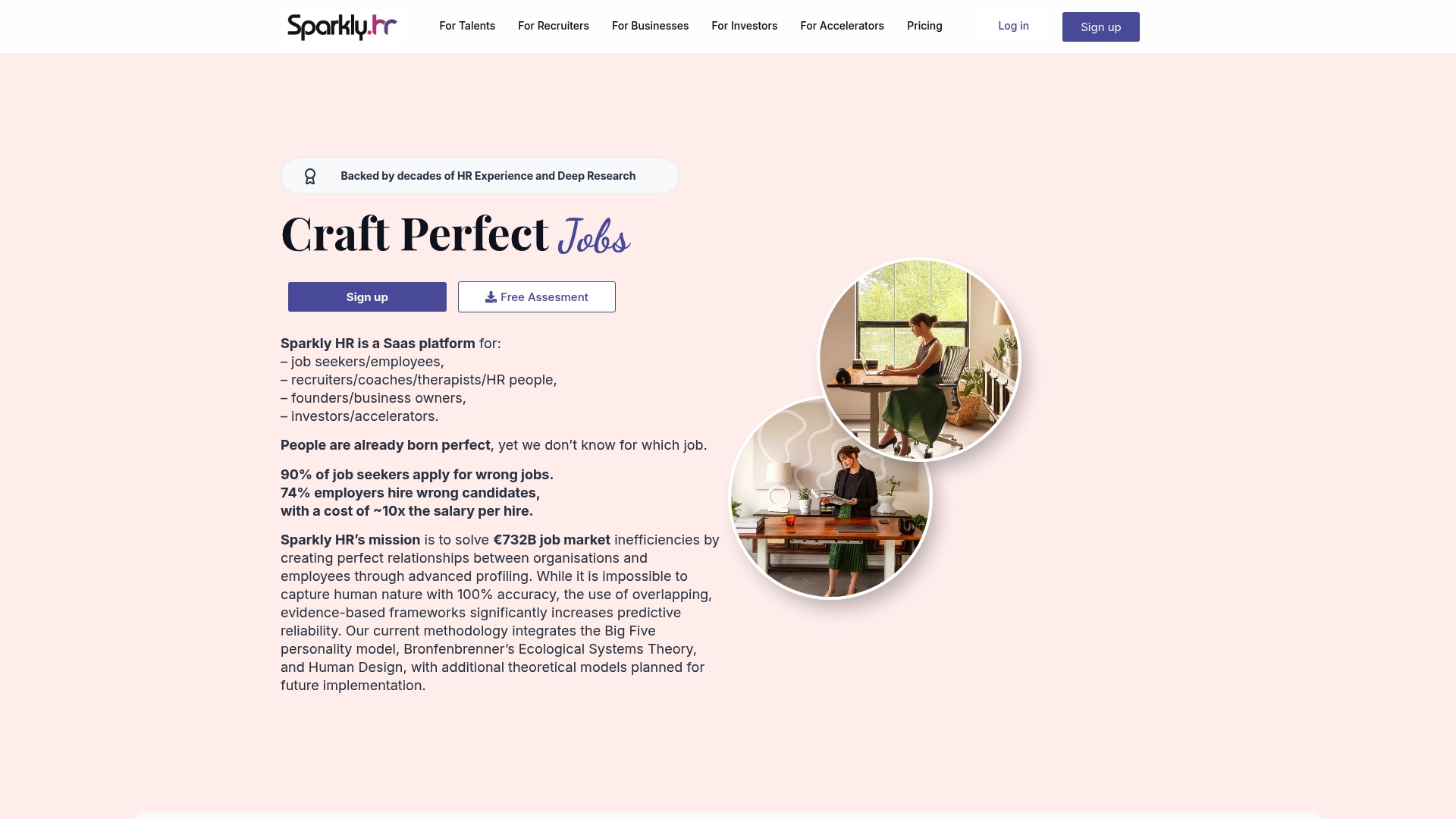
Explore our employee potential evaluation tools, SaaS for HR employee potential, and talent assessment tips to implement an effective employee potential checklist tailored to your company’s needs. Leverage Sparkly.hr resources to make data-driven hiring and talent management decisions that actually reduce turnover and unlock the full potential of your workforce.
Frequently asked questions
What is the difference between employee potential and performance?
Potential measures future capability and growth trajectory, while performance tracks current achievements against defined goals. An employee can perform well in their current role yet lack potential for advancement, or show high potential but underperform due to poor role fit.
How do personality assessments reduce employee turnover?
They identify behavioral traits aligned with specific job roles and company culture, improving engagement and fit from day one. When candidates’ natural working styles match job demands, they experience less stress and greater satisfaction, which directly reduces turnover risk.
Can AI-based assessments replace human judgment in hiring?
AI provides valuable pattern recognition and data analysis but requires human validation to prevent bias and ensure contextual relevance. The best hiring outcomes come from combining AI insights with experienced HR judgment, not replacing one with the other. Humans catch nuances AI misses, while AI spots patterns humans overlook.
What is Human Design data in employee assessments?
Human Design integrates personality frameworks with behavioral and energetic patterns to provide holistic insights beyond conventional psychometric tests. It adds another validation layer when combined with AI, psychometrics, and human judgment, helping reveal how candidates naturally operate in work environments.