
Employees who engage in job crafting report up to 17% higher job satisfaction and 10% lower turnover intentions in mid-sized company settings. Job crafting transforms how employees shape their roles through task, relational, and cognitive adjustments. For HR professionals in mid-sized US businesses, this strategy offers a practical path to reduce turnover and elevate satisfaction. This article explores what job crafting truly entails, why it works, and how you can implement personality-informed approaches to maximize results.
Table of Contents
- Introduction To Job Crafting
- Mechanisms Behind Job Crafting’s Impact On Employees
- Common Misconceptions About Job Crafting
- Frameworks And Models To Guide Job Crafting
- Quantifiable Benefits Of Job Crafting For Mid-Sized Companies
- Practical Implementation Strategies For HR Teams
- Conclusion And Next Steps
- Explore Sparkly HR’s Solutions For Effective Job Crafting
- Frequently Asked Questions About Job Crafting
Key Takeaways
| Point | Details |
|---|---|
| Job satisfaction gains | Job crafting increases job satisfaction by up to 17% and reduces turnover intentions by 10%. |
| Three crafting dimensions | Task crafting, relational crafting, and cognitive crafting each require distinct HR strategies. |
| Managerial support essential | Successful job crafting demands structured HR facilitation and active managerial involvement. |
| Personality-informed methods | Integrating personality assessments with job crafting enhances alignment and outcomes. |
| Measurable business impact | Mid-sized companies see quantifiable improvements in retention and employee engagement. |
Introduction to Job Crafting
Job crafting empowers employees to redesign their roles in ways that align with their strengths, preferences, and values. Unlike traditional top-down job design, it puts agency in employees’ hands while maintaining organizational goals. The approach encompasses three dimensions: task crafting (altering job tasks or scope), relational crafting (changing workplace relationships), and cognitive crafting (reframing how one perceives their work).
For HR professionals managing mid-sized companies, job crafting addresses two persistent challenges: high turnover and low job satisfaction. When employees feel their roles fit their personalities and aspirations, they stay longer and contribute more. In 2026, as talent competition intensifies, job crafting offers a competitive advantage by transforming existing employees into more engaged, productive team members.
The three dimensions of job crafting require distinct strategies. Task crafting might involve an accountant taking on more analytical projects. Relational crafting could mean a customer service rep building stronger peer mentorship connections. Cognitive crafting happens when a warehouse worker reframes their role as essential to customer happiness rather than just moving boxes.
Personality-focused job crafting approaches recognize that not all employees craft in the same ways. Extroverted employees may gravitate toward relational crafting, while detail-oriented individuals prefer task refinements. By integrating psychometric assessments, HR teams can guide employees toward crafting strategies that match their natural tendencies, amplifying the benefits.
Key benefits for mid-sized companies include:
- Reduced recruitment and training costs through improved retention
- Enhanced employee autonomy without sacrificing organizational structure
- Stronger alignment between individual strengths and business needs
- Increased innovation as employees reshape tasks to leverage their unique capabilities
- Better cultural fit as employees mold roles to match company values
Implementing job crafting requires HR to shift from rigid job descriptions to flexible role boundaries. This doesn’t mean chaos. It means creating guardrails within which employees can safely experiment and adapt their work.
Mechanisms Behind Job Crafting’s Impact on Employees
Job crafting works by increasing three psychological states: meaningfulness, autonomy, and competence. When employees alter their job boundaries, they create better person-job fit. This fit drives motivation because work feels personally relevant rather than externally imposed.

Cognitive crafting plays a particularly powerful role in meaningfulness. By reframing tasks, employees discover purpose in routine work. A janitor who sees their role as creating safe, welcoming spaces experiences more satisfaction than one who views it as merely cleaning. HR can facilitate this mindset shift through training and reflective workshops.
Employees who engage in job crafting report up to 17% higher job satisfaction and 10% lower turnover intentions because the process addresses core human needs. Task crafting builds competence by allowing employees to focus on strengths. Relational crafting satisfies social needs through stronger workplace connections. Cognitive crafting fulfills the need for meaning and purpose.
Proactive job crafting creates positive feedback loops. When employees successfully reshape their roles, they experience wins that build confidence. This confidence encourages further crafting, creating upward spirals of engagement. Organizations supporting job crafting through reducing turnover with job crafting initiatives see these cycles compound over time.
Steps to understand the psychological mechanisms:
- Recognize that employees naturally seek better fit between their abilities and job demands
- Understand that small boundary changes accumulate into significant role transformations
- Acknowledge that cognitive reframing costs nothing but delivers substantial motivation gains
- Support proactive crafting behaviors through recognition and resources
- Monitor psychological outcomes like meaningfulness and autonomy alongside performance metrics
Pro Tip: Track which crafting dimension (task, relational, or cognitive) generates the strongest outcomes for different employee segments. Use this data to personalize your job crafting guidance.
The mechanism also operates at the team level. When one employee crafts their role effectively, it can inspire peers and reshape team dynamics positively. Managers who understand these ripple effects can amplify job crafting’s impact across entire departments.
Common Misconceptions About Job Crafting
Many HR professionals believe job crafting means letting employees do whatever they want. This myth leads to hesitation in adopting crafting initiatives. In reality, successful initiatives require structured HR facilitation and managerial involvement to align changes with business goals.
Misconception one: job crafting only involves minor task adjustments. While small changes matter, effective crafting often includes substantial relational and cognitive shifts. An employee might maintain the same core tasks while completely transforming how they collaborate with others or perceive their role’s purpose. HR teams should encourage all three dimensions, not just task tweaks.
Misconception two: job crafting replaces traditional talent management. It complements, not replaces, existing HR practices. Performance management, career development, and succession planning still matter. Job crafting adds a personalization layer that makes these traditional systems more effective by accounting for individual differences.
Misconception three: employees instinctively know how to craft jobs effectively. Most need guidance on which boundaries they can shift and which remain fixed. Without managerial and HR support in job crafting, employees may craft in ways that benefit themselves but harm team performance or customer experience.
Key realities about job crafting:
- Requires explicit permission and guardrails from management
- Works best with regular check-ins to ensure alignment
- Needs cognitive crafting training since it’s less intuitive than task changes
- Demands personality-informed guidance to match crafting styles to individual traits
- Benefits from iterative experimentation rather than one-time changes
Pro Tip: Create a job crafting charter that specifies which role elements are flexible and which are fixed. This clarity empowers employees while protecting organizational needs.
The most damaging misconception is that job crafting happens automatically once permitted. In practice, it requires ongoing support, training, and feedback. HR professionals must actively facilitate the process rather than simply announcing that employees can craft their jobs.
Frameworks and Models to Guide Job Crafting
The three dimensions of job crafting provide a foundational framework. Task crafting changes what employees do or how much they do. Relational crafting alters who they interact with and the nature of those interactions. Cognitive crafting shifts how they think about their work’s meaning and impact.
Each dimension requires specific HR strategies. For task crafting, provide tools like skills inventories and project databases so employees can identify desirable tasks. For relational crafting, facilitate networking opportunities and cross-functional collaborations. For cognitive crafting, offer workshops on finding meaning and purpose in work.
Integrating personality and psychometric assessments elevates job crafting from generic to personalized. A personality-driven job crafting framework identifies which crafting approaches suit different personality types. Highly conscientious employees may excel at task crafting, while agreeable individuals thrive through relational crafting. Openness to experience predicts success with cognitive reframing.
| Approach | Traditional Job Redesign | Personality-Informed Job Crafting |
|---|---|---|
| Initiation | Top-down by management | Employee-led with HR support |
| Customization | Standardized roles | Personalized to individual traits |
| Scope | Entire positions restructured | Incremental boundary adjustments |
| Assessment basis | Skills and competencies | Personality, values, preferences |
| Flexibility | Fixed role definitions | Dynamic role evolution |
| Timeline | Episodic redesign projects | Continuous adaptation process |
This comparison shows why personality-focused methods generate stronger engagement. Employees feel seen and supported rather than slotted into predetermined boxes. The framework also reduces HR workload since employees drive much of the customization themselves.
Applying this framework means conducting personality assessments early, then mapping results to crafting opportunities. If an assessment reveals an employee values autonomy highly, guide them toward task crafting that increases independence. If someone scores high on social connection needs, emphasize relational crafting paths.
Quantifiable Benefits of Job Crafting for Mid-Sized Companies
Employees who engage in job crafting report up to 17% higher job satisfaction and 10% lower turnover intentions in mid-sized company settings. These numbers translate directly to bottom-line savings. For a 500-employee company with 20% annual turnover, a 10% reduction saves approximately 10 employees per year. At replacement costs of 50 to 150% of salary, this represents substantial financial impact.
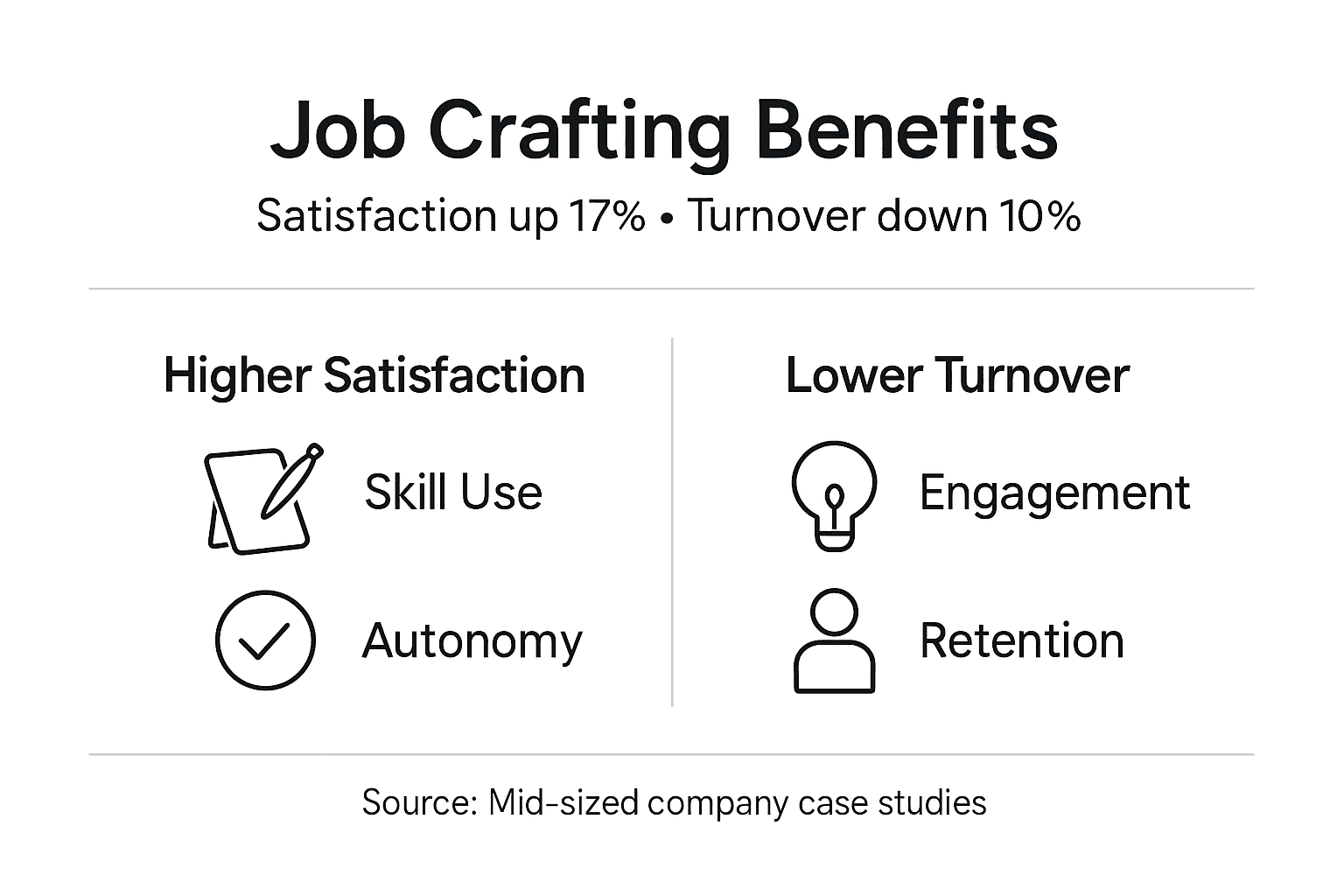
Beyond retention, job satisfaction improvements drive performance gains. Satisfied employees demonstrate higher productivity, better customer service, and increased innovation. The 17% satisfaction boost compounds these benefits across the workforce.
Case studies from US mid-sized companies show the connection between personality assessments and outcomes. A 300-employee manufacturing firm integrated personality-informed job crafting in 2025, resulting in 12% turnover reduction within one year. A 450-person professional services company combined assessments with quarterly crafting workshops, achieving 15% satisfaction increases and 8% productivity gains.
Another technology company with 600 employees used case studies on turnover reduction to implement cognitive crafting training. Employees who completed the training reported 20% higher role clarity and 14% better alignment with company mission. Turnover among trained employees dropped to 8% annually compared to 18% company-wide.
| Benefit Category | Metric | Improvement Range |
|---|---|---|
| Job satisfaction | Employee survey scores | 12-17% increase |
| Turnover intentions | Intent to leave ratings | 8-10% decrease |
| Actual turnover | Annual separation rate | 5-12% reduction |
| Productivity | Output per employee | 5-8% increase |
| Engagement | Engagement index scores | 10-15% improvement |
Key factors driving these results include:
- Consistent managerial support and role modeling of crafting behaviors
- Regular feedback loops to refine crafting efforts
- Personality assessment data informing individualized guidance
- Clear communication of which boundaries can flex
- Recognition systems rewarding successful crafting examples
The personality focus proves particularly valuable. Companies using generic job crafting see average results. Those tailoring approaches to individual traits achieve the upper end of benefit ranges.
Practical Implementation Strategies for HR Teams
Implementing job crafting requires a structured yet flexible approach. Start by conducting baseline personality assessments across teams. These assessments identify natural crafting tendencies and potential blind spots. Share results with employees and managers, framing them as tools for personalized development.
Step-by-step implementation process:
- Assess personality traits and work preferences using validated psychometric tools
- Educate managers on job crafting principles and their facilitation role
- Host workshops where employees learn crafting techniques matched to their profiles
- Pilot crafting initiatives with volunteer teams before scaling organization-wide
- Establish regular check-ins to review crafting experiments and adjust approaches
- Measure satisfaction, turnover, and performance metrics to quantify impact
- Share success stories to build momentum and normalize crafting behaviors
- Integrate job crafting into performance reviews and development planning
Managerial involvement makes or breaks job crafting success. Train managers to ask questions like “What tasks energize you?” and “How could your relationships at work better support your goals?” These conversations uncover crafting opportunities while maintaining alignment with team objectives.
Implementing job crafting with personality data creates targeted guidance. Introverted employees may need encouragement to pursue relational crafting, while highly agreeable individuals might require support in task crafting that involves saying no to requests outside their core role.
Pro Tip: Build a job crafting resource library with templates, examples, and decision trees based on common personality profiles. This scales your HR team’s ability to support crafting without constant one-on-one intervention.
Adopt an iterative feedback in job crafting mindset. Treat each crafting attempt as an experiment. When experiments succeed, document what worked. When they fail, extract lessons without punishment. This psychological safety encourages ongoing adaptation and prevents employees from abandoning crafting after initial setbacks.
Monitor both leading and lagging indicators. Leading indicators include crafting activity levels, manager-employee crafting conversations, and workshop participation. Lagging indicators cover satisfaction scores, turnover rates, and performance metrics. This dual tracking helps you refine your approach in real time rather than waiting for annual results.
Conclusion and Next Steps
Job crafting delivers measurable improvements in satisfaction and retention when implemented thoughtfully. The three dimensions of task, relational, and cognitive crafting each offer distinct pathways for employees to align their roles with their personalities and values. Mid-sized US companies adopting personality-informed approaches see the strongest results because customization addresses individual differences that generic programs miss.
The mechanisms driving job crafting’s success center on increased meaningfulness, autonomy, and competence. When employees feel their work matters, control their role boundaries, and leverage their strengths, they naturally become more engaged and less likely to leave. HR professionals facilitating these conditions create sustainable competitive advantages in 2026’s tight talent market.
Frameworks combining the three crafting dimensions with personality assessments provide practical roadmaps. Implementation requires managerial training, employee education, iterative experimentation, and consistent measurement. The effort pays off through reduced turnover costs, higher productivity, and stronger organizational culture.
Now is the time to move from learning to action. Start with pilot teams, gather data, refine your approach, and scale gradually. Job crafting represents the future of work design, where rigid roles give way to dynamic, personalized positions that evolve with employees’ growth and changing organizational needs.
Explore Sparkly HR’s Solutions for Effective Job Crafting
Sparkly HR’s assessment platform combines personality data with AI insights to guide effective job crafting initiatives. Our tools help you identify which employees will thrive with task, relational, or cognitive crafting based on their unique traits. Unlike skills-focused systems, we prioritize personality because skills can be learned, but core traits shape how people naturally approach their work.
Our employee potential evaluation framework integrates seamlessly with your job crafting programs. The role of assessments in HR extends beyond hiring to include ongoing role optimization and team dynamics. Explore our SaaS solutions for HR to access workshops, templates, and analytics that transform job crafting from concept to measurable business impact.
Frequently Asked Questions About Job Crafting
What types of jobs benefit most from job crafting?
All roles can benefit, but jobs with moderate autonomy and task variety see the strongest results. Knowledge work, customer-facing positions, and roles requiring collaboration respond particularly well. Even highly structured jobs benefit from cognitive crafting that reframes meaning and purpose.
How can managers support job crafting without losing control?
Managers should establish clear boundaries defining which role elements are flexible and which remain fixed. Regular check-ins ensure crafting aligns with team goals. Viewing job fit and job crafting as collaborative processes rather than threats to authority helps managers embrace their facilitation role.
What metrics best track job crafting success?
Track both process metrics like crafting activity levels and outcome metrics including satisfaction scores, turnover rates, and performance indicators. Employee-reported meaningfulness, autonomy, and role clarity provide leading indicators of crafting effectiveness before turnover changes appear.
How often should job crafting initiatives be reviewed?
Conduct quarterly reviews to assess progress and adjust approaches. Annual deep dives should examine organization-wide patterns and ROI. Individual crafting efforts benefit from monthly manager check-ins during initial implementation, then transition to as-needed conversations once employees gain confidence.