The pace of change in tech hiring is staggering. By 2030, around 39% of core skills are expected to shift as AI and digital tools transform workplaces from Canada to Singapore. This means traditional checklists for education or skill sets are no longer enough for mid-sized startups. When you prioritize personality assessments, you build teams that adapt, learn fast, and thrive—giving your company a lasting edge in retention.
Table of Contents
- Defining Future Skills In Hiring Today
- Key Shifts: From Skills To Personality Fit
- The Personality-First Hiring Framework
- Leading Assessment Approaches In 2026
- Reducing Turnover With Data-Driven Insights
- Overcoming Hiring Pitfalls And Biases Globally
Key Takeaways
| Point | Details |
|---|---|
| Focus on Personality Fit | Shift from traditional skills-based hiring to prioritizing personality traits that predict adaptability, collaboration, and resilience. |
| Redesign Job Descriptions | Revise job postings to emphasize personality requirements first, outlining the type of individual who will succeed in the role. |
| Implement Personality Assessment | Utilize structured personality assessments early in the hiring process to reduce bias and ensure consistent evaluations across candidates. |
| Leverage Data for Retention | Monitor personality fit and team dynamics to identify at-risk employees, enabling proactive adjustments to enhance retention. |
Defining Future Skills in Hiring Today
The job market is shifting faster than most HR teams can keep up with. By 2030, around 39% of core skills will change due to artificial intelligence, automation, and digital transformation. This isn’t just about adding new technical certifications to job descriptions.
Traditional hiring focuses on what candidates know. But here’s the reality: skills expire quickly, especially in tech startups. What matters more is whether someone can adapt, think critically under pressure, and collaborate effectively when everything changes.
The future isn’t about hiring people with every skill today—it’s about hiring people who can learn any skill tomorrow.
The World Economic Forum’s research on skills anticipated to shift by 2030 confirms that organizations need employees with resilience, analytical thinking, creativity, and leadership capabilities. These aren’t skills you teach in a two-week onboarding. These are personality traits.
This is where personality-driven hiring changes everything. Instead of hunting for candidates with a specific skill checklist, you’re looking for people whose personality traits predict they’ll master whatever skills the role demands.
Why Personality Predicts Performance Better Than Skills
A developer might code beautifully today but freeze when your entire tech stack changes in six months. A project manager might excel with one team but clash with another’s communication style. Skills are surface-level; personality is predictive.
Personality traits tell you:
- How someone responds to uncertainty and change
- Whether they collaborate or create friction in teams
- If they have the mental resilience to handle failure
- How they process feedback and adapt their approach
- Whether their working style aligns with your company culture
When you assess personality during hiring, you’re actually predicting long-term fit and performance. Someone with high adaptability will pick up new tools faster than someone with perfect technical credentials but low flexibility.
The Three Personality Dimensions That Matter Most
Not all personality traits carry equal weight in reducing turnover. Focus on the ones that directly impact performance and retention:
- Adaptability and learning orientation – Can they embrace change without burning out?
- Collaboration and communication style – Do they work well with your team dynamics?
- Resilience and accountability – Will they own problems or blame circumstances?
Your mid-sized tech startup probably has tight-knit teams where personality mismatches cause real damage. A single person who doesn’t collaborate well can destabilize an entire engineering squad. A perfectionist who resists iteration might clash with an agile environment.
Personality alignment prevents these conflicts before they drain your best people and force them to leave.
Redesigning Job Descriptions Around Personality
Instead of listing technical requirements first, start with personality requirements. What kind of person succeeds in this role? What kind of person fails?
A role might require:
- Problem-solver who thrives with ambiguity (not someone who needs clear instructions)
- Team player who communicates transparently (not someone who works in silos)
- Self-starter with high ownership (not someone who waits for direction)
- Creative thinker open to feedback (not someone defensive about ideas)
This shift means you’ll interview different candidates and ask different questions. You’re no longer asking “Can you do this?” You’re asking “Are you the kind of person who thrives doing this?”
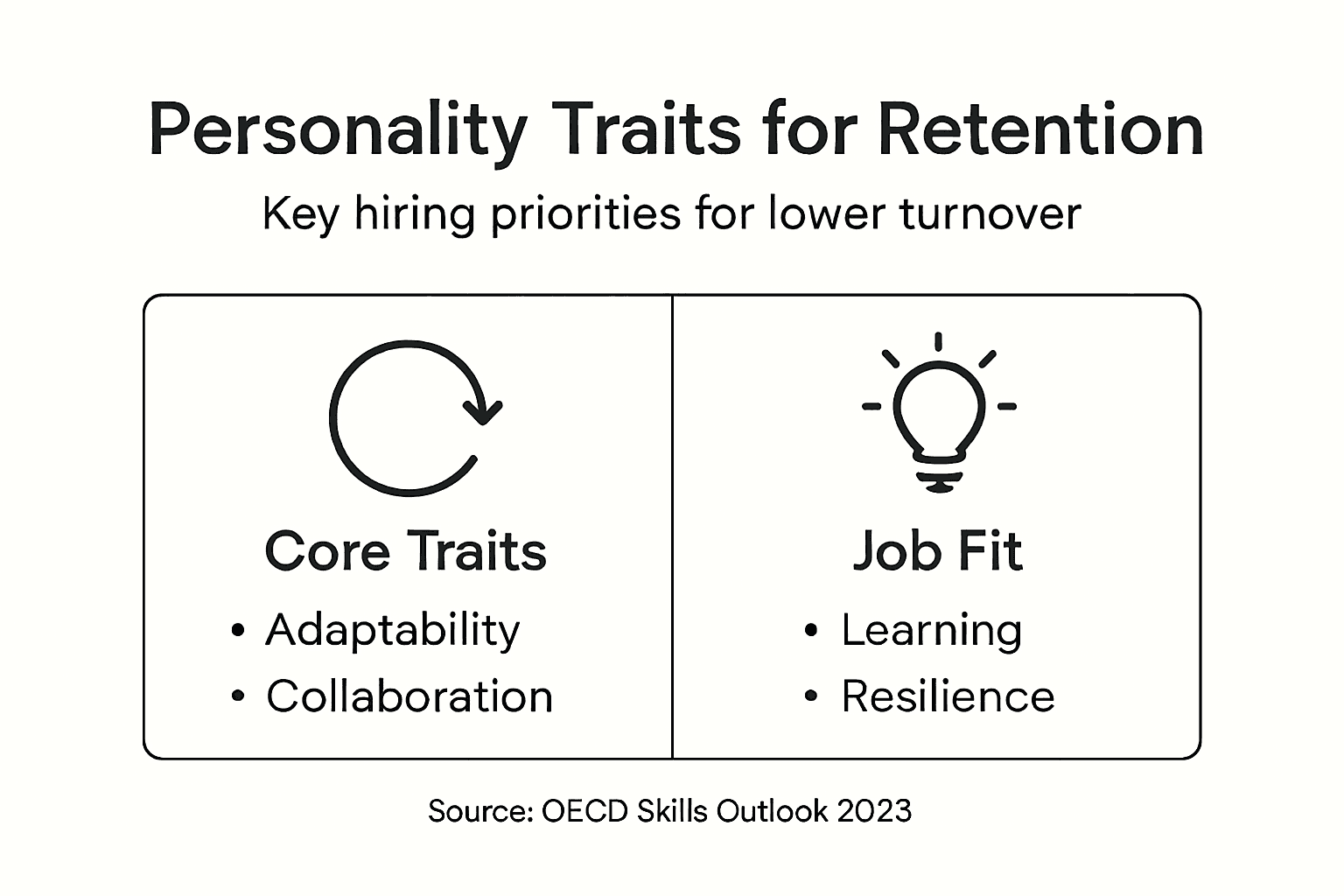
The OECD Skills Outlook 2023 emphasizes that adaptability and attitudes matter as much as technical capabilities for navigating digital and organizational change. Personality traits enable this adaptability.
Converting Hidden Potential Before People Leave
Here’s what happens in startups without personality-based hiring: A talented engineer gets frustrated because she’s in a role that doesn’t match her strengths. She’s capable but misaligned. Nobody notices until she puts in her resignation.
Personality assessment catches this before it happens. You see that someone has high analytical thinking but low tolerance for ambiguity. Instead of forcing them into a chaotic project, you shift them to a role with clear structure. They stay. They perform better.
This internal mobility based on personality prevents turnover that has nothing to do with pay or titles—it’s pure misalignment.
Practical Next Steps for Your Hiring Process
Start here:
- Audit your current roles—what personality traits actually predict success?
- Map your top performers—what do they have in common beyond skills?
- Revise job descriptions to emphasize personality requirements
- Use personality assessment tools during screening (not just interviews)
- Train interviewers to assess fit, not just credentials
This doesn’t mean ignoring technical skills. It means prioritizing personality alignment so people can develop the skills they need.
Pro tip: When recruiting for mid-sized teams where personality fit is critical, assess the personality profile of your best existing performers first. Then hire people with similar personality traits, even if their resume looks different. Your retention rates will improve dramatically.
Key Shifts: From Skills to Personality Fit
The hiring world is flipping on its head. For decades, recruiters asked “What can you do?” Now the question is “Who are you?” This isn’t soft HR theory—it’s backed by data and driven by real turnover problems.
Employers globally are making a seismic shift away from credential-obsessed hiring. The old playbook demanded specific degrees, years of experience, and a checklist of technical skills. That approach left companies with people who looked perfect on paper but quit within 18 months because they didn’t fit the actual work environment.
Here’s a comparison of personality-driven hiring versus traditional skills-based hiring approaches:
| Aspect | Skills-Based Hiring | Personality-Driven Hiring |
|---|---|---|
| Initial Focus | Degrees, credentials, technical skills | Personality traits, adaptability, learning orientation |
| Retention Impact | High turnover due to poor fit | Increased retention from culture and role fit |
| Assessment Methods | Resume review, skill tests | Personality assessments, structured interviews |
| Typical Outcome | Candidates look good on paper | Candidates thrive in real company environment |
When you hire for personality fit, you’re not replacing skills assessment—you’re predicting who will actually stay and thrive.
Recent hiring trends show that nearly two-thirds of employers now use skills-based and personality-focused hiring rather than relying solely on academic credentials. This shift applies especially to early-career hires, where personality alignment directly impacts retention.
For mid-sized tech startups, this matters more than ever. You can’t afford to hire and burn through people. You need employees who fit your culture, collaborate well, and adapt when everything changes.
Why Skills Alone Won’t Stop Turnover
Here’s the uncomfortable truth: a candidate with impressive technical skills will still leave if they hate the work environment. Someone brilliant at coding might be miserable in your team because they prefer structured work while your startup runs chaotic sprints.

Skills are learnable. Personality is not.
When you hire purely on skills, you miss critical information:
- Will this person communicate openly or create silos?
- Can they handle ambiguity or do they freeze without clear instructions?
- Will they take ownership or blame circumstances?
- Do they collaborate or compete within teams?
- Will they adapt to your culture or fight it?
Someone with 5 years of experience but low adaptability will struggle more than a junior developer with high curiosity and flexibility. Your startup’s environment demands the latter.
The Personality-First Hiring Framework
The shift toward personality-driven hiring emphasizes cultural fit and behavioral traits alongside competencies, significantly improving retention outcomes. This framework reorders your priorities entirely.
Instead of this:
- Screen for credentials
- Test technical skills
- Interview for culture fit
You do this:
- Assess personality alignment first
- Confirm technical capability (or trainability)
- Validate cultural fit through behavioral interviews
This order matters. Personality predicts whether someone will stay. Skills predict whether they can do the job. Both matter, but personality matters more for retention.
What Changes in Practice
Your job descriptions shift. Instead of “5+ years of React experience,” you write “Self-directed problem-solver who thrives with ambiguity and communicates progress proactively.” Your screening process changes. Instead of resume-scanning, you use personality assessments before interviews.
Your interview questions change too. You stop asking “Tell me about your experience with X” and start asking “How do you respond when a project gets completely reprioritized mid-sprint?” You’re evaluating how they think and behave, not just what they’ve done.
Your hiring team has to change. Interviewers need training to assess personality traits, not just verify credentials. Most hiring managers never learned this skill.
Pro tip: Before implementing personality-focused hiring, audit your top 10 performers to identify the personality traits that actually predict success in your organization. This data becomes your hiring template and prevents you from chasing generic personality profiles that don’t match your specific culture.
Leading Assessment Approaches in 2026
Assessment tools have evolved far beyond basic personality tests and outdated skills questionnaires. Modern hiring demands a multi-layered approach that combines data from multiple sources to predict who will actually succeed in your organization.
The best assessment strategies in 2026 don’t rely on any single tool. They layer personality assessment, structured interviews, work samples, and competency-based evaluation to build a complete picture of a candidate.
The most effective hiring systems in 2026 combine automated and manual assessments to eliminate bias while improving accuracy.
Leading assessment practices incorporate structured interviews paired with competency-based evaluation to ensure candidates are evaluated fairly and consistently. This approach removes subjective judgment while maintaining the human insight needed to assess personality fit.
The Four-Part Assessment Stack
Instead of relying on a single personality test or interview, build an assessment system with multiple checkpoints. Each layer reveals different information about the candidate.
Personality and behavioral assessments capture how someone thinks, responds to stress, and collaborates. This is your first filter—does their personality align with your culture and role requirements?
Structured interviews ask every candidate the same questions in the same format. This removes bias and makes comparisons meaningful. You’re not asking subjective “tell me about yourself” questions; you’re asking behavioral scenarios.
Work samples or simulations show what candidates actually do under pressure. A developer solves a real coding challenge. A product manager tackles a case study. This is performance data, not just potential.
Reference and background validation confirms the story. You’re not just asking “Is this person trustworthy?” You’re verifying patterns that showed up in assessments.
The following table summarizes the four-part assessment stack for modern hiring:
| Assessment Layer | Purpose | Example Tool |
|---|---|---|
| Personality Assessment | Measures adaptability and collaboration style | Hogan, Predictive Index |
| Structured Interview | Ensures fair, consistent evaluation | STAR-based behavioral questions |
| Work Sample/Simulation | Assesses real-world problem solving | Coding case, role-play scenario |
| Reference Validation | Confirms behavioral patterns | Reference call, background screen |
Why This Matters for Tech Startups
You probably have limited hiring bandwidth. One bad hire costs you months of productivity and disrupts your team. A multi-layered assessment system catches misalignment early before you waste interview time on candidates who won’t work out.
Small teams also need personality alignment more than large organizations. One person with poor collaboration skills can destabilize your entire engineering group. Assessment tools catch this before they’re hired.
Building Your Assessment Strategy
Start by defining what you actually need to assess. Don’t just grab generic personality tools—customize them to your reality.
For each role, identify:
- Core personality traits that predict success
- Critical competencies beyond technical skills
- Team dynamics your new hire must fit
- Work style preferences of your existing team
Then layer assessments that measure these factors. Reliable assessment tools combined with structured evaluation methods ensure fair and valid hiring aligned with your actual job requirements.
Your assessment isn’t perfect. But it’s better than gut feel. Data beats instinct.
Pro tip: Create an assessment score card that weights personality fit (40%), technical capability (35%), and cultural alignment (25%). This gives you consistent, defensible hiring decisions that reduce turnover because you’re explicitly selecting for long-term fit, not just immediate skills.
Reducing Turnover with Data-Driven Insights
Most HR teams guess about why people leave. They conduct exit interviews, nod thoughtfully, and then repeat the same hiring mistakes. Data-driven retention is different—it stops problems before they happen.
When you track personality fit, workload balance, team dynamics, and engagement metrics, you see patterns. You notice that people with low collaboration scores leave within 6 months. You spot that certain team combinations clash. You catch burnout brewing before the resignation letter arrives.
The power of data isn’t predicting the future—it’s catching problems early enough to fix them.
Research shows that managing workload balance and task sequencing reduces burnout and voluntary exits. Simple interventions like breaking up sequences of difficult work can keep people engaged longer. But you only know this if you’re measuring it.
What Data Actually Predicts Turnover
Forget the clichés. People don’t leave companies for 10% more money or shinier offices. They leave because they’re misaligned—the work doesn’t match their strengths, the team doesn’t value their style, or they’ve hit burnout.
Data-driven insights reveal the real patterns:
- Personality-role mismatch – People with high structure needs in chaotic roles burn out fast
- Team friction – Certain personality combinations create conflict that spreads
- Workload imbalance – Same task difficulty for everyone exhausts some people
- Engagement decline – Declining engagement signals regret weeks before resignation
- Growth stagnation – People leave when they feel no development happening
You can measure all of this. Most teams don’t.
Why Team Dynamics Matter More Than You Think
Individual personality fit is one piece. But team cohesion and collective engagement significantly influence turnover more than external factors. A great person in a toxic team still leaves. A decent person in a strong team stays.
This is critical for mid-sized startups. Your teams are tight enough that one personality misfit destabilizes everyone. Data lets you see these dynamics before they spiral.
Track which team combinations perform well. Notice which personality pairs create friction. Identify which managers develop people versus burn them out. This is the data that actually prevents turnover.
Turning Data Into Retention Actions
Data without action is just noise. Here’s how to actually use it:
- Identify at-risk employees early – Monitor engagement, stress indicators, and role-personality fit
- Redesign tasks for people – Shuffle assignments so high-structure people get clear work
- Fix team combinations – Move someone out of a clashing team before resentment builds
- Adjust workload distribution – Balance difficult projects so no one burns out alone
- Create growth paths – Show people how they develop in their current role
This requires tracking data over time. You need historical patterns to spot when something shifts. One conversation with one employee means nothing. Twelve months of engagement data shows real trends.
Building Your Data Infrastructure
You don’t need complex software. Start simple: track personality assessment results, engagement surveys, performance feedback, and tenure. Map which combinations stay and which leave.
Over time, you’ll see your organization’s retention patterns. Then you can intervene.
Pro tip: Create a simple turnover prediction dashboard that tracks personality fit scores, team dynamics ratings, and engagement levels quarterly. When someone’s score drops significantly, that’s your signal to check in before they start job hunting. Most people signal regret months before they resign if you’re watching.
Overcoming Hiring Pitfalls and Biases Globally
Your brain is wired to prefer people like you. That’s not a character flaw—it’s cognitive biology. But it destroys diverse hiring and guarantees you’ll miss better candidates.
Unconscious bias in hiring is real. Hiring managers gravitate toward people who remind them of themselves, speak the same way, come from similar backgrounds. They justify it as “culture fit.” Really, it’s exclusion dressed up in corporate language.
Bias isn’t fixed by good intentions. It’s fixed by changing processes and removing subjective judgment from decisions.
Research from Harvard Business School reveals that unconscious bias and affinity preferences lead hiring managers to favor similar candidates, perpetuating homogeneity and exclusion. This happens globally across tech, finance, and every other industry. The fix isn’t awareness training alone—it’s structural changes.
For mid-sized tech startups going global, bias is especially dangerous. You’re hiring across cultures and backgrounds. Unconscious preferences will shrink your talent pool and lock you into sameness.
The Hidden Biases You Don’t See
Affinity bias is obvious in hindsight but invisible when it happens. A hiring manager interviews two candidates with identical skills. One went to the same university as the manager. One didn’t. Same college alumnus wins, every time.
But there’s another layer: recruitment intermediaries can reinforce bias too. Recruiters make assumptions about what employers “really” want based on past hires. Recruitment intermediaries may inadvertently reinforce gender and other biases by filtering candidates through their own assumptions, marginalizing entire groups before they even reach your hiring team.
You think you’re seeing all qualified candidates. You’re not.
How Personality Assessment Reduces Bias
Structured personality assessments are more objective than gut feel. They’re not perfect—no tool is—but they remove some of the bias from the hiring process.
When you use standardized personality assessments:
- Same questions for everyone – No interviewer ad-libbing different questions for different people
- Quantified results – You compare scores, not “vibes” or “chemistry”
- Documented criteria – You can justify why someone was selected (or rejected)
- Consistency – Same process for every candidate across every team
This doesn’t eliminate bias. But it makes bias visible. You can audit your decisions. You can spot patterns. You can fix them.
Structural Changes That Actually Work
Awareness training alone doesn’t work. Research shows you need structural changes:
- Use diverse hiring committees – Mix perspectives, backgrounds, roles
- Implement structured interviews – Same questions, same order for all candidates
- Add personality assessment early – Before subjective interviews
- Document decision-making – Write down why you chose someone
- Audit your hiring data – Track diversity, rejection rates, hires by demographics
- Change recruiter incentives – Reward diverse slates, not speed
These aren’t nice-to-have additions. They’re the only way to counteract bias at scale.
Global Context Makes It Harder
When you’re hiring across countries and cultures, bias multiplies. Different communication styles get misread. Unfamiliar education systems get devalued. “Cultural fit” becomes code for “seems like us.”
Personality assessment helps here too. A person from Indonesia and a person from Canada might communicate completely differently. But if both score high on adaptability and problem-solving, those traits are real. Culture shouldn’t determine personality.
Pro tip: Before your next hiring round, audit your last 20 hires for demographic patterns. Look at who you hired, who you rejected at each stage, and whether personality assessment scores varied by background. This data reveals your actual biases. Then design your next process to correct them.
Unlock the Future of Hiring with Personality-Driven Assessment
The article highlights a crucial challenge for mid-sized tech startups and growing companies everywhere The struggle is clear How do you reduce costly turnover when traditional skills-based hiring falls short Because skills can be learned fast what really matters is personality traits like adaptability collaboration and resilience that predict long term success and fit
That is exactly where Sparkly steps in We are not another skills test Sparkly HR uses an innovative approach by merging four diverse sources including human insights AI psychometric assessments and Human Design to provide you with higher probability data that reveals true personality fit This method helps you redesign jobs and shift team members to unlock the full potential of your workforce Uncategorized – Sparkly HR
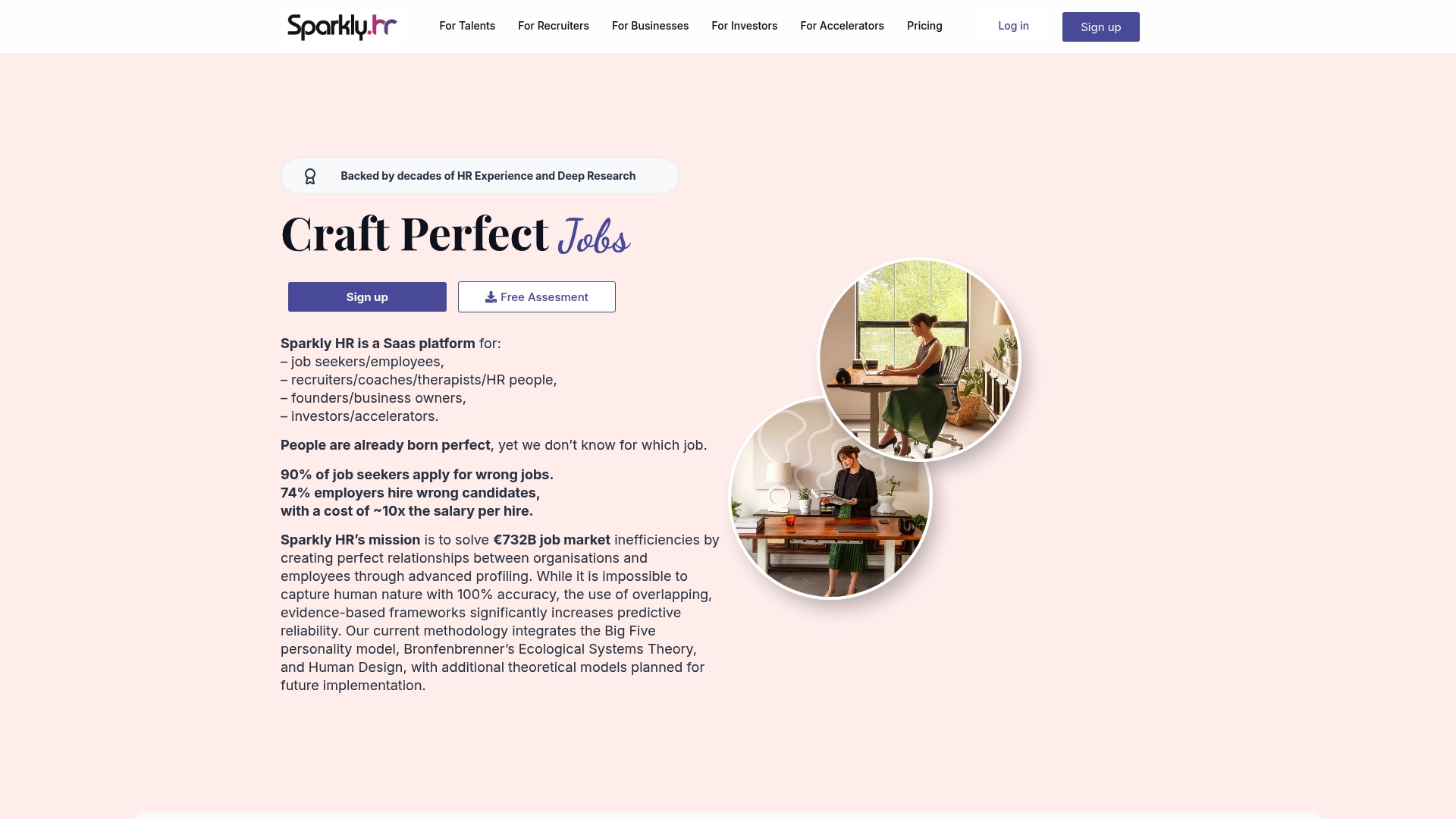
Don’t wait until turnover drains your team Take control now by integrating personality-driven assessment into your hiring and talent management process Explore how Sparkly’s unique SaaS solution transforms uncertain hiring decisions into confident predictions of employee success and retention Visit us at Sparkly HR to start reshaping your workforce with data you can trust. Ready to reduce turnover and hire better long term? Discover more here today.
Frequently Asked Questions
What are future skills in hiring that reduce turnover?
Future skills focus on personality traits such as adaptability, collaboration, and resilience, rather than solely on technical skills, to ensure employees fit well within the company culture and can thrive amidst change.
How can personality-driven hiring improve employee retention?
Personality-driven hiring emphasizes traits that predict long-term fit and performance, leading to better team dynamics, reduced turnover, and a work environment where employees are more engaged and satisfied.
What are the key personality traits to assess during the hiring process?
The key personality traits to assess include adaptability and learning orientation, collaboration and communication style, and resilience and accountability, as these traits are predictive of success in a constantly changing work environment.
How can companies implement personality assessment in their hiring process?
Companies can implement personality assessments by revising job descriptions to include personality requirements, using standardized assessments early in the screening process, and training interviewers to focus on personality alignment along with technical skills.
Recommended
- Future of Recruiting Explained: How Personality Data Transforms Hiring
- Talent Optimization Explained: Reducing Turnover Faster
- Talent Retention Strategies: Boost Engagement With Personality
- Job Fit Definition: Boost Retention With Personality Data
- How Astrology Predicts Personality: Zodiac Insights | Lunaris
- Finance Recruitment Trends in Birmingham (2026) | IBACO Recruitment