
Talent Pipeline Definition: Transforming HR Retention

Turnover can disrupt even the most dedicated HR teams, leaving gaps that impact everything from morale to business growth. As workforce expectations shift and retention becomes more complex, building a strong talent pipeline is more than just filling seats. When you look at modern solutions, personality assessments stand out for helping companies align the right people with the right roles, creating lasting engagement and a resilient HR strategy.
Table of Contents
- Defining Talent Pipeline In Modern Hr
- Types And Stages Of Talent Pipelines
- How Talent Pipelines Function In Practice
- Personality Assessments’ Role In Talent Pipelines
- Building Robust Pipelines For Turnover Reduction
Key Takeaways
| Point | Details |
|---|---|
| Proactive Talent Management | Talent pipelines should be viewed as strategic frameworks for identifying, attracting, and nurturing talent, rather than just recruitment tools. |
| Personalization and Development | Organizations must implement personalized professional development and continuous talent assessment to align individual growth with company goals. |
| Adaptability and Flexibility | Successful talent pipelines are dynamic and adaptive, necessitating regular reassessment to remain aligned with evolving organizational needs. |
| Emphasis on Culture Fit | Integrating personality assessments enhances predictive talent development by ensuring individual traits align with organizational culture and objectives. |
Defining Talent Pipeline in Modern HR
In today’s dynamic business environment, a talent pipeline represents a strategic approach for organizations to proactively identify, attract, and retain high-potential professionals across different career stages. This sophisticated HR mechanism goes beyond traditional recruitment, creating a systematic framework for nurturing talent from initial engagement through long-term professional development.
Modern talent pipelines are increasingly characterized by their adaptive nature, focusing on strategic talent management approaches that align organizational culture with individual career aspirations. The core components of an effective talent pipeline include:
- Continuous talent identification and assessment
- Personalized professional development programs
- Dynamic succession planning strategies
- Cultural integration and engagement initiatives
- Flexible career progression pathways
The evolution of talent pipeline management reflects significant shifts in workforce expectations. Organizations now recognize that sustainable talent strategies require more than competitive compensation—they demand holistic approaches that prioritize employee growth, personal fulfillment, and meaningful organizational contributions.
Talent pipelines are no longer just recruitment tools, but strategic mechanisms for organizational transformation and long-term workforce sustainability.
Successful talent pipeline development integrates multiple sophisticated elements, transforming traditional HR practices into dynamic, proactive talent ecosystems. By understanding individual personalities, organizational needs, and emerging workforce trends, companies can create more responsive and engaging professional environments.
Pro tip: Regularly reassess your talent pipeline strategy to ensure alignment with evolving workforce dynamics and organizational goals.
Types and Stages of Talent Pipelines
Talent pipelines are complex strategic frameworks that organizations develop to systematically identify, attract, and nurture potential candidates across multiple career stages. Strategic talent pipelining processes involve creating comprehensive approaches that go far beyond traditional recruitment methods.
Typically, talent pipelines can be categorized into several distinct types:
- Emerging Talent Pipeline: Focuses on early-career professionals and recent graduates
- Technical Talent Pipeline: Specialized approach for recruiting high-skill technical professionals
- Leadership Development Pipeline: Targets potential managers and executive-level candidates
- Diversity and Inclusion Pipeline: Deliberately designed to attract underrepresented talent groups
- Succession Planning Pipeline: Identifies and prepares internal candidates for critical organizational roles
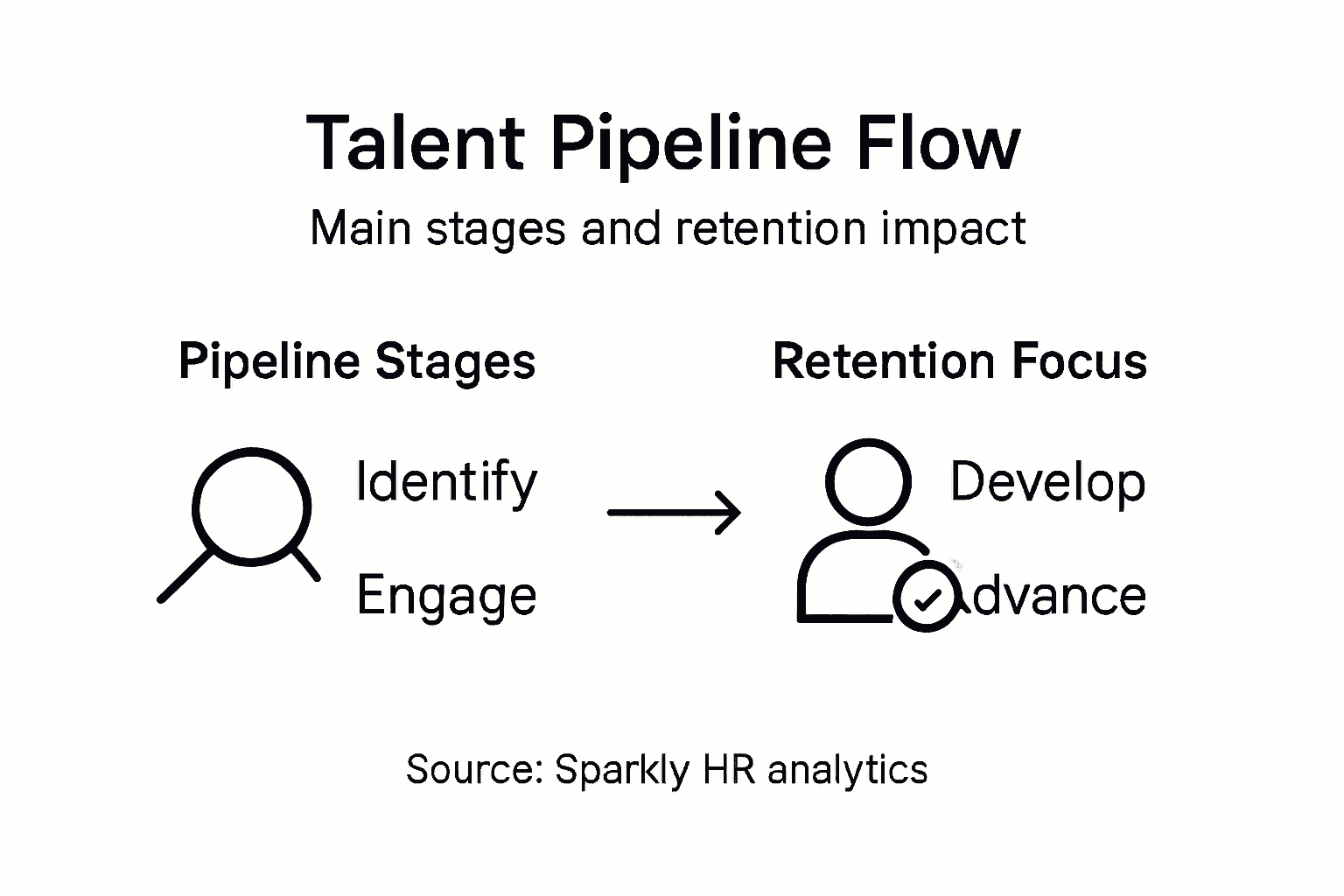
The developmental stages of a talent pipeline generally follow a progressive cycle that includes:
Here’s how different types of talent pipelines support organizational goals:
| Pipeline Type | Main Purpose | Key Business Benefit |
|---|---|---|
| Emerging Talent | Invest in new professionals | Accelerates future-ready workforce |
| Technical Talent | Attract specialized skills | Ensures innovation and competitiveness |
| Leadership Pipeline | Develop future leaders | Supports succession and stability |
| Diversity & Inclusion | Broaden talent base | Drives creative problem-solving |
| Succession Planning | Prepare internal successors | Reduces leadership disruption risk |
- Talent Identification
- Initial Engagement
- Relationship Cultivation
- Skills Assessment
- Continuous Development
- Potential Placement
Effective talent pipelines transform recruitment from a transactional process into a strategic, relationship-driven approach.
Successful talent pipeline management requires continuous monitoring, adaptability, and a deep understanding of both organizational needs and individual career aspirations. By creating flexible, dynamic pipelines, companies can proactively address potential skill gaps and maintain a competitive workforce.
Pro tip: Implement regular feedback loops and personality assessments to ensure your talent pipeline remains responsive and aligned with evolving organizational dynamics.
How Talent Pipelines Function in Practice
In real-world organizational contexts, talent pipelines operate as sophisticated, dynamic systems that transform traditional recruitment into strategic workforce development. Strategic talent alignment processes enable companies to proactively identify, nurture, and integrate potential talent across multiple organizational levels.
The practical implementation of talent pipelines involves several critical operational components:
- Continuous talent mapping and skill assessment
- Proactive candidate relationship management
- Personalized professional development tracking
- Internal mobility and succession planning
- Data-driven performance potential evaluation
Talent pipeline functionality typically encompasses a comprehensive workflow that transforms potential candidates into high-performing organizational assets. This approach requires multiple interconnected strategies:
- Initial talent identification through targeted recruitment channels
- Comprehensive skills and personality profiling
- Structured developmental opportunity creation
- Regular performance and potential reassessment
- Strategic internal and external talent placement
Effective talent pipelines function as living ecosystems, constantly adapting to organizational needs and individual professional growth trajectories.
Successful talent pipeline management demands a holistic approach that integrates advanced technological tools, nuanced human insights, and strategic organizational planning. By creating flexible, responsive frameworks, companies can systematically develop a robust, future-ready workforce prepared to navigate complex business challenges.

Pro tip: Implement cross-functional collaboration between HR, leadership, and department heads to ensure your talent pipeline remains agile and aligned with evolving organizational objectives.
Personality Assessments’ Role in Talent Pipelines
Personality assessments have emerged as a critical strategic tool in modern talent pipeline development, transforming how organizations identify and cultivate potential talent. Comprehensive candidate evaluation techniques enable companies to move beyond traditional skills-based recruitment toward more nuanced, holistic talent selection processes.
The key dimensions of personality assessments in talent pipelines include:
- Identifying intrinsic motivational patterns
- Evaluating cultural fit and team dynamics
- Predicting long-term performance potential
- Uncovering hidden talents and adaptability
- Matching individual traits with organizational needs
Understanding personality assessments requires recognizing their multifaceted role in talent management:
Below is a summary of personality assessments’ impact on talent pipelines:
| Assessment Focus | Talent Pipeline Value | Long-Term Outcome |
|---|---|---|
| Motivation | Predicts engagement potential | Reduces attrition risk |
| Cultural Fit | Ensures team harmony | Increases productivity |
| Adaptability | Identifies growth ability | Builds resilient teams |
| Leadership Traits | Spots future leaders | Strengthens succession plans |
- Predicting job performance beyond technical skills
- Revealing candidate adaptability and learning potential
- Assessing emotional intelligence and interpersonal capabilities
- Determining leadership and collaboration potential
- Identifying potential skill development trajectories
Personality assessments transform talent pipelines from static recruitment channels into dynamic, predictive talent development ecosystems.
Successful implementation of personality assessments demands sophisticated, data-driven approaches that balance psychological insights with organizational strategic objectives. By integrating advanced personality profiling techniques, companies can create more responsive, adaptive talent management systems that anticipate future workforce requirements.
Pro tip: Develop a consistent, standardized personality assessment framework that allows for objective comparison while maintaining individual candidate dignity and potential.
Building Robust Pipelines for Turnover Reduction
Building robust talent pipelines requires a strategic approach that goes beyond traditional recruitment methods, focusing on creating sustainable workforce ecosystems. Strategic talent management frameworks enable organizations to develop comprehensive strategies that proactively address potential turnover risks and create engaging professional environments.
Key components for developing turnover-resistant talent pipelines include:
- Continuous skills and potential assessment
- Personalized career development pathways
- Cultural alignment and engagement initiatives
- Transparent internal mobility opportunities
- Competitive professional growth strategies
The process of building robust pipelines involves multiple critical stages:
- Comprehensive talent mapping
- Detailed personality and potential profiling
- Targeted development intervention design
- Regular performance and engagement monitoring
- Dynamic talent repositioning strategies
Effective talent pipelines transform workforce management from reactive recruitment to proactive talent cultivation.
Successful pipeline development demands a holistic approach that integrates organizational objectives with individual professional aspirations. By creating flexible, responsive frameworks that prioritize employee growth and satisfaction, companies can significantly reduce turnover and maintain a competitive, adaptive workforce.
Pro tip: Implement quarterly talent review sessions that assess individual potential, alignment, and development opportunities to maintain pipeline dynamism and engagement.
Elevate Your Talent Pipeline with Data-Driven Personality Insights
Navigating the complexities of talent pipelines requires more than traditional recruitment tools. This article highlights that personality assessments and continuous talent development are essential for building sustainable workforce ecosystems that reduce turnover and boost engagement. If you struggle to identify true potential beyond resumes or want to develop tailored career pathways aligned with your organizational goals, understanding personality traits is the missing key.
Sparkly HR offers a revolutionary approach by merging human intuition, AI, psychometric assessments, and Human Design into one powerful solution. Unlike typical skill-based assessments, we focus primarily on personality, unlocking deeper insights to design roles and shift team dynamics more effectively. Explore how our Uncategorized - Sparkly HR resources can help your team stay ahead by transforming talent pipeline management into a proactive, data-driven strategy.
Don’t leave your talent pipeline to chance. Harness predictive, high-probability data from Sparkly HR to reduce turnover, enhance succession planning, and foster meaningful professional development. Start transforming your workforce today by visiting https://sparkly.hr and see how intelligent personality assessments can unlock the full potential of your current and future employees.
Frequently Asked Questions
What is a talent pipeline in HR?
A talent pipeline is a strategic approach used by organizations to proactively identify, attract, and retain high-potential professionals throughout various career stages, transforming recruitment into a systematic talent development process.
How do talent pipelines support employee retention?
Talent pipelines facilitate employee retention by creating personalized career development paths, fostering culture integration, and encouraging continuous skills assessment, ultimately leading to enhanced employee satisfaction and engagement.
What are the main stages of a talent pipeline?
The key stages of a talent pipeline typically include talent identification, initial engagement, relationship cultivation, skills assessment, continuous development, and potential placement, all aimed at developing a workforce ready to meet future challenges.
What role do personality assessments play in talent pipelines?
Personality assessments are used in talent pipelines to evaluate intrinsic motivation, cultural fit, and long-term performance potential, enabling organizations to better match candidates with roles and foster a collaborative work environment.